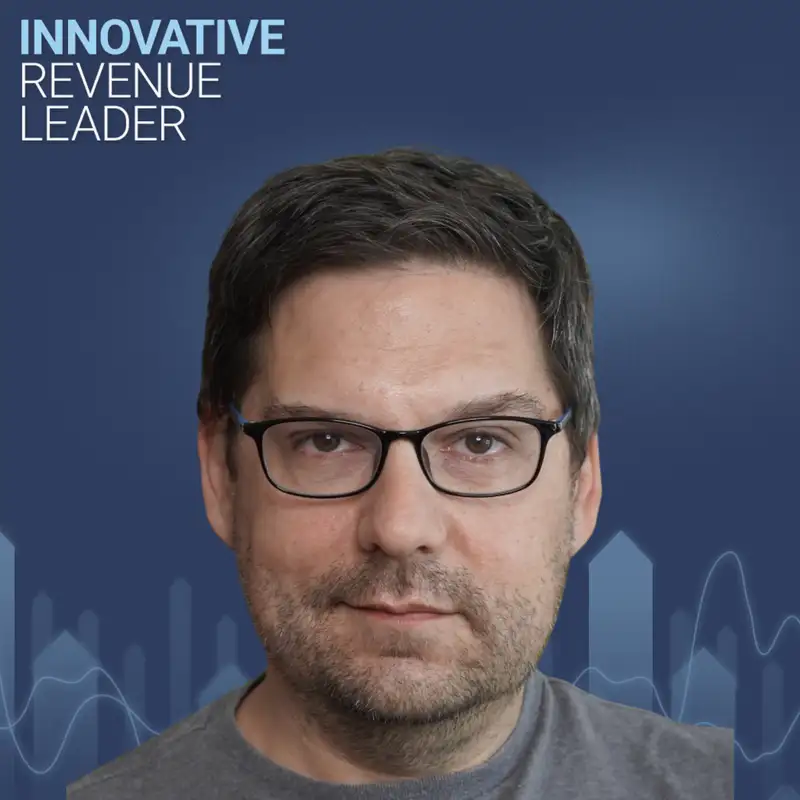
IRL - Eilon Reschef
===
Speaker 2: [00:00:00] Welcome to the Innovative Revenue Leader Podcast. I'm your host, Seth Mars. Join me as we deliver practical insights to help B2B CROs Find new and innovative ways to grow in this fast changing environment. The Innovative Revenue Leader is sponsored by Sandler, a triad company, empowering sales professionals and leaders to master the craft of selling at all levels.
seth-marrs_1_05-20-2026_080720: Welcome back, everyone. I'm super excited to have today's guest. He's a revenue AI product innovator, entrepreneur. He was a key, key component of how the revenue orchestration space was created. He leads product strategy and innovation around AI-driven customer interaction analysis and revenue execution workflows.
Basically, the ability to turn unstructured data into insights. He previously co-founded Webcollage, an e-commerce SaaS platform connecting major global brands and thousands of retailer websites before it was acquired by Answers. He's transformed [00:01:00] complex technical challenges into business-aligned resilient strategies is a strong executive stakeholder, um, for the space, for the B2B sales space. He's currently the co-founder and chief product officer of Gong. Elon, great to have you on, on the show.
eilon-reshef_1_05-20-2026_150720: Thanks for inviting me, Seth. Glad to have this conversation
seth-marrs_1_05-20-2026_080720: you and I have had lots of conversations, so it's cool to be able to have one like this where we can, we can talk about the, the different ways of the world around B2B sales.
This, the, the, the kind of the, the high-level question, what's the most innovative thing that, that you've seen in-- that you're seeing in B2B right now?
eilon-reshef_1_05-20-2026_150720: Sure. So I'm obviously, uh, um, we, we at Gong kind of work with, uh, numerous B2B kind of revenue organizations. Uh, what excites me right now is the increasing potential of, um, call it AI, right? Or agents or, um, uh, technology, um, to kind of, uh, maybe takes-- take revenue to the next level. And what I mean by this is [00:02:00] everybody's using like a Claude or OpenAI or something for personal productivity, like write me an email or, or whatnot.
This is, this is happening all the time. And what's happening when you sort of, uh, um, systemize it with a system, again, such as Gong, but in general, the capability of a system to go back and do, call it process mining or understand what's, what's working in your organization. So imagine you're upselling a product, and then AI goes and says, "Hey, what's working for you in your organization?"
Then scans all of your conversations, emails, uh, outcomes, whatnot, comes back with this recipe. That was always an almost intractable problem in its own, right? Intelligence. How do you even know this? And this is just phase one. And now what if you can go and, and be this like, hey, from this, create me whatever, call it an agent or a system or an AI process that now goes back and helps or automates the people.
So now if you know how to sell product X, it basically goes to every one of your deals and says, "Hey, with this deal, you should be doing that." In the past, they used to call it next best action, but next best action was always like limited to some sort of like [00:03:00] a very high prescriptive stuff, or it was kind of getting confused with like sort of...
And now specific to this, what I learned about this is the blueprint that you want to do, apply it at scale, see how it works, and close the loop again and again and improve, improve, uh, uh, uh, close this loop. So I feel this is sort of the next generation of how people, you know, maybe potentially run repeatable businesses in general.
But since I'm mostly kind of concerned with revenue organizations, definitely the way to run revenue organizations moving forward.
seth-marrs_1_05-20-2026_080720: Uh, so like it, it's that, that natural evolution into-- It's, it's interesting to hear you talk about the excitement you have around agents, right? Because I don't think that's always been the case. You, you've always been a, uh, highly innovative but also highly skeptical of, of people's talk around innovations, like agents in, in, in general, right?
Like you're not really a terms guy. You're more of a-- Like you, you, the way you just described that there around you, it's really around how do you get value from these technologies. What's kind of convinced you to talk agents? Because, like you and I had a conversation a while [00:04:00] back, like way back when around like real-time conversation intelligence.
You're like, "Look, sounds cool, just not a fit for the market," and that's proved to be true. Like what's made you buy into agents so much right now and, and Gong's place in driving those for B2B organizations?
eilon-reshef_1_05-20-2026_150720: I'm actually sk- still skeptical about, um, sort of the talk around agents or other things, 'cause what happens is, you know, people who actually build stuff kind of talk, and then the newspapers make a thing out of it. And usually the more controversial you are, uh, the more it, it gets more news, and that gets more, more, more clicks.
So suddenly people sort of read the press instead of just being, "Hey, we're going to increase productivity by thirty percent," it becomes this like, "Oh, salespeople are going to go away, or engineers are going to go away or..." And I think that's ridiculous. It's like, why, why would, why would you even care? Like, what's it-- Why is-- Like, yeah, but so if you sort of de-hype some of this, uh, um, i-ideas, I mean, I, I-- The way I look at agents, and again, oversimplifying, it's basically it's an, it's an LLM-powered automation whatever.
And now the nice thing about LLMs, they [00:05:00] can do much more than, you know, we built Gong ten years ago, and we-- I had to sort of pay data scientists to create a model that comes up, you know, with an action item for a call. That was like six, seven years ago. Now you prompt the heck out of it in, in thirty seconds, right?
So it just allows you to do many, many more things. So being able to go into conversations and analyze them and create a playbook or a blueprint, I call it an agent, but it's essentially an intelligence tool that brings you all of this knowledge together. And then the ability to sort of build some other automated process that takes this blueprint as an input and again re-re-- sort of looks at customer X and like, how should you work customer X given this blueprint?
It's also like LLM-driven automation. I think the market kind of calls those agent. I actually feel it's a, it's a way to explain it more than it is like, "Hey, agents are going to replace humans," or the, the not the newspaper version of it, but more like, "Hey, it's actually a business process, drives outcome, very tangible outcomes."
It's managed using, again, there's a record for it somewhere. This is an agent X, you can track it, you can measure it. I think the name agent kind of resonates, and I, I use it like a b- just because I think it makes the s- the, the [00:06:00] story easier to understand, not because it changes materially how the system works.
seth-marrs_1_05-20-2026_080720: Yeah. And, and you could see it in the, in the product, right? Like the way you created the names for all of the different agent sections. You, you're using it as a way to help people understa- almost like I, I was like looking at the way that you did it. It's like I'm using it as a way to help you use it rather than as a way to talk about world dominance with the-- because of the name and what it's gonna be.
So it's very practical and useful in the setup.
eilon-reshef_1_05-20-2026_150720: That, that's the intent, right? So I, I feel like, um, you know, as a company, you know, every company's got its own DNA. Our DNA is, hey, we're not like over-hyping things. We're trying to br- well, we're focused on revenue outcomes. That's, uh, where, where, yeah, call it like revenue per employee, productivity, whatever the metric is.
I mean, these are the key metrics, right? Eventually. And then we kind of go backwards from this. And like if we have an automation, it's like obviously one of the ones you're, you're very familiar with is, is call reviewing, right? AI call reviewer. I mean, so in the past maybe we called it Scorecard, but Scorecard is the thing.
It's not the, the, sort of the, the, the automation that does. We call it an AI call reviewer. I [00:07:00] think it helps people understand. It's like, hey, I got this automation agent, it reviews my conversations. Do I want this? Well, I should want this because I-- otherwise I'd have to do it or nobody's gonna do it. And I think it helps kind of put, orient people towards the right, uh, function and then I think intuitively towards the right outcome, uh, which is kind of we, we...
So if you kind of think about the blueprint ideas or we didn't find a name for it yet, but like think about an AI miner that kind of whatever, just like, uh, finds your blue-- or maybe the architect of the blueprint is one builds you the blueprint. Another one is the monitor that monitors the accounts and kind of drives next best action.
So I mean, we're eventually gonna find names and we're gonna standardize on them, but the idea and the name is like, how do you make it clear for somebody who's using it, why is it there, what is the value that it's providing, and kind of take it from there. So
seth-marrs_1_05-20-2026_080720: Yeah. Data extractor agent, pretty self-explanatory. Account reviewer, like yeah, it's like, okay, I, I actually know what I'm doing with this. I'm gonna go in and, and play around with it. It makes it accessible.
eilon-reshef_1_05-20-2026_150720: Exactly
seth-marrs_1_05-20-2026_080720: Gong is incredibly good at driving insights from unstructured conversations and th-that go beyond-- It, it, it's interesting because it [00:08:00] goes beyond technology.
I, I can't tell you in the time that I've, I covered this space, how many times people have come to me and said, "You know, Gong's dead because of X new technology, Y technology, Z technology." And, but you've always, it's always been an advantage to you. Like, can you talk through the principles that, that you have that allow you to stay p- focused on your approach and stay on the leading edge as this new technology comes out?
So when someone says, "Oh, you know, an LLM comes out that basically renders Gong useless," or X comes, agents come out, I don't need Gong. Like that's happened to you probably four or five times in the last year, but it als- it always seems that what is posed to you as a weakness ends up becoming a strength, and then you use it to make what you do at your core better. How do you think about that and make that a reality?
eilon-reshef_1_05-20-2026_150720: Yeah, I think it's a good point because each time there's new technology, people are like, "Oh, that's going to kill X." And sometimes it does kill X, right? Um, I c-- I mean, Kodak is no longer, I mean, it's still around, but Kodak [00:09:00] is obviously not doing a lot of-- doesn't manufacture many films. But I, I, I think the way we look at the market is we were founded, Amit and I founded the company, uh, with, with the goal of, of increasing revenue productivity, um, again, using, we didn't call it AI at the time, using data, data science, machine learning, whatever the na-name was at the time.
And that's our main focus. And every technology that comes along, we're like, "Hey, let's plug it in to see how we can drive revenue outcomes." So, um, when we started, it was, it was even the basic thing of like, hey, helping you listen to somebody else's call. You know more, you, you act better, you kind of up-up-uplevel your team members.
So obviously, that was the beginning, but the more, the more, actually, the more technologies, to your point, the more technology allows you to do, um, the, the, the, the more outcomes we can drive. Now, uh, actually, I remember a customer who unfortunately left us when downtimes were like the company was like, you know, kind of reducing by fifty percent whatnot, and they left us, and then they came back eighteen months later, and le-- we do a win-loss analysis, and the win, win review, basically, the guy said, "I felt like I ge- got into a new piece of software."[00:10:00]
And he told the interviewer, which wasn't us, "Just don't tell them, but I'd probably pay double for this right now." Uh, which I, I-- it was a good testament to like, hey, we're actually doing some work over the product, but the idea is like each time there's new technology, you know, LLMs, agent-- agents, basically kind of automated LLMs, but LLMs, agents, uh, better speech-to-text, all of these things, you're always going to orient this into, into sort of how do you drive outcomes.
Now, the alternative is always you're going to buy-- buil-build it yourself, right? You, you can build anything yourself. You can build Zoom yourself, Slack, Microsoft, Gong. I don't know if you can build Anthropic yourself, but you can easily kind of build things yourself. Most revenue organizations don't feel are in, in the business of building software, rightfully so, in my mind, uh, which is why they appreciate us kind of packaging all of the value, making sure that we host it, we maintain it.
We, we actually calibrate it in a way that drives the outcome versus you having to kind of try to do it yourself. Very, very few organizations can build this stuff, and even if they can, even a smaller portion of them can actually, um, get it to a place where it drives outcomes. It's very easy to quote unquote, build an agent on [00:11:00] your machine.
Can you actually roll it out to two hundred people and make sure it actually works consistently? I mean, this is really, really hard.
seth-marrs_1_05-20-2026_080720: Yeah. I mean, it's one-- It's, it's we're kind of getting pulled into with the LLMs and do it yourself into the like I can do everything thing. It, I mean, we will swing right back to it. I think we've kind of-- I, I think we-- it's more talk about doing everything, but when it comes back to it, where I'm going to apply resources, where you should apply resources as a, as a good fiduciary to your business is to what you're good at.
And like we're in that situation, that's why we're on the phone. Like we, we aren't good. We, we do not have the competency to do what Gong does. do under- what we do have the competency to do is understand what a technology can do and how we apply it to make our business better. That's, that's always ended up being the way that works best.
Why would you invest in resources even if you could to manage that, that, that part of it? And you-- Uh, the, the thing that I've always seen with that, like working with clients around it is I'm gonna build it myself. You give me the requirements and then [00:12:00] it may be now it's three months, I give you that, and then it within three months when you've built it, it's already out of date, and then nobody wants to work on it anymore because I'm finished.
This, when you buy tools that do very specific things, it just allows you to be always on the cutting edge and focus on what you do good, which in go-to-market is go sell stuff, go, go find a way to grow your business.
eilon-reshef_1_05-20-2026_150720: and 100%. And also there's the 80/20 rule, right? It's like, uh, obviously you spend most of the time doing the unsexy 20%. What, what, what kind of Claude code and, and, you know, whatever it is, like Codex, all of the other ones let you do is actually get the 80% much faster, which is phenomenal, by the way. So we obviously used a lot for internal tools and other things where you pretty much need it when the 80%.
Um, but the 20% is still gonna, like to your point, you're gonna host it, you're gonna retain it, you gotta blah, blah, blah, all of the stuff that is still taking time. Even like one times, like, "Oh, I need to interview a few people to understand why it's not working." And I actually had this, like, somebody send me a form that they've built using Claude and, and like a, a financial advisor, and I tried to fill it in, I [00:13:00] got an error, and I ca-- He told me basically, "I'm playing around with Claude code.
Do you mind being like a guinea pig for this form?" I'm like, "Okay, whatever." And then I told him, "You know, it does-- it didn't work for me." And he's like, "Oh, bum-bummer, it worked on my machine." And I told him, "You can't imagine how many times I heard this statement that says, 'It worked on my machine,' in my professional life."
He's just an insurance guy or whatever, financial services guy. He doesn't know it's like a joke. "It worked on my machine." That's the eternal truth of software development, right?
seth-marrs_1_05-20-2026_080720: Yeah, yeah, yeah. E- democratizing it so everybody could use it together is a little harder task than people realize. You c- it's, it's not just so simple to vibe code.
eilon-reshef_1_05-20-2026_150720: Exactly. Exactly. Sorry for being the one finding your bugs, but probably stick to financial advising. You know, let other people do your softwares
seth-marrs_1_05-20-2026_080720: Yeah. Yeah, ex- exactly. Spend more time trying to help me make more money and less time trying to give me a fe- yeah. have had a, a, a, you guys just crossed $500 million, grew 55% last year. So you've been on a nice run probably the last year, year and a half. Y- y- trajectory has always been good. [00:14:00] What's, what's one of the downtimes that, that you, that, that you had over the course of this? 'Cause I mean, it usually companies reveal themselves in those moments, right? And how they handle that. And I think if you look back at your history, you've done some things a little bit differently than your competitors.
You've stayed strong on some principles and bent in other ones. what's the lowest point that you guys were at and, and kinda how did you respond to turn that into kind of another like just really strong growth trajectory, uh, the one that you're in right now?
eilon-reshef_1_05-20-2026_150720: Yeah, it's a great question. You know, obviously the-- not obviously, but the lowest was when the, um, technology markets were, were kind of going south. Was it '22, '23? October '23, yeah. Um, and we got to a point where it was kind of like it hit us in, in multiple rounds. So first of all, customers weren't growing as, as a company, right?
So you bought, yeah, like you bought 87 licenses, nobody was, was gonna, um, uh, um, you know, kinda hiring salespeople anymore. And then at the time, we had a l- a lot of concentration in tech. Nowadays, we're much more diversified, [00:15:00] you know, so we have like, uh, the CBSs of the world. But at the time it was maybe 80 or 70% technology.
And then the other thing was happening, people actually, because everybody was growing before that, people were buying ahead of time. So someone was like, "I'm gonna buy 800 license. I actually only have, uh, so whatever, 100 license. I only have 80 people." So now renewal cycle one, it's like, okay, I'm only gonna renew 80.
I never had more than 80. Renewal cycle two, I'm actually gonna reduce it to 60 because I only have 60 people. And in that best case scenario, worst case scenario, by the renewal cycle two, I'm not-- I'm no longer around 'cause, you know, if you're a, I don't know, like an early stage, kind of B round, C round company, you might be not around or get acquired or pivot or...
And we had literally companies going bankrupt as well. And then of course, like any other software company, we also had a bunch of customers who were- weren't like using Gong to its full capacity, right? It's by the way, mostly on app because yeah. And then these guys were like, "Maybe we shouldn't renew at all."
And mayb- maybe the customer I mentioned before that was coming back probably was in this bucket. 'Cause if you use Gong, you're not gonna, you're not gonna like stop using it. But if you bought [00:16:00] systems and you never, for various reasons, didn't like, uh, kinda use it. And so at that time, we had maybe a couple of flat quarters or certainly like low single-digit growth quarters.
seth-marrs_1_05-20-2026_080720: Yeah
eilon-reshef_1_05-20-2026_150720: I think what we did maybe a little bit different than other companies is we never fired engineer- engineers 'cause we always believed, and we did downsize the sales organization a bit just because there was nobody to sell to, right? That you gotta do it, you know Talent acquisition people, you're gonna downsize that because you're not hiring, and that's like you, you can't be responsible and not do that.
But engineers, we never, we never cut back on engineering, and we said, "Hey, we believe this solution has got merit." It's-- the, merit didn't change. the market changed a little bit, but then if we invest in technology, when the market picks up, and luckily both Amit and I were around in, you know, sort of 2000 downfall and 2008-9 we've been around those kind of downturns, and it's always like sp- you know, sort of ups and downs in the technology market. So we said, "Hey, we raised a lot of money, so we're not like cash-strapped." And then we said, "Let's use the time to [00:17:00] actually, um, improve the product, continue and build it."
Going out of this semi short, I don't know, semi recession, uh, we had new products, right? So now y- we had like a forecasting product. We had a sales engagement product, and these two products are actually doing very, very well. They're like a nine-figure business for us right now.
seth-marrs_1_05-20-2026_080720: Yeah
eilon-reshef_1_05-20-2026_150720: um, so I, I think it worked well in, in kinda call it betting or believing or having conviction that this is the-- we are in the right direction despite this hiccup that we had along the way.
Uh, but it does take a little bit of, uh, courage, right, to not give up
seth-marrs_1_05-20-2026_080720: Yeah, I, I mean, based on what you-- Y- you basically just said, "I, I believe more in this than ever. I'm gonna double down on continuing to make it better, and we'll come out of this."
eilon-reshef_1_05-20-2026_150720: Exactly.
seth-marrs_1_05-20-2026_080720: When you
eilon-reshef_1_05-20-2026_150720: Exactly
seth-marrs_1_05-20-2026_080720: came out stronger than ever
eilon-reshef_1_05-20-2026_150720: Exactly. So when people sort of like understood that, okay, we're, we're back to business, so to speak, and then I-- you know, nowadays Gong is considered by most sort of the, the, the, the sort of the, the known leader in the space, and people are like, "Okay, now I'm back in business. Let's kinda buy-- Let's go with, I mean, whoever is gonna [00:18:00] winning."
And, you know, we were fortunate enough to be in this position, but it is a lot due to the investment we've made during the tough years for sure.
seth-marrs_1_05-20-2026_080720: And I think that like people will listen to that and go, "Oh yeah, of course they did." Because that sounds easier to say. That's easier enough to-- That's easier to say than it is to actually do because it's logically there. But I know in the industry, your competitors around you, many of your competitors around you, they were out, they were moving to outsource models.
They did- they didn't use that time to double down on how do I make my product better. They used that time to say, "How do I move my US-based engineers to other countries that are more affordable?" So they were in like cost mitigation mode. They would also probably say they didn't, they didn't hire-- they didn't cut their engineers, engineers, but they absolutely cut the dollars and they als- absolutely disrupted their engineering path by taking one engineer in the US and moving it over to India or to Poland or to whoever else. [00:19:00] You-- How could you not? it's, it may sound like, yeah, that's the logical path in hindsight, but the reality is many, I would say most of the competitors in that environment, what they were doing was moving to an offshoring model to get more affordable engineers rather than focusing heavily on engineer, on, on innovation
eilon-reshef_1_05-20-2026_150720: 100%. And I think it takes, I don't, I don't know, a-- people maybe underestimate the amount of, um, the amount of work it takes even to move just a project from one team to another is huge. And if you're doing it, especially, you know, across continents and across time zones and across whatnot, it, it's a big disruption.
If you do it for certain re-good reasons, it still might be okay, but if you're doing it to save cost, there is gonna be a price. And in a way, it's like, do you play to win or do you play not to lose? I think Amit and I are, like, odd enough that we just don't like to play not to lose. We're just like, why are we in this game if we're playing not to lose?
So we wanna play to win. But I also get why people might, might do cost reduction. By the way, we have a large office in, in Ireland, in [00:20:00] Dublin, and 200-- we just crossed the 200 people mark, and we have an engineering office there that's doing very well. It's growing very fast. And we also moved some content to that, that, that location, right?
And, but that wasn't for cost saving. It was just, hey, we wanna build a, a super strong team there. They're, they own the Engage product. All of Engage product is there. So we're like, yeah, we're gonna pay the price of this transition, but we did it at our own pace and our own, uh, um, conditions so that it becomes as successful as we can, we can make it, which I, I think worked well for us, and then obviously time will tell, but seems to have been working very well.
seth-marrs_1_05-20-2026_080720: Yeah. I mean, you're not against trying to be efficient in the cost side, but you're not gonna do it at the, at, to the detriment of the product.
eilon-reshef_1_05-20-2026_150720: Yeah, and Ireland is not cheap. I mean, the, the, the reason to go there wasn't money. It was, it was good talent. I mean, they're like obviously kind of European Union and, and, and it's like actually great talent. So we, we were able to hire a very good talent there. So love this. And also like, uh, English speaking and, uh, there's like product talent and UX talent, so it's like a very kinda self-contained environment versus, [00:21:00] you know, you kinda mentioned maybe India.
It's like, uh, that's kinda mostly for engineers. So now you gotta do like, "Hey, where, where do I do product? Where do I do UX?" It's, it's becoming harder to manage. But yeah, I mean, it's, it's what you optimize for. If you optimize for P&L, you're gonna get to one results. If you optimize for the upside, you're typically gonna get to different results.
Not always good, but like in our case, I think it worked out well
seth-marrs_1_05-20-2026_080720: Yeah. Yeah, for sure. So talking about, you, you mentioned how you're releasing new products. You released a new product this year, Enable, right? So th- that is different than your competitors. Most of the competitors on the revenue orchestration side are focused on the deal level. You've always dabbled in the ena- on, in, on, on the enablement side, but the enable piece is kind of a, a, a foray into that where like...
So what was the, what's the thought in moving in that? And like, h- do you see like going with like, if I'm a sales enablement leader, how do I use Gong? Like how, how should, like what, what, what should I be reading with this? 'Cause I mean, you get role play, you get some form of [00:22:00] con- you get like a, a light version of content.
You get the, you get the scorecards, AI scorecards. But like talk a little bit more about that, that move because if I'm an enablement leader and I've been told over and over I need a revenue enablement tool, I see Gong's kind of putting some pretty cool features into this space.
Like can you just talk through like if, what, what they should think of that and how they should think of it,
eilon-reshef_1_05-20-2026_150720: Yeah. Gong has always been, uh, friendly with, with enablement people. Some of our best customers are enablement leaders buying Gong from day one, from twenty sixteen when we launched the product, because Gong has always been a way to up-level people, right? Just the fact that you could in- initially understand what works, right?
Do you talk too much? Do you-- Are you, are you kind of following the right message? We have this whole initiative tracking capabilities, like tracking the right message. So it's always been enablement leaders being, if not the buyer, then a pr- a primary user to our system. And we've always believed that you mentioned D-level.
I, I think if you look at like the overall game, the out- you know, outcome, right? Call it revenue per rep, whatever it is, it eventually translates to productivity. Productivity has got two things. It's got efficiency and effectiveness, right? [00:23:00] If you're only gonna go after efficiency, you're gonna get a, a brick wall at some stage, and you gotta do some effectiveness.
We've been trying to do both, and eventually, if you help with both, you're gonna drive eventually productivity. So we've always thought that ef-effectiveness and, and enablement are super important. Um, we've always had things like you mentioned, AI scorecard, like s- a way to evaluate conversations. Um, and then, uh, what we figured is we found, um, y- I mentioned initially what am I excited like about, right?
Part of the excitement is, hey, mine what's working and kind of replicate that. And what we realized, we could actually mine conversation, be like, "Hey, what should I coach people on? Or what should people train on?" And then we said, "Hey, if you know this, you can actually, you know, build in our case, build an AI trainer that kind of trains you on this, and you don't have to go and go train a trainer, right?
It actually knows what you should be training on." And then we've already evaluating your quality, so it kind of leverage the same call reviewing logic and, and kind of train people in the field in the same way you're training sort of, uh, uh, kind of training them in a locker room. So it's one system, uh,
seth-marrs_1_05-20-2026_080720: Yeah
eilon-reshef_1_05-20-2026_150720: one [00:24:00] methodology.
So we said, "What if we built all of this?" And then for us it was also a benefit because we kind of helped us get into this like voice agent space in a s- in a way, because we feel there is value in this. I, I-- like we have lots of plans around voice communication in general. It is becoming mature, uh, so more mature.
Um, so we said, "Hey, from a technology perspective, we're going a, a step forward. And then from a product footprint perspective, we're kind of covering people we already like Gong. We're bringing them a new product that people have been doing role play before, but the technology is kind of pretty much changed completely, so no other company that's ever done this has any advantage because their technology is, you know, dead by now.
Anyways, we're gonna use like latest LLMs and whatnot." And then we have a big advantage or two advantages. One is like y- you still do everything in Gong, and then means like one software, one data's platform, but in their case, also one way to evaluate people. And then this like whole new notion of like, "Hey, I'm actually gonna build training based on what happened versus on somebody's, yeah, I got an idea of what people should train on.
Let me write a script and then see if maybe it's the right [00:25:00] script." And the nice thing about our AI trainers, I've, I've listened to one of those trainings and basically training on a cold call, and then they're calling this, you know, fake customer, the, the role play customer, and then they're like, "Hey, can I...
Is this Bob?" And Bob is like, "Yeah." "Can I do s- can I tell you something?" And, and but Bob is basically saying, "You know, I can't talk right now. I'm, I'm in the car." And then they literally picked it up from a real customer conversation. Nobody would ever program it and, and, you know, role play and say, "I'm in the car."
But you know, that's a good practice, right? Now I gotta fight somebody who's in the car, and they, you know, AI just picks it up. I mean, it's amazing, and you get this very realistic scenario that i- is very hard to do if you don't have the core, call it revenue graph, that is like, wh-where do you take the data from?
So that, that was our thought process going into the space. So far it's, it's, it's been going kinda very nicely. We've been selling it for three months now, and I'm not gonna share numbers, but we do have already at least one customer who bought more than 2,000 licenses
seth-marrs_1_05-20-2026_080720: yeah, it's a-- You, you said it up front. You said there's efficiency and effectiveness. And I think one of the things that you've got right with this, [00:26:00] and I'm really grateful you have because it's enabled us in some of the things that, that we're doing, is me, this is your effectiveness play, not your efficiency play.
And like one of the things that I've seen, like working with you on the project that we've been working on with, with the performance ecosystem, is by using trackers and scorecards, I'm able to turn those conversations into like skill, like breakdowns of the skill and then tie those directly to, directly into performance.
Like it, it-- So the, this world, it feels like this world is gonna actually turn effectiveness into a measurable tool, a measurable process for the, for the first time. so it's interesting that I didn't expect you to think of like the, to hear that way. I totally expected to hear you say that the voice agent was something that you cared about 'cause the engineering side of it.
But the, there's a commercial lens to this, which I think is really important in that this is almost your [00:27:00] foray into how do I help companies drive effectiveness? Or
eilon-reshef_1_05-20-2026_150720: Yeah. I would argue that we have some of this already in the sense of like, hey, you know, even our coaching capabilities, like, and, and we have a lot of things around just plain coaching. The fact that you can, you know, run in your treadmill and, and coach people throughout this period is, is, is, is essentially effectiveness, right?
But you're right. I think effectiveness is super critical. Obviously, companies such as Sandler kind of focus on that part more and, and I think in many ways, to your point, like maybe it wasn't measurable as the other ones, so people are like almost like prefer to handle something that's, that's measurable, which is efficiency is kind of in, in, in some ways is easier to measure.
It's like what my conversion rate from stage two to stage three, these sort of things. Um, but obviously people have no idea what they're doing. They're not gonna do well no matter what tools you give them. So you gotta do both, right?
seth-marrs_1_05-20-2026_080720: Yeah. Yeah, yeah. we've been working together for probably six months now on the, uh, at Sandler with the sales performance ecosystem, really building this out, like in, and using Gong to be able to like flex it to [00:28:00] do really cool things with the tracker, really cool things with the AI scorecards, and also just like operationalizing it.
And, and you've been a really big proponent of making that a reality, and it's enabling us to be able to actually make skills, tu-turn skills into a, to effectiveness, like measurable effectiveness. Like doing, an unstructured conversations, pulling them in, and then saying, "Does your methodology work or not work?" what kind of led you to say, "You know, this is a project that I buy into. This is something that I, that I believe in, and I'm going to, I'm gonna support it with..." Like, like what kind of like, why was this one that you're like, "Yep, I think this is one that we wanna support it. It fits the vision of what we're trying to do at Gong"?
eilon-reshef_1_05-20-2026_150720: there's a couple of things. One is we've been friends with Sendler for, for a long while. We've kind of had those discussions for many, many years. I felt your point about live conversation. I felt that the keyword trackers that we had back in 2023 were just not good enough to implement that, and I was like, "I don't wanna go [00:29:00] into a partnership and disappoint any partner because they're gonna get like mediocre results for the level of nuance that you guys have."
And, and, uh, and I, I don't wanna like invest in something that eventually is not gonna get customers, we call it raving fans, basically very happy and satisfied customers, right? Um, so that was a long time. So we always believed in, in this model. And to your earlier point around Sendler not being soft- not, not building software, which I, I think is a great idea, uh, I mean, the focus on all
seth-marrs_1_05-20-2026_080720: we
eilon-reshef_1_05-20-2026_150720: of y'all do.
Um, I, I-- we're also not in the business of business consulting. We, we just don't have the, the right people, the right mindset, and, and, and the right kind of practice around it. So of course, we have implementation teams, but we also have like business partners. Even for implementation, we have numerous business partners who go to the partner and be like, "Let me help you integrate with all of your other ecosystems," and they know the other ecosystem way better than we do.
"Hey, this is how you kind of pull data from the Zoom info," or, "This is how you push data into this, you know, this version of a HubSpot or whatnot." And, and, and, and that allows us to focus on kind of building the core product and innovation. And I think it's same, same, same, [00:30:00] same, same in, in your case. And eventually, yeah, we're, we're gonna build the technology, but do we wanna be the, um, domain experts around, you know, how do you measure it?
How do you even like talk to-- Like, how do you-- Well, let's assume you found something is wrong. Like, who's gonna talk to the salespeople? Who's gonna educate them? Who's gonna help them track? Essentially, who's gonna drive change management? Unf- you know, maybe fortunately, unfortunate, this is not something that we are-- we excel in.
Um, so love to have this done by, by partners who are kinda committed and all in around this, uh, again, put it under change management methodology, but people just Sendler is way better than us, I hope when-- than, than we are in it.
seth-marrs_1_05-20-2026_080720: Yeah. In my opinion, it just allows both of us to take advantage of our strengths, similar to what we've been talking about the whole time. So let me pivot a little bit. I got one question for you. So i-it-- you personally, like when you graduated college, if you can go back to when you graduated, would be one piece of advice that you'd give yourself after, based on all this experience that you've had running companies, building companies?
Like what, what would be one thing that you'd [00:31:00] tell yourself?
eilon-reshef_1_05-20-2026_150720: Well, it's, it's an interesting question. I've been-- my, my-- In, in many ways, my, um, career planning, uh, methodology has always been kinda played by ear. I never planned my career, and I actually usually coach people to don't overthink about your next role, just focus on doing your, your best at, at what you do right now.
So if you're an engineer, be the best engineer. If you're a salesperson, be the best salesperson, and good things will happen. If I had like one person on my team who's like, "I wanna be a CEO," it's like, good for you, but, you know, we don't-- we're not looking for CEOs right now at Gong, so maybe you should find a different place, right?
seth-marrs_1_05-20-2026_080720: Yeah.
eilon-reshef_1_05-20-2026_150720: In many ways it's, it's like I probably wouldn't do much differently in the sense of like at any point in time, I was kinda trying to do my best and not thinking too much about the next step. And I feel it's kinda a, a smoother, uh, um, a smoother way to go. I actually remember applying my-- to my master's degree, and I went to this like whatever kind of university and, and they gave me this form and I literally like, I'm just gonna fucking, excuse my French here, apply right now.
So I literally sat for half an hour and I handwritten my application. [00:32:00] And I gave it in at the same moment. And then, you know, a couple of years-- And I did, I did get accepted, surprisingly enough, and it's like, who was that kid who just couldn't even go home and just like, you know, properly write an application?
It's like, who's gonna ever hand write an application, right? I was probably the only student who ever did this. Like, it, it was many years ago, but still, it's like, why, why would you even like, I don't know, maybe... And, and I think there's some spontaneousness in it and, you know, maybe good or bad, but I like, I felt it, it served me right, so I wouldn't like necessarily go back and be like, "Hey, this young guy, don't do this ever again."
It's like, it worked for mine. It, it, it was fine.
seth-marrs_1_05-20-2026_080720: Well, I mean, what you're saying is i- be the best you can be in the moment you're in and follow, follow your instincts in that moment. Don't get too caught up with all the things that are happening
eilon-reshef_1_05-20-2026_150720: Yeah. Yeah.
seth-marrs_1_05-20-2026_080720: You or, or where things could go
eilon-reshef_1_05-20-2026_150720: Yeah, yeah. And I think now I can probably, being older, I can probably name it in the sense of like, hey, focus on the things you control versus the things you can't control. These sort of like things that now you can kind of name, like, hey, this is the title, this is the principle. But I think if you sort of take out the principle, it's basically not [00:33:00] yet.
It's just not overthinking about like next steps and whatnot. As long as you're of course enjoying the moment, enjoying what you do. If you are, if you're an engineer and you don't-- you wanna be like a, a, I don't know, a teacher, go be a teacher. But don't like, uh... But i-if you're in a good spot, don't, don't overthink
seth-marrs_1_05-20-2026_080720: Yeah. So where would people go? I mean, it, it, Gong is, is kind of grown into kind of a household name in B2B now. but where would you recommend people go to learn more about Gong, to learn more about you, and to hear more from you about the things? Because you do a lot of posting on, and really, really interesting topics, uh, about what you're seeing in the market, technology.
Like, what would you recommend? Where, where should they go to find you and Gong?
eilon-reshef_1_05-20-2026_150720: Sure. I mean, Gong is obviously ar-around, you know, www.gong.io. I mean, if you want like a demo or whatnot, just there's a button that says Request a Demo or, or of course, if you're a company that needs, uh, more productivity in your revenue organization, I mean, love to sort of have a discussion around potentially using Gong if you're not a Gong customer.
If you are Gong customers and you have feedback, you know, uh, feel free. I, [00:34:00] you know, I'm always happy to get feedback even firsthand. So, um, LinkedIn is, uh, you know, just ping me on LinkedIn. I tend to be pretty, uh, probably more responsive than I should, but I am pretty responsive on LinkedIn, so
seth-marrs_1_05-20-2026_080720: You-- Yeah, you absolutely are. Elon, it's always great talking to you. I really appreciate you doing this. Thanks for, for joining
eilon-reshef_1_05-20-2026_150720: Same here, and thanks for inviting me. It's been a great conversation. So, uh, thanks for, uh, making me part of it
seth-marrs_1_05-20-2026_080720: Yeah, it is fantastic
Speaker: And that wraps up another episode. Thank you for joining. For show notes and other episodes, visit us@innovativerevenueleader.ai. The Innovative Revenue Leader is sponsored by Sandler, a Trilia company. Sandler provides top corporate sales and business development training while empowering sales professionals and leaders to master the graph of selling at all levels.