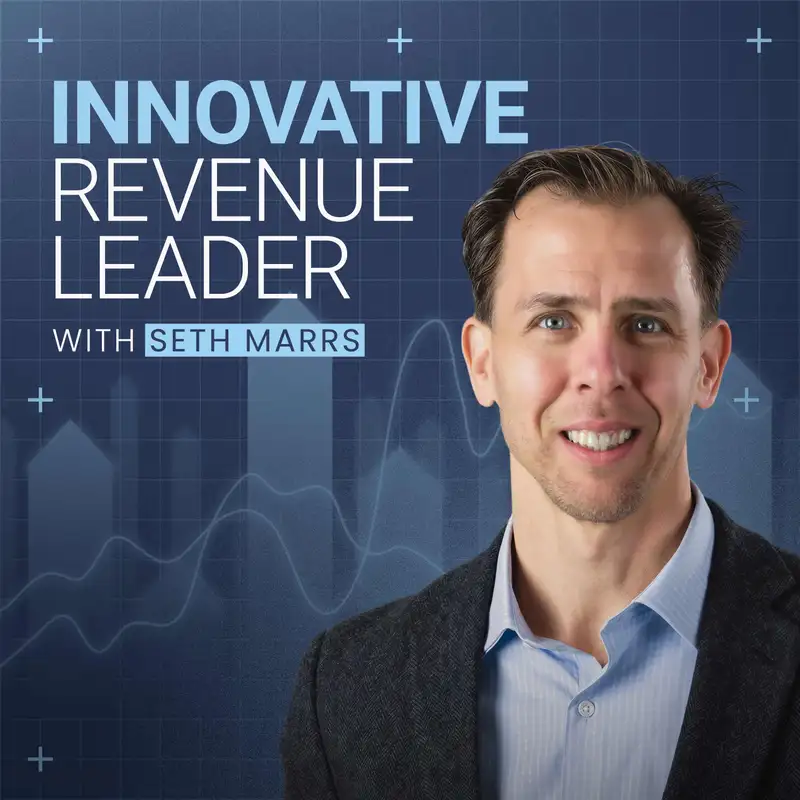
Welcome to the Innovative Revenue Leader podcast with Seth Marrs. This podcast explores the future of sales performance, giving Chief Revenue Officers and other growth leaders the insights, tools, and stories they need to lead with confidence. Through candid conversations with top executives, analysts, and tech innovators, we uncover how to harness data, optimize talent, and build tech-enabled sales teams that win. Listeners will walk away with actionable strategies to drive growth, outpace change, and future-proof their revenue engine.

All Episodes

Latest Episodes

All Episodes
#34

Forecasting Is a Leadership System, Not a Reporting Exercise - Nicola Miller - Innovative Revenue Leader - Episode #34

What separates reactive forecasting from truly predictable revenue operations? In this episode of Innovative Revenue Leader, Seth Marrs sits down with Nicola Miller, Sr. Sales Programs Manager at DocuSign, to explore how modern revenue organizations are evolving from subjective forecasting practices toward signal-based, proactive forecasting systems. Nicola shares a practical framework for forecasting maturity, explaining how organizations progress from rep-opinion-driven forecasting to operationally mature systems powered by engagement signals, pipeline intelligence, AI-supported insights, and management consistency.The conversation also explores the cultural and operational challenges behind forecasting transformation, including leadership accountability, manager inspection routines, risk communication, behavioral change, and the evolving role of sellers in an AI-enabled revenue environment. Throughout the episode, Nicola provides actionable insights for revenue leaders looking to improve forecast accuracy, operational discipline, pipeline visibility, and organizational predictability. Takeaways:Forecasting is ultimately about predictability. Nicola explains that effective forecasting is less about spreadsheets and more about helping businesses make decisions early enough to influence outcomes.Signal-based forecasting is replacing subjective forecasting. The discussion explores how organizations are moving beyond rep opinion and incorporating CRM data, engagement signals, conversation intelligence, buying activity, and pipeline movement into forecasting models.Forecasting maturity evolves through operational discipline. Nicola breaks forecasting maturity into four stages, progressing from anecdotal forecasting to proactive, AI-supported forecasting systems.Management consistency matters more than technology. A major theme throughout the episode is that forecasting success depends more on management processes, inspection routines, and operational rigor than tooling alone.Forecasting transparency can create organizational tension Nicola discusses how better forecasting exposes business reality and can create discomfort around accountability, visibility, and risk communication.AI will shift sellers toward higher-value work. The conversation explores how automation and AI may reduce administrative forecasting tasks while allowing sellers to focus more on judgment, relationships, negotiation, and executive alignment.Great operators embrace ambiguity and growth. Nicola shares career advice around saying yes to stretch opportunities, staying curious, and growing through discomfortQuote of the Show:“Don’t confuse confidence with competence” - Nicola Miller Links:LinkedIn: https://www.linkedin.com/in/nicolamiller013/Website: https://www.docusign.com/Ways to Tune In:Innovative Revenue Leader Website: InnovativeRevenueLeader.ai Spotify: https://open.spotify.com/show/4Hn0sJKCzneggQj3j4XKo3?si=02c4c44769dc41bb Apple Podcasts: https://podcasts.apple.com/us/podcast/the-innovative-revenue-leader/id1843401468 Amazon Music: https://music.amazon.com/podcasts/48477601-e33b-4c80-a4af-739863e58131 Podchaser: https://www.podchaser.com/podcasts/the-innovative-revenue-leader-6233089 
#35

Reinventing Revenue Forecasting - Jamie Sacks - Innovative Revenue Leader - Episode #35

How can revenue leaders simplify forecasting while using AI and sales signals to drive better decisions? Today’s guest is a sales strategy and forecasting leader focused on transforming how revenue organizations operate. Introducing Jamie Sacks, Head of Sales Strategy and Operations at LiveRamp. Jamie joins host Seth Marrs to share how LiveRamp reimagined its forecasting process, improved forecast accuracy, and leveraged AI-driven insights to create a stronger bias for action across the business.He also dives into dashboard fatigue, sales signal synthesis, simplifying forecasting processes, and why revenue operations teams should focus on making sellers’ jobs easier instead of adding friction.Takeaways:• Forecasting should drive action, not just report outcomes. Jamie explains that forecasting becomes far more valuable when it helps leaders identify risks, intervene in deals, and take action instead of simply documenting what already happened.• Simplifying forecasting improved forecast accuracy dramatically. After rebuilding their forecasting process and focusing on clearer definitions and better signals, LiveRamp improved forecast accuracy from over 15% variance to around 5%.• AI is changing how sales teams interact with data. Jamie discusses how AI-driven systems can synthesize signals across tools like Gong, Salesforce, and Outreach to help sellers and leaders quickly identify what matters most.• Revenue operations should reduce friction for sellers. He emphasizes that RevOps teams should focus on helping sellers spend more time selling and less time navigating dashboards or administrative processes.• Dashboard fatigue is a real problem in sales organizations. Jamie shares that many dashboards become static, underused, and disconnected from how sales teams actually want to interact with data.• Successful change management requires clear philosophy alignment. When LiveRamp transitioned forecasting systems, Jamie focused heavily on aligning the process with the organization’s broader philosophy around better insights and better data usage.• AI is empowering non-technical operators. Jamie highlights that modern AI tools are making advanced analytics more accessible to people without deep technical or coding backgrounds.Quote of the Show:“Forecasting is about being accountable to what you forecast.” - Jamie SacksLinks:LinkedIn: https://www.linkedin.com/in/jamie-sacks-2b20802a/?skipRedirect=trueWebsite: https://liveramp.com/Ways to Tune In:Innovative Revenue Leader Website: InnovativeRevenueLeader.ai Spotify: https://open.spotify.com/show/4Hn0sJKCzneggQj3j4XKo3?si=02c4c44769dc41bb Apple Podcasts: https://podcasts.apple.com/us/podcast/the-innovative-revenue-leader/id1843401468 Amazon Music: https://music.amazon.com/podcasts/48477601-e33b-4c80-a4af-739863e58131 Podchaser: https://www.podchaser.com/podcasts/the-innovative-revenue-leader-6233089 
#32

Forecasting Starts with Pipeline Discipline - Thorsten Reichenberger - Innovative Revenue Leader - Ep. #32

Why do so many forecasting efforts fail to deliver accurate outcomes despite advanced tools and data? Today’s guest is a global revenue operations leader driving transformation at scale. Introducing Thorsten Reichenberger, Head of Forecasting and Engagement Environment at Digital Industries.Thorsten joins host Seth Marrs to share how large, complex organizations can rethink forecasting by focusing on pipeline management, process discipline, and organizational enablement.He breaks down why forecasting should not be treated as a standalone task, how organizations must segment and better understand different revenue streams like run rate vs true opportunity, and why data quality and consistency are critical to success. Thorsten also dives into the human side of transformation, emphasizing that changing behavior, not deploying tools, is the hardest and most important part of building a high-performing revenue organization. Takeaways:• Forecasting is the result of strong pipeline management. Thorsten explains that forecasting is not a standalone activity but the output of how well opportunities are managed, engaged, and progressed through the pipeline.• Not all revenue should be treated the same. He highlights the importance of separating true opportunities from run rate or contractual revenue, allowing teams to focus effort where active selling is required.• Data quality and consistency are critical. Organizations must focus not just on tools, but on ensuring data is accurate, consistent, and usable to generate meaningful insights.• Change management is the hardest part of transformation. Thorsten emphasizes that while tools and processes can be implemented, changing behavior and adoption across teams takes time and sustained effort.• Enablement must be continuous, not one-time. Training and communication must be ongoing, delivered through multiple channels, and reinforced consistently to drive adoption.• Scaling requires structured support across the organization. He describes building layers of support, including forecast managers and internal champions, to drive consistency across a global organization.• AI and agents will support, not replace sellers. Thorsten notes that AI will act as a “digital colleague,” enhancing insights and efficiency, but human judgment and interaction remain essential.Quote of the Show:“Forecasting is not a task itself. It’s actually the pipeline management which gets important.” - Thorsten ReichenbergerLinks:LinkedIn: https://www.linkedin.com/in/thorsten-reichenberger-b03b101/Website: http://www.siemens.comWays to Tune In:Innovative Revenue Leader Website: InnovativeRevenueLeader.ai Spotify: https://open.spotify.com/show/4Hn0sJKCzneggQj3j4XKo3?si=02c4c44769dc41bb Apple Podcasts: https://podcasts.apple.com/us/podcast/the-innovative-revenue-leader/id1843401468 Amazon Music: https://music.amazon.com/podcasts/48477601-e33b-4c80-a4af-739863e58131 Podchaser: https://www.podchaser.com/podcasts/the-innovative-revenue-leader-6233089 
#31

Outbound Entering a New Era - Peter Mollins - Innovative Revenue Leader - Episode #31

How is AI fundamentally changing the way revenue teams generate pipeline? Today’s guest is a forward-thinking marketing leader at the forefront of AI driven go-to-market strategy. Introducing Peter Mollins, Vice President of Marketing at Nooks. Peter joins host Seth Marrs to break down how AI is reshaping outbound, sales development, and the way modern revenue teams operate.He shares how traditional outbound methods are evolving, why AI powered dialing and automation are increasing efficiency, and how teams must rethink productivity and performance metrics. Peter also dives into the importance of signal-based selling, the shift toward higher quality conversations, and what it takes for revenue organizations to adapt to this rapidly changing landscape.AI is transforming outbound execution: Peter explains that AI is dramatically increasing the volume and efficiency of outbound activity, fundamentally changing how pipeline is generated.Productivity is being redefined: Traditional metrics like calls and emails are becoming less meaningful as AI changes the scale and speed of activity.Signal-based selling is becoming essential: He highlights the importance of using data and intent signals to prioritize outreach and improve connection rates.More activity does not equal better outcomes: With increased automation, teams must focus on quality conversations rather than just volume.AI enables more focused selling time: Automation reduces manual work, allowing reps to spend more time actually engaging with prospects.Revenue teams must adapt quickly: Organizations that fail to evolve their processes, metrics, and workflows risk falling behind.Quote of the Show:“More activity doesn’t necessarily mean better outcomes.” - Peter Mollins Links:LinkedIn: https://www.linkedin.com/in/petermollins/Website: https://nooks.aiWays to Tune In:Innovative Revenue Leader Website: InnovativeRevenueLeader.ai Spotify: https://open.spotify.com/show/4Hn0sJKCzneggQj3j4XKo3?si=02c4c44769dc41bb Apple Podcasts: https://podcasts.apple.com/us/podcast/the-innovative-revenue-leader/id1843401468 Amazon Music: https://music.amazon.com/podcasts/48477601-e33b-4c80-a4af-739863e58131 Podchaser: https://www.podchaser.com/podcasts/the-innovative-revenue-leader-6233089 
#30

Rethinking the BDR Role in Modern GTM - Kathy Macchi - Innovative Revenue Leader - Episode #30

How can revenue teams balance scale and personalization without sacrificing effectiveness? Today’s guest is a deeply experienced operator and systems thinker in B2B go-to-market strategy. Introducing Kathy Macchi, Executive VP and Co-Founder at Inverta. Kathy partners with host Seth Marrs to share how AI and evolving buyer behavior are reshaping the BDR role, sales motions, and how revenue teams operate.She dives into how what was once considered unscalable personalization is now achievable, why disconnected systems are limiting execution, and how the role of BDRs is shifting from activity-based outreach to driving buying group engagement and internal consensus. Kathy also emphasizes the importance of leadership, alignment, and operational discipline in turning strategy into real pipeline outcomes.Takeaways:• Relevance at scale is now achievable. Kathy explains that teams historically had to choose between personalization and scale, but AI now makes it economically feasible to deliver deeply relevant outreach across a much larger set of accounts.• The BDR role is shifting toward buying group engagement. Rather than just setting meetings, BDRs are evolving into “signal interpreters” responsible for engaging multiple stakeholders and helping drive internal consensus within buying groups.• Deals stall due to lack of internal alignment. She highlights that many deals do not fail because of value or urgency, but because organizations struggle to align multiple stakeholders and reach agreement internally.• Disconnected systems limit execution. Kathy points out that teams are often overwhelmed by fragmented tools and data, making it difficult to extract meaningful insights and act with clarity.• Context matters more than data volume. It is not about having more information, but about delivering the right insight in context so sellers know how to engage effectively.• BDR success depends heavily on training and leadership. Many organizations underinvest in onboarding, coaching, and leadership, which directly impacts the effectiveness of the role and overall pipeline performance.• Sales and marketing alignment determines success. Kathy emphasizes that whether BDRs sit in sales or marketing matters less than having unified leadership, shared goals, and clear accountability for pipeline outcomes. Quote of the Show:“The challenge isn’t a lack of data, it’s a lack of context around what actually matters.” - Kathy MacchiLinks:LinkedIn: [https://www.linkedin.com/in/kathy-macchi-aa148b/Website: http://www.inverta.comWays to Tune In:Innovative Revenue Leader Website: InnovativeRevenueLeader.ai Spotify: https://open.spotify.com/show/4Hn0sJKCzneggQj3j4XKo3?si=02c4c44769dc41bb Apple Podcasts: https://podcasts.apple.com/us/podcast/the-innovative-revenue-leader/id1843401468 Amazon Music: https://music.amazon.com/podcasts/48477601-e33b-4c80-a4af-739863e58131 Podchaser: https://www.podchaser.com/podcasts/the-innovative-revenue-leader-6233089