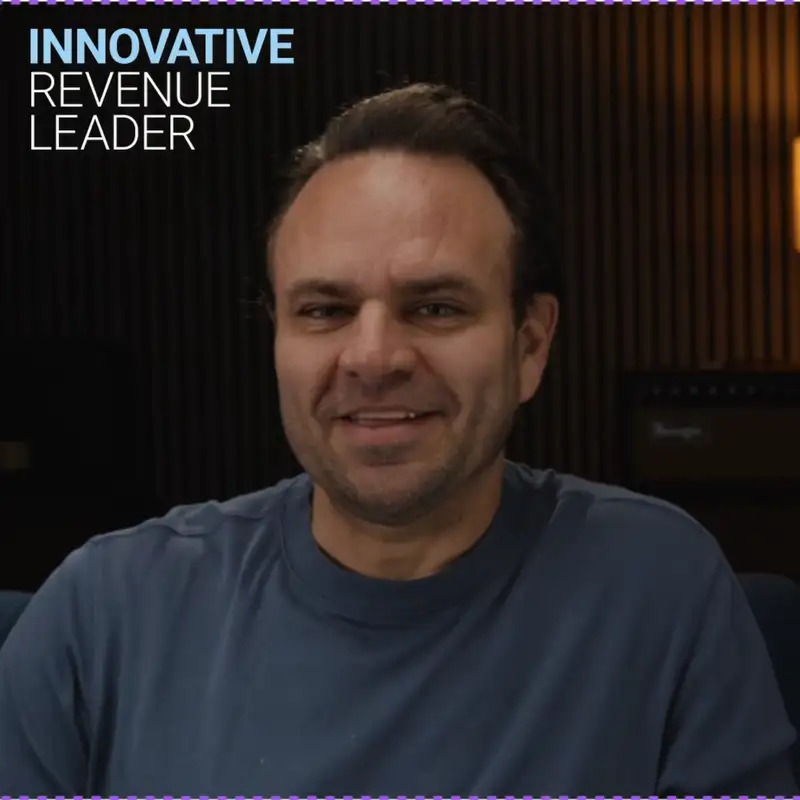
Innovtive Revnue Leader - Christopher O'Donnell
===
Speaker 2: [00:00:00] Welcome to the Innovative Revenue Leader Podcast. I'm your host, Seth Mars. Join me as we deliver practical insights to help B2B CROs Find new and innovative ways to grow in this fast changing environment. The Innovative Revenue Leader is sponsored by Sandler, a triad company, empowering sales professionals and leaders to master the craft of selling at all levels.
squadcaster-jf2a_3_07-22-2026_101324: Everyone,
Speaker: welcome back. I am really excited to be speaking with today's guest. He's the founder of a company in emerging category that's incredibly interesting around AI native CRMs.
squadcaster-jf2a_3_07-22-2026_101324: He's
Speaker: a SaaS growth operator,
squadcaster-jf2a_3_07-22-2026_101324: product
Speaker: framework
squadcaster-jf2a_3_07-22-2026_101324: author,
Speaker: and a category-defining executive. He spent decades leading product at HubSpot, architecting tools that reshaped how sales teams operate,
squadcaster-jf2a_3_07-22-2026_101324: built
Speaker: a comp- built and exited ProfitWell for $200 million, proving operational
squadcaster-jf2a_3_07-22-2026_101324: operational
Speaker: rigor can scale.
squadcaster-jf2a_3_07-22-2026_101324: He's a
Speaker: a creator of Marketing Your [00:01:00] SaaS Product and Product Poker,
squadcaster-jf2a_3_07-22-2026_101324: dis- uh, which
Speaker: is distilling winning growth
squadcaster-jf2a_3_07-22-2026_101324: and
Speaker: product strategies. Founder-- He's the founder and CEO of Day.ai.
squadcaster-jf2a_3_07-22-2026_101324: Christopher
Speaker: O'Donnell, great having you on.
Speaker 2: Thank you so much for having me, Seth. I've been looking forward to this.
Speaker: Yeah,
squadcaster-jf2a_3_07-22-2026_101324: same
Speaker: here.
squadcaster-jf2a_3_07-22-2026_101324: It's
Speaker: such an interesting time, and you're right in the center of it.
squadcaster-jf2a_3_07-22-2026_101324: Let's
Speaker: just start off around,
squadcaster-jf2a_3_07-22-2026_101324: what's
Speaker: the thing that you're seeing that is,
squadcaster-jf2a_3_07-22-2026_101324: that's like
Speaker: what's the most innovative you're-- thing you're seeing for B2B
squadcaster-jf2a_3_07-22-2026_101324: right now?
Speaker 2: executives right now? I think the light bulb moment is happening right now. And, uh, CROs, VPs of sales, frontline managers, rev ops people are having this realization that, you know, it's not about saving time.
That was the initial hope with this stuff.
Speaker: Yeah.
Speaker 2: It's about spending time better, which, you know, i- and not to be too industry about it, but it's like the ROI focus is, is starting to be part of the conversation, and people are seeing- Yeah ... real results. [00:02:00] And so that is the entry point for me on all of it, is just literally a day in the life of the sales rep is totally transforming.
Um, and this is real, and people are seeing it. It's a very basic thing to, uh, you know, to be the answer to my question- Yeah ... of what's the most innovative thing. But there's, you know, uh, you're, you know, you're a sales professional. You know that that's the absolute best thing that you could have is more better time face-to-face selling and, and doing what- Yeah
salespeople do best and really wanna do when they show up to work. And that's happening, it's real. We could talk about how, what's working. Yeah. You know, it's, it's really exciting.
Speaker: Yeah. And I mean, the, the crazy part about it is that's been talked about forever. Like, people- Yeah ... have been running those numbers forever, and they have not moved ever.
They just sit in the same spot. But,
squadcaster-jf2a_3_07-22-2026_101324: you
Speaker: are seeing those things actually happen with the work you're doing with customers using Day.ai. They are getting capacity back. And I
squadcaster-jf2a_3_07-22-2026_101324: one
Speaker: of the things you said that I think is really interesting as well is [00:03:00] we're seeing that transition too. It's not just about giving you capacity, it's enabling, using these tools to enable you to be better at the time you spend when-- with the work you are doing.
Which is crazy because you're killing-- you're doing two things where most companies have just focused on one or the other.
Speaker 2: I think that's exactly right. I mean, it-- this arc started before we had the, you know, the ChatGPT and, and Claude. It just was slower. You know, w-we, we saw apps like Gong, for example.
Yeah. And then the more sort of y- uh, point solution, accessible meeting recorder things. And now everything we do, everything's being recorded. So we're sort of years into that. And at the very beginning of this company, I did a very interesting exercise, I didn't know it would be this interesting, where I went and analyzed all of the meeting recorder apps and the feedback that people gave online, you know, 15,000 reviews.
And [00:04:00] it wasn't this feature or that feature. It was really a benefit of all these people saying, "I can pay attention in meetings. I can watch the body language." A-and this is like a small thing, like, "Oh, it takes notes for you. I guess that's cool." It's like, well, hold on, hold on. It allows the human to do what they wanna do, which is to look someone in the eyes and pay attention.
And so- Yeah ... for years, that was like all we had. We had this sort of glimmer into the future of if you had Gong, you know, your, your salespeople are present in meetings and happier, less likely to quit, all the rest of it. Now we're starting to see, you know, the next one and the next one and the next one, where we had a rep start, um, here at our company, and she was in our Boston office.
And in her first week, she's like three, four days in, she looks up from her laptop. We, we like to all sit around together, uh, as a default- Yeah ... and talk about customer stuff and then peel off for customer [00:05:00] calls. It, it's kind of a cool culture. So she looks up and says to the group, "I don't have any of these update CRM time blocks on my calendar."
And I'm never going to again in my career. You know, she's an experienced seller, but earlier in her career, right? Yeah. And so she- Yeah ... she's at that moment like, "I'm never gonna have to do that." I used to have 90 minutes, you know, every day or three times a week, whatever it is, to update HubSpot, update Salesforce, you know.
And the interactions between the manager and the rep of like, "Hey, you know, can you-- We have a forecast, you know, we have pipeline review tomorrow. Can you like update your stuff?" And blah, blah, blah.
Speaker: Yeah.
Speaker 2: And I talk to my friends, you know, at these vendors and e- even at the LLM vendors and, and it's like they're updating this stuff.
So that's the next one to go, Seth. Like that's gone. Yeah. Like why would you, why would you log into one of these things to add your notes? You're adding [00:06:00] notes from memory? Like you're moving a deal from stage to sta- From stage. Yeah ... like what are you doing? You know what I mean? Don't you need a record of why it moved and what the criteria are for stage transition and a whole audibl- auditable ledger that somebody can use from Claude Code?
Like what are we doing, guys? It's 2026. So those are starting to stack up and you get into like how are we coaching them and, you know, th- like every part of their day is changing and it's super fun to work on.
Speaker: Yeah. I mean, it's, it's,
squadcaster-jf2a_3_07-22-2026_101324: it's
Speaker: fascinating, right? Because that's kind
squadcaster-jf2a_3_07-22-2026_101324: been
Speaker: the reason for being with CRMs, and it kind of takes me into a question because you are sitting at the front end of what, what is a revolution around
squadcaster-jf2a_3_07-22-2026_101324: what
Speaker: people have perceived to be a CRM in the future, which, let's face it, a CRM has never been about the seller.
The CRM has been about, at best, the manager, and most likely it's about the company and just trying to aggregate data.
squadcaster-jf2a_3_07-22-2026_101324: And,
Speaker: hearing you talk [00:07:00] about, "I'm just trying to figure out how do I give more time back in the seller's day to win," I almost like--
squadcaster-jf2a_3_07-22-2026_101324: That,
Speaker: that
squadcaster-jf2a_3_07-22-2026_101324: is
Speaker: very refreshing because I don't think that's the view of how these products have been built in the past.
squadcaster-jf2a_3_07-22-2026_101324: So
Speaker: can
squadcaster-jf2a_3_07-22-2026_101324: can
Speaker: we double-click in a little bit just like
squadcaster-jf2a_3_07-22-2026_101324: CRM
Speaker: versus a native AI CRM? Because you hear CRM in both of those titles, but what you're talking to me about is very, very different than what I typically perceive when I think about a, a CRM. If, if you also like--
squadcaster-jf2a_3_07-22-2026_101324: It's
Speaker: also, it sounds like you're solving a different problem.
Like you're trying to solve a different problem, but eliminating a lot of the need for a CRM in the back end.
Speaker 2: Yeah. I mean- What was the original purpose of CRM?
squadcaster-jf2a_3_07-22-2026_101324: Rolodex
Speaker 2: Yeah, yeah, right. I mean, if we go back to, I think if you go to the Wikipedia page on CRM, [00:08:00] which I'm, I'm famous for my colleagues for many years of going back and sanity checking the Wikipedia definition, even when we know something like, like super cold or think we do, I'm like, "Let's just check what the world really thinks this is."
I think on there they have like the first example of this being, um, you know, if you were a, a Roman noble or a senator or whatever, you would have a, uh, shall we say, full-time steward of your personal relationships called a lector. And, and, and they would follow you around, right? And so you're walking through, through town, and, you know, they'll come up and whisper in your ear, you know, "That's, that's Marcus," you know.
"He owes you three goats." A- and and you're like, "Okay, cool. Got it." Um, and so you walk by and you're like, "Hey Marcus," you know, "Let's go." Yeah. "Where are the goats?" You know? Um, and then, you know, you get into some of the presidents, I think Roosevelt had this, you know, [00:09:00] file and, and i- where it was like before you get a one-pager before you meet with someone in the Oval Office.
Speaker: Yeah.
Speaker 2: And then a really kind of mixed bag thing happened after the business card was invented, which was we invented spreadsheets, and then we put the spreadsheets on the internet when that was invented, and we became very accustomed to that being kind of what we were going to work with. Mm. You know, break that business card out into a spreadsheet row, and then let's create an associated one that talks about the company that's on the thing, and then let's create another, you know, spreadsheet for the sales opportunities, and okay, great, we really got it.
To use your frame, Seth, which I really like, of who is, who is this thing serving at any given point? Yeah. I mean, i- if you squint, bear with me and afford me a little, you know, uh, suspension of disbelief here, but I think it's kind of mostly right. Maybe Siebel was built for the CEO [00:10:00] to know, "Hey, are we gonna hit the number?
Are people doing things? Like, what's going on out there in the field?"
squadcaster-jf2a_3_07-22-2026_101324: Mm-hmm.
Speaker 2: And then Marc Benioff does a very clever thing and realizes he could change the business model, goes across the street and does a s- very similar product, but in the cloud, and you rent access to it. Uh, and that was maybe very friendly for the VP, and now these teams- Yeah
are growing and they have layers of management. At HubSpot, we really liked, and, you know, I, I bet they're still on this, uh, mental model. I think it's a good one and a fun one. When we did the sales products at, at HubSpot, we were trying to build for the rep.
Speaker: Yeah.
Speaker 2: And there were a bunch of really neat things.
Do you remember back in, like, uh, 2013, '14, '15, this explosion of apps that a rep would just start using?
Speaker: Yeah, yeah. Salesforce was one of them at the time before it got kind of turned
squadcaster-jf2a_3_07-22-2026_101324: turned
Speaker: into what it became. [00:11:00] Y-
Speaker 2: Right? Like, you're a little team.
Speaker: By it themselves.
Speaker 2: By it themselves, right. You're just a, a team inside Thermo Fisher or, or at an earlier stage company.
You're like, "Hey, wait a second, this thing is super, super helpful for us." Um, and then you got into the sales enablement space and you had things that would do, you know, content management or Gmail, you know, let you see who opens emails or let you do a little email blast from Gmail, all those kinds of things.
And we thought, okay, well, if you, if you carry this forward, the next step is to actually build for the prospect, and isn't that kinda cool? Like, it, you know, maybe the best products are bought, not sold You know? And so as salespeople, we're, we're of service to assist in somebody buying, but they're in charge.
We're just there as a, as, you know, and that kind of thing. I think what's different now is the expectation is we get back to the original promise. And the way the systems have to be built is that they actually solve for every step [00:12:00] along the way, and the customer voice wraps back right to the CEO, and it's a closed loop.
You know? And, and what's working, where a founder can be involved, m- copy that should be changed on the website. You know, people are talking about bots doing support tickets and, and sort of cheering that their bots are doing support tickets. Like, why do you have a support ticket in the first place? You should detect that and have a pull request and then email the person and say, "Hey, we saw you run into something that wasn't quite right.
We fixed it. Thank you for not even needing to tell us." Like- Yeah ... that's the new expectation. So it's the same thing. And, and- Yeah ... it, it is a superset, you know? A context graph, a customer memory layer, an AI native s- you know, successor to CRM does everything a CRM does. And you can use one on top of your current CRM, or at least you ought to be able to, um, and then make a decision about where that core CRM space [00:13:00] goes.
Maybe that layer you want to store in Databricks long term. Maybe you keep that in this context graph. Maybe you keep Salesforce. Like, that's kind of none of our business. Who's to say? Um, and it's exciting to watch what'll happen.
Speaker: So you said something there I just want to pick on a little bit. Are
squadcaster-jf2a_3_07-22-2026_101324: are
Speaker: you
squadcaster-jf2a_3_07-22-2026_101324: talking
Speaker: about, like, disaggregation
squadcaster-jf2a_3_07-22-2026_101324: of
Speaker: data?
So
squadcaster-jf2a_3_07-22-2026_101324: like, I
Speaker: I don't care where-
squadcaster-jf2a_3_07-22-2026_101324: you
Speaker: you store your data. I mean, you can put it, you can leave it in a CRM if you want, and you
squadcaster-jf2a_3_07-22-2026_101324: you
Speaker: you can put data over the top of it. You can put it in Databricks, and we'll put it. So-
squadcaster-jf2a_3_07-22-2026_101324: you,
Speaker: you become the context layer of, I take it and have access to that information to make it visible to you, but I don't care where you store it.
Speaker 2: Yeah. It, it-- That is what I'm saying, and I'll be transparent a-about where I'm being a little too cute. because there, th-there is
Speaker: Oh, yeah.
Speaker 2: In the AI world, where you can trust it to be filled out correctly and you can fact-check the crap out of it, um, you don't have that limitation The AI also wants to be able to ask questions [00:14:00] in natural language.
It wants to be able to take a clue or a lead and run around and grab all the associated things. This is very similar to Palantir, right? Um, you couldn't build a system on Salesforce that looks at a satellite photo of a Walmart parking lot and says, "We gotta take a look at that Camry in the corner." Right?
Mm-hmm. Palantir can do that because it is structured differently. The data is structured very differently to let the AI run around it and make connections because those connections are all represented in that data substrate. So it's a little technical, but that's, that's how to think about it. Anything you can get in there will perform way better than what's not in there, and anything that's not in there, probably you can still use without any kind of a problem.
squadcaster-jf2a_3_07-22-2026_101324: So I
Speaker: Yes.
squadcaster-jf2a_3_07-22-2026_101324: I wanna,
Speaker: wanna expand on that because I think it's-
squadcaster-jf2a_3_07-22-2026_101324: important point
Speaker: For the audience to understand this is
squadcaster-jf2a_3_07-22-2026_101324: a
Speaker: a structured data set requires structured data. So by default, you have [00:15:00] limitations on what you can put in. You can't put a--
squadcaster-jf2a_3_07-22-2026_101324: You
Speaker: can put a picture in,
squadcaster-jf2a_3_07-22-2026_101324: but
Speaker: the pixelating of that picture, analyzing of that picture.
squadcaster-jf2a_3_07-22-2026_101324: So
Speaker: the-- I think it, uh, and correct me if I'm wrong, what you're talking about is I open up a realm
squadcaster-jf2a_3_07-22-2026_101324: of
Speaker: visibility to insights that go beyond what you have determined you need to structure and put in a database. So when I take a phone call and put the phone call in, I have all of it. So even if I wanna ask a question I didn't even know the answer to later, I can go back and ask that question and get an answer, create a field,
squadcaster-jf2a_3_07-22-2026_101324: set
Speaker: it up,
squadcaster-jf2a_3_07-22-2026_101324: versus
Speaker: if once I structure it, yeah, everything there is what I want, but when a new thing comes in, it's a burden, and I,
squadcaster-jf2a_3_07-22-2026_101324: and
Speaker: it creates work.
Where in the new world, I create a home for everything and allow you to roam and the AI to roam and get exactly what you need at the moment. Did I...
squadcaster-jf2a_3_07-22-2026_101324: Is,
Speaker: that-- Is, am I aligned kinda in how you're talking about it?
Speaker 2: That's exactly it. I [00:16:00] mean, for the more technical folks, um, th- y- you were nice in, in prep in tell- in saying, you know, these are, these are really serious people watching this and, and they're technical and they're very senior.
So in, in that spirit, you know, what can Palantir do? Well, it can look at a car. I'm oversimplifying. You know, I, I didn't work at Palantir, but you know, the general principle to illustrate it, it can look at a car, see the license plate, see a registration, know that that's associated with a person. Maybe that person is associated, you know, with a location.
That location is associated with other sets of people. Those people are associated with, you know, other organizations, you know, X, Y, and Z. And so it's very easy to at least investigate different patterns in things. Now, what does that mean in sales? Okay. Well, let's say you wanna understand why, uh, you wanna speed your pipeline up. just- Yeah ... start with the- Common
Speaker 3: problem. Yeah.
Speaker 2: You know, something we all wanna do. Okay. [00:17:00] Well, you wanna speed your pipeline up, and let's say in this theoretical example we're making up, um, you know, a, a relatable thing. Like, what's a relatable thing? You know, legal is backlogged.
Speaker: Yeah.
Speaker 2: Okay. And that, uh, legal is backlogged actually for a very preventable reason, which is, you know, they're doing red lines, but they're doing the same red lines over and over and over.
And the red lines they're doing, they give every time, and the right answer is that they should just update the standard terms.
Speaker: Yeah. Exactly.
Speaker 2: Okay. How do you get from the raw material Two, an email to the general counsel that says, "Hey, you know, Maria, listen, you know, we have, you know, seven million dollars of pipeline this quarter that would not even touch your team if we were able to just make these [00:18:00] updates to the terms."
How do you get from point A to point B? Okay
Speaker: And
squadcaster-jf2a_3_07-22-2026_101324: and
Speaker: way that would typically work is you would run a
squadcaster-jf2a_3_07-22-2026_101324: a Kaizen
Speaker: or a process improvement event, and then you'd go through it and say, "This is what needs to happen." And then you'd run the change, and you'd run through all of that to be able to get it done, is the way I've seen it in the past.
How are you--
squadcaster-jf2a_3_07-22-2026_101324: seen it in the past.
How
Speaker: Like, so I-- Con-
squadcaster-jf2a_3_07-22-2026_101324: Con-
Speaker: so I'm interested in seeing- Yeah ... how this solves with
squadcaster-jf2a_3_07-22-2026_101324: with
Speaker: a data on AI and, and the future.
Speaker 2: So,
and, and you are being very generous assuming that the person in this, you know, situation would know to do the type of process that you just ran, which, you know, people- They
Speaker: won't.
It would have to go to a team who
would, who
would run it and then prioritize it, and then maybe it gets...
squadcaster-jf2a_3_07-22-2026_101324: gets--
Speaker: So
squadcaster-jf2a_3_07-22-2026_101324: So
Speaker: would months,
squadcaster-jf2a_3_07-22-2026_101324: be
Speaker: months to do that.
Speaker 2: Right. So, you know, not to make this about our product, but this is the new expectation. This is where things are going. It happens to be very easily doable in our product.
You could say, "How do we speed our pipeline up?" [00:19:00] And it will tell you, "You need to update your terms of service because everybody is asking for the same red lines." You know? You goof. Yep. "You want me to write Maria an email? Like, actually, let me just go ahead and write the email. Click here to review it and send it."
It, it literally is just completely connected from point A to point B. How does that work? Well, we have the primary source material, and so you do want to have represented in that graph, you wanna know, well, what's a deal? What are the stages of the deal? And you need to know much more about the stages than you do in a traditional CRM.
You need to have more of like what you would hand out in a laminated big card at sales kickoff. You know, the ones that- Yeah ... you know, people throw away on their way to the bar. All the
Speaker: different things that you need to do to move it, all that stuff.
Speaker 2: You n- the system needs to know all of that, you know? Um, and it needs to be watching it all and, and have a sense, a map ahead of time in the graph of where everything sits.[00:20:00]
Uh, and that graph needs to be all data that is inspectable and fact-checkable and, and correct, right? Um- Yeah ... and easily updatable and re-runnable, all the rest of that. So let's assume we have that. An agent can go, "Oh, okay. Well, we're talking about your deals. Got it. Here are your deals." That's 10 milliseconds.
Um, stuck. Well, stuck means they've been in the same stage probably for a long time. Like, let me look for patterns. That's 10 milliseconds, or not even. And it says, "Okay, these things are stuck in negotiation. Um, and what do I need to get out of negotiation? I need, you know, a clean contract," blah, blah, blah.
Well, do I have a clean contract? Well, no. Oh, okay. Then it's already basically there Like, so in the first few hops of the graph, it has already figured out probably the answer. Then it goes into this mode of, "Let me really run down this hypothesis." It can pull [00:21:00] the Gmail conversations. It can pull the recordings.
It can pull, you know, the Slack conversations, the, the DocuSigns that have been sent back and forth. And then it looks at it and it goes, "Well, hold on a second. I see a pattern here." And now remember, the frontier models are very good at a lot of these things. They're very good with no training. They know a lot about the work that you and I do.
They know a lot about sales process. They know a lot about the law. And so it's like, boom, hold on a second. Why do you guys have such a low cyber insurance thing? Why, why are you doing indemnities this way? This doesn't make a ton of sense. Okay. And then it responds. That whole thing can happen very easily within, you know, under 10 seconds, like five seconds
Speaker: Yeah.
Because of the graph that you've created.
Speaker 2: Right.
squadcaster-jf2a_3_07-22-2026_101324: Now,
Speaker: Yeah. Now, we've talked a lot about sales and,
squadcaster-jf2a_3_07-22-2026_101324: the,
Speaker: the immediate place I went when thinking [00:22:00] about,
squadcaster-jf2a_3_07-22-2026_101324: an
Speaker: AI-native CRM and, and talking to a company like yours replacing what a CRM does is
squadcaster-jf2a_3_07-22-2026_101324: all
Speaker: of the CRM. So there is a lot to the, the whole ecosystem that goes around a Salesforce or a CRM.
When you're looking at that, your definition of a CRM, is it that as well, that you would do marketing automation, that you would do customer success, that you would do all of that? Or are you hone- We've only talked about the seller side, but are you also expanding that to include everything there as well?
Speaker 2: 100%. I mean, I'm not, you know, it- anybody who-- I don't, I don't know who's, who's, like, watching us closely or, or, you know, wondering what our next move is, but, um, it's, it's not... It will not take, like, the Oracle of Delphi to, you know, put two and two together. I, I want to do a lot. Yeah. And, you know, before we did the, the sales products at HubSpot, um, you know, I led the, the marketing product build, and so we love that [00:23:00] stuff.
I see the marketing stuff that we're gonna do, and people are already doing even though we don't have, like, a packaged marketing product. Uh-huh. 'Cause Seth, you can do stuff like, uh, I was just talking to our CMO yesterday actually about, like, fun ideas. We're just brainstorming about agents that we could spin up for ourselves.
And I said, "Oh, dude, I have one I want to try." Um, and we're spinning this up where it's basically, like, a full-time virtual employee in Day AI that all it does is watch customer conversations, Gmail, Slack, meetings principally, but all over, and compare the language the prospects are using to the language we use on our website and just think about it, and then reach out to us when, you know, there are real opportunities here.
Like, and this is i-incredibly valuable right now in an industry where the term harness didn't exist six months ago.
Speaker: Yeah, that's the new thing. That's the new thing now.
squadcaster-jf2a_3_07-22-2026_101324: So
Speaker: talk a little [00:24:00] bit more about that because, uh, that is something that is coming up a lot more. Give me the context from you and your definition.
squadcaster-jf2a_3_07-22-2026_101324: definition of that
Speaker 2: Yeah. So a harness is you have the model, and I think everybody kind of understands the, you know, you have a, uh, a set of weights, you know, this, whatever. It's a black box in the cloud of, of intelligence. And these things principally are going to, uh, you know, nine times out of 10, they're set up to take a bunch of text and give some text back.
And then at the application layer, you can do all kinds of interesting things. You can add instructions to the text that gets sent, and the text that comes back maybe is code, and you can show it in a live, you know, webpage renderer or whatever, right? But it's all the same principle.
Speaker 3: Yeah.
Speaker 2: What is maturing quickly now is the layer on top of that, which itself has a couple of layers, but collectively we can think of as a harness.
Speaker: Mm-hmm.
Speaker 2: If I had to describe it [00:25:00] very simply, it is the set of domain and user and organization-specific tools and instructions that give that model what it needs to really do professional-level work within a domain, within a problem area. So if I-- Let's use something outside of sales and marketing tech. If I want to build a harness, um, you know, to...
Let's say we want to teach an LLM how to play an instrument
Speaker: Yep.
Speaker 2: You can say, "Hey, Claude, you wanna learn how to play an instrument?" It'll say, "That sounds amazing. I would love to learn how to play an instrument." Okay, well, what are the problems? "Well, I don't have any fingers. I don't have any ears. I don't have a way to look up music."
But the irony is the model already knows a lot about music theory and all of this kind of stuff, so you're starting from greater than [00:26:00] zero. So what does that harness look like? All right, well, let's give it fingers, ears, eyes. Let's give it a way to play an instrument, you know? And so you're gonna say, "Here's a tool that lets you write, you know, uh, a passage of music, choose which instrument, and render an audio file."
Speaker: Yeah.
Speaker 2: Claude will go, "Thank you." Okay? Then you say, "Here's a way to search, you know, uh, to get audio, uh, files and download them, so you can go look at, you know, a Stevie Wonder song or this or that." And Claude goes, "That's amazing. Well, I don't have a way to listen to it." Okay, so let's give you a tool that lets you do, you know, uh, FFT transform, you know, fast Fourier transform analysis, which is gonna be the closest we can get you to understanding what's happening in the music and do further analysis.
Claude goes, "Thank you." And then you say, "All right. Now I'm gonna give [00:27:00] you a, a loop. I'm gonna give you agent and skill definitions. I'm gonna give you a bunch of text files that future Claude or whatever LLM you're using can use to teach itself more and more, write down what it knows, experiment, evaluate, et cetera."
So Seth, you end up with a little folder. Mm-hmm. It's really just a folder, you know, uh, in the cloud or frankly, on your hard drive. People are doing a lot of this on their laptops, which is really exciting. And that set of files, it is instructions, reference documents, code, things called tools that are executable code.
And the collection of th-those things together takes the model, let's say Claude Opus 4.8, whatever it is, and you want it to have some domain ability, like to learn and practice and play an instrument. Yeah. You can create a file on a [00:28:00] folder on your hard drive that literally gives it that ability, and that middle part is called the harness
squadcaster-jf2a_3_07-22-2026_101324: Much.
Speaker: Now,
squadcaster-jf2a_3_07-22-2026_101324: I
Speaker: think when you think about that, is this finally something that's
squadcaster-jf2a_3_07-22-2026_101324: pulling
Speaker: the value of a tool in a foundation model back to, into
squadcaster-jf2a_3_07-22-2026_101324: in-individual
Speaker: applications?
So the foundation model doesn't have that harness. It can do all that stuff, but it doesn't have the instructions. But there's a lot of value in, in that folder.
squadcaster-jf2a_3_07-22-2026_101324: that
Speaker: folder has very unique expertise around a lot of different things. Is that kind of taking us to the point where this conversation of I can do everything in a foundation model kind of now changes to, no, you actually need expertise, and this is the way we're doing expertise in the way, in the world of AI?
Speaker 2: You, you're exactly right. And a lot of the investor papers that are coming out, which, you know, I mean, maybe they're talking their own book a bit because there's, you know, there are only so many foundation models one can invest in, I've noticed. Yeah. [00:29:00] Yeah. Um, but, but I, I think it's very authentic in that, you know, the application layer and the harness, um, and the tooling that allows these foundation models to really come to life, there is a Cambrian explosion of enterprise value happening there.
I think exactly what you said is, is just true. Every word of what you just said, I think is, uh, is exactly true, um, and fascinating. The, the components of that, and I'm really just sort of summarizing what you just said- Yeah ... 'cause you said it really well. It's, um, you know, look, you may need data to do the thing you're trying to do.
Speaker: Yeah.
Speaker 2: Coding apps, one of the reasons, um, this is fun, and I've never talked about this, uh, publicly. We talk about it internally, but, um, I think you'll like this. Why are the coding apps so far ahead of everything else that's out there? One of the things that you just don't have to do as a coding [00:30:00] app is get the relevant data to what you're trying to produce because it's code, it's already on the hard drive in a folder.
Speaker: Yeah.
Speaker 2: It's all there. So Cursor has been for three years optimizing the way it can explore a folder on a hard drive. And I won't-- I'm not saying that's, like, totally an easy problem. I- Yeah ... it's a hell of a lot easier than trying to do, like, data permissioned Gmail between a CEO and a BDR. Yeah. I mean, like, you kidding me?
This is, like, a completely different species. Then you need, uh, long-running agents, long-horizon agents. This is, you know, Sequoia, others have been talking about this for a couple of years. So you need some answer there. The foundation models will do something with that and are doing something with that. Um, and then vendors add a lot of value because doing that in different [00:31:00] ways will be appropriate for different tasks.
Like using Codex to try to run a sales team, it, it's just not gonna be for that.
squadcaster-jf2a_3_07-22-2026_101324: makes
sense. Let me,
Speaker: Makes sense. Let me, let me-- So,
squadcaster-jf2a_3_07-22-2026_101324: be- before-- I
Speaker: I wanna ask a couple personal questions, but like- Sure ...
squadcaster-jf2a_3_07-22-2026_101324: the
Speaker: the last thing I wanna ask, just on the context side, 'cause I--
squadcaster-jf2a_3_07-22-2026_101324: I--
Speaker: you talked a lot about context, and that seems to be the other unique advantage is the context layer that you're building.
You combine that. Uh, can you talk a little bit around why context? Because I think people hear context and they don't necessarily understand why it's important, but it's foundational
squadcaster-jf2a_3_07-22-2026_101324: to
Speaker: why you're going to be successful, the way that you build it out, the way that you structure it.
squadcaster-jf2a_3_07-22-2026_101324: Just,
Speaker: like, talk a little bit around why that's an advantage for you.
squadcaster-jf2a_3_07-22-2026_101324: you.
Speaker 2: Yeah. I mean, it actually works i- i- is really the punchline. No, a- a- and I say that earnestly. I mean, look, we're all trying to do the same stuff now, which is cool. 90 days ago we weren't, but I got on a call yesterday and a, a [00:32:00] sales, you know, she, she was very, very sharp. Um, you know, somebody in charge of a, a team of sellers was trying to do things like ask, "How is this cohort of frontline reps that we hired doing compared to tenured ramped reps?
Um, and I wanna know numbers, behavior, uh, you know, uh, business acumen. You know, I wanna know everything, the real story of what's going on." Great. Now we're all trying to do the same thing. You know, 90 days ago I didn't get on a call with somebody running a sales team who even i- it ever occurred to them that they could get that answer.
Speaker: Mm-hmm.
Speaker 2: So why do you need the context graph? How are you gonna get that answer? The idea that, that people have today, and it's quickly eroding as people actually try it-
Speaker 3: Mm-hmm ...
Speaker 2: is, [00:33:00] well, I can use one of these foundation vendor apps and connect all of my data sources and ask questions and get answers like this.
And you really can't in practice. Um-
Speaker: Doesn't know what-- Yeah.
Speaker 2: It, it just doesn't end up working. And we encourage people in pilots or in, you know, just a prospect conversation, they say, "Well, you know, I was thinking of doing this, you know, with, uh, Claud- Claude and Salesforce MCP and Gong MCP, you know, and everything."
And if they have those apps already, we'll say, "Hey, do me a favor tonight and try it." These shops that make these models are using Salesforce, and they were using the MCP and they aren't anymore.
Speaker 3: Yep.
Speaker 2: It's-- It ends up being faster to just open the legacy app and enter the data by hand. Um, and so we're right at that moment where the epiphany is happening.
Um, it's super fun.
squadcaster-jf2a_3_07-22-2026_101324: Awesome. So [00:34:00] a little bit about you, like technology,
Speaker: a little bit about you, like technology, has this always been your thing? Have you been like a, a- as a kid, were you, were you the one in the, like doing all the
squadcaster-jf2a_3_07-22-2026_101324: science
Speaker: fairs and all these school, I mean, uh, uh, coding at a young age? Like has this always been your thing?
Speaker 2: Oh, dude. So, so I had... So in my childhood, I had these two sets of cousins, and one set, set of cousins, uh, were like all American athletes, every sport, tri-varsity- Yeah
blah, blah, blah. President of the United States, you know? Big Irish Catholic family all over, so I got like a million of these cousins. And I'm sitting there and like Seth, I'm, I'm okay at sports, man, but I, I'm not, like that's not my thing. Do you know what I mean? Yeah. I'm like a men's, men's league tennis, squash guy.
I can ski okay, you know. And then my other cousins were these hyper geniuses, you know? My, my cousin Nicholas went on to literally graduate college at 17 years old and build Google Search. He was on the little hall, you know, with [00:35:00] Jeff Dean and Matt Cutts and all those cats, and like literally spent 20 years building Google Search.
He was a rocket scientist. So, you know, I'm there. My sports cousins gave me an Apple IIGS that they had gotten 'cause nobody wanted to mess around with this thing. I was probably 10 or 11 years old, and my Aunt Mary, bless her soul, was like, "Hey, does Christopher want this computer?" You know? And it had no software, it had nothing.
Um, and uh, and I got it, and I was like, "I don't know, this seems cool." And I started, and I had to teach myself to program Basic, you know, just to, for the computer to do anything. Yeah. I'm like drawing lines on the screen with Basic 'cause I had no, I had no disks, you know? Yeah. Um, and I learned to type and I learned, you know, to get into that stuff, uh, pretty early.
My mom sent me to a web development course in Porter Square, Cambridge in 1994, and to this day she has [00:36:00] no explanation. I'm like, "Mom, how..." Like '94, Seth. There was not-
squadcaster-jf2a_3_07-22-2026_101324: No, seriously,
Speaker: Yeah. No, seriously, there was no internet. The,
The, the internet was just like, it was intranet at that time.
Speaker 2: Dude, this was like before GeoCities.
I'm sitting in this ro- Oh, no ... this, in Porter Square, and they're teaching us the blink tag. The blink, you know, HTML tag. And I'm like, "I don't know, this is pretty cool. I don't have a lot of friends." You know what I mean? Um, I'll, I'm gonna hang out and do this. And then I ended up i- in undergrad, I ended up, um, going to get a degree in literally computers and music, which was a real degree at my university that I, I went there for this.
And got really into, like, the intersection of kind of creative stuff and, and software development. And it actually took me a little while before I realized that, uh, it was one of these liberal arts, you know, environments where they're like, "Don't think too much about having a job." And then I graduate and I'm like, "Now I'm thinking about having a job, [00:37:00] guys."
And I call them, I called career services. The guy laughed at me, Seth, so straight up. Like I, I'm like, "Hey, yeah, you know, I'm living with my mom. You know-" "... I was thinking about like, so what do you do after this? Do you ha- like what job do you get?" And he's like, laughs and hangs up. Uh, but uh, but that ended up being very helpful to me because working with musicians,
Speaker: Creative, yeah.
Speaker 2: Dude, I mean the stuff we're doing, d- you know, Chris in the other room here, I, I went to high school with, he's one of the best drummers, keyboard players, producers, photographers, you know, ever. And it, you know, at this point in time, you know, it's like, "Hey Chris, you gotta come here." He's like, "Well, I don't know anything about coding or anything."
I'm like, "Don't worry about that." And he, he can do video production with Claude and anything you want, anything you want on this planet- Yeah ... that guy can make. And so i- that persona is favored right now, and I love that persona, so.
squadcaster-jf2a_3_07-22-2026_101324: So awesome. That's so awesome.
Speaker: One [00:38:00] piece of advice, like to finish up. Tell me. Oh What, one
squadcaster-jf2a_3_07-22-2026_101324: of
Speaker: of advice when you graduated college that you'd give yourself that you, uh,
squadcaster-jf2a_3_07-22-2026_101324: if, you
Speaker: knew back then it would be hugely valuable?
Speaker 2: I-- You said one piece of advice. I thought you were gonna give me a piece of advice and I was like, "Yes, please."
squadcaster-jf2a_3_07-22-2026_101324: Yeah.
Speaker 2: I don't know, man. You know, don't give up. Like-
Speaker: Yeah ...
Speaker 2: that's the thing. I played a lot of poker in that period living with, with my parents, you know, after undergrad, and my dad wanted me to go to, to grad school, business school, and I never did.
And later he said, "Those years you spent playing cards were your business school." And I think he was right. And you know, there's a thing when you watch people playing poker and you can see everybody's cards. Yeah. Very often you find yourself in this spot where you're, you're just like, "Don't fold."
squadcaster-jf2a_3_07-22-2026_101324: Yeah.
Speaker 2: You know, you're saying
to somebody like, "You have so much value, you have no idea.
Just like, don't fold. Don't let them get you off this hand." And that's, [00:39:00] that's really it. You know, my dad said it, this is a great adventure, you know, your career. It's a great adventure. Focus on broadening and deepening your skills and, uh, and being of service. You know? Yeah. If, if I can root for whoever I'm building for, I'm gonna have a good day that day.
squadcaster-jf2a_3_07-22-2026_101324: That's awesome. Christopher,
Speaker: Yeah. That's awesome. Christopher, so great to talk to you. Thanks for coming on. Really
squadcaster-jf2a_3_07-22-2026_101324: the conversation
Speaker 2: enjoyed the conversation. Dude, thank you so much for, uh, for having me. This was great.
Speaker: And that wraps up another episode. Thank you for joining. For show notes and other episodes, visit us@innovativerevenueleader.ai. The Innovative Revenue Leader is sponsored by Sandler, a Trilia company. Sandler provides top corporate sales and business development training while empowering sales professionals and leaders to master the graph of selling at all levels.