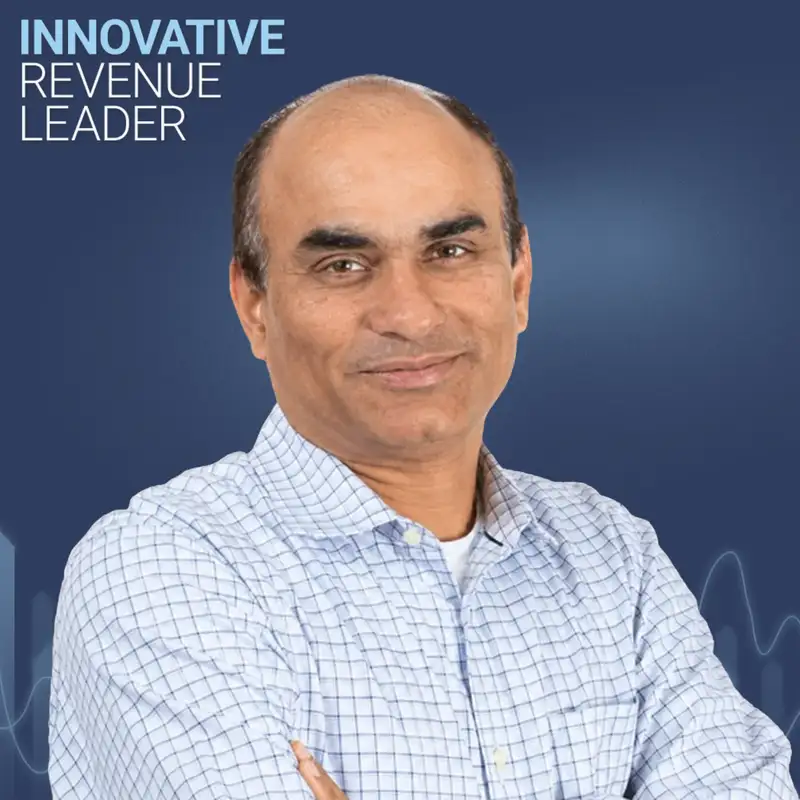
IRL - Krish Mantripragada
===
Speaker: [00:00:00] Welcome to the Innovative Revenue Leader Podcast. I'm your host, Seth Mars. Join me as we deliver practical insights to help B2B CROs Find new and innovative ways to grow in this fast changing environment. The Innovative Revenue Leader is sponsored by Sandler, a triad company, empowering sales professionals and leaders to master the craft of selling at all levels.
Hello, everyone. Welcome back. I'm really excited to introduce today's guest. He's a category-defining enterprise product executive, former chief product and technology officer, two-time IPO veteran, and AI startup advisor. He was a Stevie Gold Award winner for Cloud and Data Visionary of the Year in 2026, spent six years As Chief Product and Technology Officer at Seismic, launching the AI-powered Seismic Enablement Cloud and scaling the company from 145 million to over 400 million, all while holding the number one analyst position ev- every year.
[00:01:00] He served as EVP and Chief Product Officer at Medallia all the way through its successful New York Stock Exchange launch or IPO. He spent eight years in executive product roles at SAP across analytics, supply chain, IoT, and co-founded Platza University to reimagine technology education. Krish, it's so great to have you on.
Thank you. Likewise, Seth. Pleasure to be here. Thanks for having me on the show. Yeah, yeah. So I'm gonna jump in with the question that we asked to, to, to everyone just to start. Like, you've got a great viewpoint of what's going on in, in B2B sales tech. If you're a CRO today, what, what, what would you think they should think is the most exciting thing you're seeing in B2B that, that they should be looking at in B2B right now?
Yeah. Yeah, no, I would be, I would be a mess if I didn't say anything but AI. Yeah. Uh, you know, clearly, you know, for the past 25 years, I've been building enterprise software, and for the most [00:02:00] part, enterprise software had been largely focused on things like capturing information, managing workflows, generating insights.
But humans had to connect the dots, and they had to do the work. Now think of a salesperson. You know, we give them CRM, we give them conversation intelligence, intent data, content systems, email, digital sales rooms, all powerful tools. But then we made the seller the integration layer between all these tools, and they had to figure out what needs to be done.
So what's fundamentally changing now is that that AI can increasingly reason, uh, can make decisions on behalf of the seller, can take action, and it's progressively evolved in multiple stages. You know, the first stage was that, hey, answer questions. And that itself is a mind-boggling innovation in terms of ask any question and get an answer.
But then very quickly, it's moved to reasoning and completing tasks so that, hey, compose an email for me [00:03:00] or create a response to this buyer request, or help me prepare for a meeting, reconcile an invoice. And this is where most of the enterprises are, are today. And very quickly, where it's moving towards is acting autonomously, getting the agents to monitor, decide, always stay on top of things.
And so the, the seller becomes more like a supervisor and most of the work is being done by the agents. I- I mean, like the way that, if you think about it, the way that's been talked about is people process technology, and it's always been around how do I take the person in the center, and I have the process that I'm trying to optimize for the person, and then I put technology to kinda supercharge the process.
It seems like the seller and the person is moving up, and an agent's coming in, so it's not just going to be, "I'm trying to make the seller better. I'm gonna make the agent better, too." So it's this almost new type of talking about how technology can help. That is so true because it also [00:04:00] frees up the seller's time to focus their, their time towards what they really wanna do.
You know, engage with the buyer, build the relationship, do the sale, discover, discover opportunities. And a lot of the, the grunt work, as well as staying on top of things and follow-up preparation type activities are delegated down to the agents. Yeah, so now it's off my plate. Now I go sell. I go sell more.
Yeah, exactly. So i- in your career, you've had multiple successful runs with really high-profile companies. What approach do you take when you build products that's, that's caused it to resonate so much with the customer, with, with customers? I mean, I would say my philosophy has always been that great products come from deep customer empathy.
And so one things that I've held-- three things I've held constant across every, every company I've been at is, one is solve the problem at a level deeper than a customer can [00:05:00] describe it. 'Cause customers will tell you to build all kinds of features. And so yes, listen to the customer, but build for the solving the underlying problem and build for the market.
And the second is name the problem before you name the product. And, and, and usually it helps, especially when you're early in the category, uh, the market doesn't have words to describe the pain point, so then you get to define it, right? And, and the third is sort of like focus on the value more so than on the activity or vanity metrics.
You know, people often get hung up on, "Hey, I'm getting downloads" or "I'm getting usage," or "I'm getting logins," versus, you know, the real, the real focus should be on did the customer win more or do better because of you? And that conviction is what has led to willingness to bet, uh, on things early [00:06:00] and, and, uh, follow where the market is going.
It's, it's so interesting when you, when you talk about, like, the, the first one you mentioned, right? There's a, like, a belief. Like, you say a problem, customer, "I fix your problem." You say a problem, "I fix your problem." But the truth is really that you have to, like, uh, it's-- I think it's really telling advice is you need to look and work with companies that look through your problems.
So you may say, "Here's my problem," but you're an expert in your way, and I need to look at your problem and say how it, maybe that's not the problem. The problem is these four things, and if I do these four things, the product will be way better and your problem will be solved It, it's interesting because that you think of it that way, because I've watched it over the years where you have people that are like break-fix.
You give a problem, I solve it. And then what you have is this kind of hairball of a product that solves a whole bunch of problems that doesn't really think through and try to solve it in a way that allows the whole set of things to work. That's right. I mean, that is [00:07:00] so true. And then several problems are latent, where the customer feels the pain but is not able to quite describe what they're doing.
So the, the skill is to extract that, understand the pattern behind, behind the symptoms so that you can really figure out what is worth solving. Yeah, so true. So true. So I-- You had talked a little bit around some of the stuff going on, and we're alluding to, to agentic AI earlier. I-- just for, for the audience, like, can you define what that means?
And I mean, you talked a little bit about how it's going to affect things, but how, how this is going to... Like, could you expand on what you talked about on where this is going with autonomous and, and how that's going to work? Yeah. Yeah. I mean, at the simplest of definitions, right? So generative AI gave us all the ability to ask questions and get answers, where, where the AI is trained on either the world's information or your company's, um, knowledge and be able to answer, answer any question that [00:08:00] you have.
Agentic AI takes it one step further, where now it's about acting. You know, can, um, reason, deci- understand my context, understand the problem that's been given, and figure out a way to act upon it. So I'll give you an example from the revenue world. So most AI and revenue teams today are still pretty assistive in the sense that, hey, you can summarize a meeting or draft an email or build me a deck and that type of stuff.
Agentic AI takes it to the next step, where understand the objective, you know. Gather all the context from conversations, from email, from interactions to really understand what's happening either with my deal or with a particular buyer, and then execute that work for me. And for revenue stack, it's particularly important because it's shifting where the value is sitting.
You know, historically, we built system of records. You know, we built CRM that told you [00:09:00] what happened. Then we built engagement tools that we gave sellers to do the work themselves. Now it's all about the system of action. So like, take an example, right? Where you and I, I'm working on a deal. Uh, a new stakeholder suddenly emerge and is joining the deal.
Now you want an agent that's continuously monitoring that. Then it notices it, figures out what this new person is, what's their background, does deep research on them, prepares the right materials, coordinates follow-ups, and keeps that deal moving so that me as a seller, I didn't have to stitch all that together.
Together. I, you know, and, and now I'm in a much better position to be able to engage with the buyer. This re- will redefine and reshape every layer of the stack. You know, the interface is become secondary because now, you know, either I'm on the, you know, UI or I'm on Claude or OpenAI or email or wherever.
But then data, [00:10:00] business logic, permissions, govern actions, those things become a lot more important. They are the product. Yeah. It's kind of like the way that when you said that, it, it's like the loose ends that a good seller would catch most of the time. A bad seller would always miss it, or maybe your infrastructure, your tech infrastructure was never good enough to catch it.
But in this situation, as a seller, you won't even think about that anymore. You'll just see, your agent will be working in the background, see the new buyer come in, do all the research for you, pop it into the place it needs to be, tell you what you need to know, and you're just gonna be running towards closing that deal.
So true. In, in many ways, it's sort of the grand equalizer, where it is scaling and multiplying the best behaviors, what some of your best sellers did naturally. Yeah. Yeah. It's, yeah, it's crazy. It, that's a level up, too. Yeah. For sure. So, like, when we talked earlier, you mentioned the concept that I really liked, which is h- hybrid [00:11:00] enablement of agents and people I think that's hard for people to grasp.
Can you talk just a little bit? Because the way you said it to me I thought was really cool. Like h- a- what does that look like? How do you enable an agent and a seller and then keep those two things harmonious? Yeah. I mean, so historically, enablement used to be about like teaching humans how to fish, right?
And, and now it's about managing a fleet of agents that fish for you and also teaching you when to pull them all back type of thing, right? And so for the past decade, focus of enablement has been around helping sellers find the best content or, uh, and, you know, effectively learn the right skills, get trained how to engage with buyers, those types of things, because sellers did all the work.
And the focus was how do I make the seller more better-- productive and better in what they do? And now in the agentic enterprise, that's no longer sufficient. [00:12:00] The new reality is that enablement will now have to be responsible for multiple things, especially when agents start picking up a lot of the work.
Now you've got-- you have to continue to do human enablement because-- but the skills that you're teaching the humans are different. Where now you have to teach them things like judgment. Uh, what, what should-- where should I trust the agent to do the work versus what do I need to do myself? How should I think about handoffs?
Um, focusing on higher order work like multi-stakeholder alignment or relationship building, um, those types of things. Then agent enablement is largely about like making sure that they have access to the governed machine-readable, accurate content and knowledge, because that's going to determine what they're going to do and what they're going to say and recommend.
And then also define the guardrails so that your, your agents don't [00:13:00] hallucinate and, um, and they stay within the boundaries of what they're supposed to do. And then the third piece is the hybrid enablement, which is when you've got a system where both humans and agents are working side by side, then managing the handoffs becomes really important.
Uh, where should, where should I intervene? Where should I not? And so to support this paradigm, enablem- the whole enablement stack needs to be rethought. Like historically, content. Content used to be about managing libraries and taxonomies and files and artifacts and so on because humans were the one who would navigate through these libraries and find the right piece.
Now, if agents are doing that work, the content-- you have to rethink content differently. It needs to be machine readable, it needs to be about facts, and it needs to be about... So, um, an agent may not be interested in reading a thirty-page or a ten-page case study. There it can very quickly identify the [00:14:00] five facts, like, hey, you know, by deploying your, your, your software or by this, this technology, there was a thirty percent increase in time to market or whatever that statistic might be.
And so now that becomes the focus in terms of what content needs to be. Similarly, learning. Like learning historically was about teaching humans, you know, about, about, you know, your products and services. Now it splits into two. Now it's about like knowing when to trust AI versus when not to trust AI. And for agents, it's about like, you know, um, learning from their mistakes.
When-- If they are noticing a pattern where sellers are overriding their actions, that's a learning moment for an agent to go change its, its behavior. So in many ways, sort of like even coaching, for example. So when a rep gets it wrong, then it's a coaching moment. But when an [00:15:00] agent gets it wrong, something is wrong with your data or your content or your knowledge.
There's a gap. Either it's a gap or it's a fact that's incorrect that needs to be changed, and so on. So in many ways, enablement leaders now almost have to behave like product managers, where they're running experiments, they're measuring outcomes, they're iterating constantly until they sort of get it right.
Yeah. It's int-- Like so- Like, you, you hear this constant talk that's starting to pop up more and more around loops, right? Like how I, I'm-- I need the... And, and when you talk about the hybrid side, y- they both need to learn separate and do learn in separate ways. A human versus an agent are gonna learn separately, but they also need to learn in a connected way to make sure as they learn that if I learn something new on an agent side and I don't connect that to how the seller's gonna engage with me, I'm broken.
If I learn something on the seller side, how on earth do you maintain that over time? Like, what-- Like, [00:16:00] I, I think we're at the beginning stages of this, but, like, h-how do you think about maintaining the continuity as both sides are learning differently in different ways? Yeah. I mean, I think it comes down to, like, where in, in, in more sort of like predictable deterministic type activities, you can, you know, have the agent pick up a lot of those tasks.
Like, you know, like summarizing a meeting or identifying tasks and that type of stuff. But when it involves any, any interaction with the buyer, then initially, until there's a trust built up between the seller and the agents, verify before, before you act. And then once they-- a pattern is starting to develop where, hey, the seller has built enough confidence on the agent that it's getting, you know, most of the things right and, and they're okay to sort of like let their guard loose a little bit to, to have the agent pick up more.
And this has to be [00:17:00] done-- will vary from seller to seller, will vary from company to company. And as more confidence and trust is built in between, between the sellers and the agents, um, a comfort level gets established in terms of being able to delegate more and more of the, of the work down to the agent.
Right. So go slow to go fast. I'm gonna-- I'm not gonna trust you until I think I can trust you, and as long as you're-- The agent's always gonna be learning from you as it's going through until you build that trust. That's right. And that's why, like, I made that comment earlier, where now the onus is also on the enablement team, where they have to start thinking about, "How do I design the right evalu-eval frameworks?
How do I run the right tests?" And because they need to also build enough confidence as to are they, are their agents able to work the right way, and they are staying within the guardrails, and there's enough confidence being built up. [00:18:00] And suddenly that becomes a big part of their job, and not just creating content and creating training materials and, and playbooks as what they did in the past.
Got it. Got it. Yeah, it's fascinating. So a-another term that comes up all the time is context. And, and as you know, the landscape of technology across like B2B sales organization, it's everywhere, right? You have revenue orchestration, you have sales enablement, revenue enablement, CPQ, all these different types of categories that support sellers.
It seems like every one of those is operating that their context is the center of gravity for everything, and then everything else just splinters off. It's like, okay, I'm a CPQ tool, so my data is worth more than everybody else's. I'm gonna pull in enablement data, but this is the real center and I'm gonna build off of that What's the real, like, center of gravity?
And, like, how will that battle kind of be won? Because no one wants to be subservient. [00:19:00] Truth is, almost everyone is going to be to a certain set of data. That, that is a great question. I mean, I mean, in many ways, like, context, in my mind, belongs to the business problem and not to any one application. And so every vendor obviously, you know, will view context starting from their system.
You know, CRM will say it's the record. Conversational intelligence will say it's the, it's the call. Productivity will say it's the email graph, uh, enablement content and so on. They're all partially right, which means no one is really right and complete. The c- the center of gravity really is around the decision that you're trying to make, and context isn't owned by one particular system.
It has to be assembled around that decision. So the way I look at it is that it's a c- it's a combination of facts, like what's true, plus signals, like what you're capturing. Signals could be coming from emails, [00:20:00] conversations, activities, interactions, and rules. Rules in terms of what is allowed, what's not allowed.
And every system contributes a piece of that. Like in case of enablement, you know, they have to own the facts, and they have to own the truth, right? And so whoever can assemble all these three around the decision that's being made in a trusted manner is the one that win. But then you always have to view the context through the lens of, like, what's the decision you're trying to make?
And I mean, technically, that doesn't exist today. Like, that tool, you could argue, doesn't even exist today to do that. That's-- It's almost like you have this equity thing happening where all these tools are correc- connect- collecting context, and they all wanna be the tool that aggregates it, but they all have a bias towards their tool and their data because their context is where their business is now.
Do you, do you think you're gonna see providers emerge that do that? I mean, it's, it's sort [00:21:00] of like everyone is trying to assemble the context, viewing it from the lens through the decision or the problem they're trying to solve. Yeah. So because if you just try to assemble context without a, without a, you know, a lens or without a decision, then it's, it's just data.
It's just data exhaust, right? So for example, if you look at a call transcript. You know, a call transcript could mean something very different depending on what- lens you're looking through it in. A CFO evaluating an ROI, you know, would be very different from, like, a manager looking at the transcript to coach a rep or a compliance officer looking at it from a, you know, governance perspective.
So the lens is that business understanding. If you take an example, right? So if you now hear in a call that says, "Hey, um, we need..." The customer says, "We need to revisit our implementation timeline." Now, for a salesperson, that could [00:22:00] mean, hey, my deal is at risk. And so then the, you know, the, that triggers an appropriate set of actions.
But if you're customer success, that deal could be is that, hey, I need, I need to address my onboarding activity because something is affecting the timeline. And for finance, it could be about revenue recognition. So, so it's... The, the way to really think about it is based on the problem you're trying to solve, you have to either assemble that context yourself or tap into systems that can provide that context to you, but you're looking at it from the lens of the problem that you're trying to solve.
Does that make sense? It does. Do you think, like, digging in, because the lens concept is really, it's really interesting and compelling, right? Because this is classic sales marketing alignment stuff because there's the way... That, that I've seen in working with these two groups is marketing will look at the exact same data [00:23:00] very differently with a different lens than a salesperson would look at that, at that same data.
And they would act on it differently. They have different uses for it. But for all intents and purposes, it's the, it's the same thing You, right now you have this weird hodgepodge of context gathering that's happening with these tools, hugely valuable. The lens is being put out there kind of as a secondary thing be- do, do you, do you see that splitting?
Because if I'm a, if I'm a conversation intelligent provider and I'm capturing the call, I'm gonna have the best context for conversations that happened. That doesn't mean that I have the best lens for how a seller should look at everything across a deal. How do you think that's gonna move? I mean, to, uh, give an example, right?
So if y- you, you took the example of, of call transcriptions. So if my lens is through the deal, like, you know, where [00:24:00] I'm looking at, hey, is this deal going to close? So then the lens through which I'm looking at is, hey, I need to know about all conversations that have happened so far around the deal, all communication exchanges that have happened, and I'm always looking at it from the point of view as to like, okay, are there any objections?
Are there any red flags that, that I need to address that might stop me from closing the deal? Right? But now take-- look at the same problem from a different lens, which is if I'm enablement and I'm looking at improving the seller skills, as an example, then I'm not looking at one particular deal. I'm looking at, hey, this seller may be working on five, six deals at any given point of time, and over the past year may have worked on hundreds of deals.
And so I'm looking through the-- I'm looking at the same transcript, the same email exchanges, but across multiple deal, but from a [00:25:00] seller point of view or a seller lens saying, "Is that seller making the same mistakes everywhere? Are they, are they jumping into conclusions too soon? Are they missing certain types of skills?"
And, and so then I will construct the context accordingly to help me answer that question. Um, now if you think about from a manager coaching perspective, that's a third lens. Now, where I'm a manager, I've got a team of, you know, five, 10 people. Each one is working on five, six deals at any point in time.
And so when I wanna look at my team as an aggregate, if they are, you know, missing certain capabilities or where do I focus my coaching efforts on, then I'm looking at sort of like that aggregate team view, uh, for, for each. So that lens essentially defines the problem statement that we're addressing, and the key is not to replicate the data everywhere so that [00:26:00] you can, you can leverage the dataset, uh, but the context you'll have to assemble You know, specific to the problem you're trying to solve.
Yeah. And a- all those things you mentioned take a whole different shape on how you would go about analyzing all that information. So you're gonna have a context advantage, but then your ability to properly create lenses into your business to take advantage of it is gonna be another thing that pushes the envelope of where this goes with new technology in the future.
That's right. That's why, like, you know, when people-- Where, you know, when you look at things like, you know, everyone is talking now about a meeting preparation agent or a follow-up agent, and they're not all not the same because they're really-- you really have to peel the onion a bit to see, okay, what is the lens through which they're looking at?
There is no right or wrong answer. It's more like what is it that, that you-- the problem you are trying to solve and how close is that towards what you're trying to do? Yeah, that makes sense. So I, [00:27:00] I've got a-- Like, one of the things that you've been really successful with is just, is, a- and it's, and you take a lot of pride in this too, is creating categories and, and building categories.
I'm really interested in that because, I mean, obviously, like, as an analyst, I did the, I did that as well and worked in those categories. But it's kind of odd as a business own- as, as someone w- in a business, because a category can technically only exist if it has multiple people, multiple businesses in it.
How do you go about crafting a category while also s- making sure you're at the top of the category? Yeah, no, that's a, that's a great observation and question. Um, I mean, clearly you don't, you don't create the category by just inventing a name, right? Uh, and, um, I mean, the-- you create really by looking at problems that existing categories are not addressing completely.
And as I said earlier, you know, uh, if, uh, the, the beginning, I said, like, [00:28:00] focus on naming the problem before you name the product, because then the vocabulary becomes yours. And, uh, and then the second is like, you know, you have to arm the ecosystem, right? Where your analysts, practitioners, frameworks, um, they are also describing the space in your words and, um, and in many cases, you're, you're almost planting it in, in their language.
And, uh, and it's perfe-- and you should be perfectly okay where like, you know, let them claim it as their idea. It's not even yours, right? Because that's how it multiplies. But then the third and the most hardest one is that you have to redefine the category before it commoditizes. You know, a lot of, lot of leaders hang on to the definition that they came up with for too long, and the world has moved on.
Like when I was at Sizmek, for example, we had to reinvent the category almost four times. Like when I [00:29:00] started, enablement was defined as content management because that's what enablers did. You know, that job was to create content, create playbooks, create materials, and arm the field. Then it evolved into sales enablement, where it was not just about creating the content, but also providing them with the tools to engage with buyers effectively.
Then it became sales enablement. Then it expanded to revenue enablement because it was not just about salespeople, it's also about other functions in the organizations that were selling, your ecosystem, your partners, you know, wholesaler, wholesalers, et cetera. And then once the agentification started, then it evolved into revenue execution, because it's not just about people enabling people, but...
And so I think being proactive about it, where, and, and having the conviction, of course, that you have to constantly validate it with your customers and, and the market. Uh, but that sort [00:30:00] of has served well for me. Yeah. It's interesting because it is true. People do cling to the categories. Like, you'll... Y- Y- And they do evolve.
Like, y- you had early days, like, uh, like, like sales, sales engagement platforms are a great example. People still talk about that category, which had died, like, four or five years ago. That is so true. And it's like, you don't... If you're a vendor, you absolutely don't want to be clinging to sales engagement platforms because it immed- immediately ties you to a BDR and, like, it's just, like, n- no, you don't wanna do that.
Let's talk about one that's right now. I think you're at... You talked about moving from revenue enablement to revenue execution. There are two categories that are kind of, uh, have just had a whole bunch of, of firms come out with evaluations. Revenue orchestration platforms really around helping the seller do what they're doing, and then revenue enablement, which is a different way of helping the sellers do what they're doing.
Eventually, do you see those two kind of merging into that revenue execution category that you're talking about? [00:31:00] Yeah, absolutely. And, and it'll happen faster than what than most of our vendors would like Because, you know, enablement, as I said earlier, was about preparing the human. And then orchestration is about sequencing the work.
Yeah. Now, when agents do the work, preparing the agent and directing the agent essentially become the same job. Yeah. Right? And so enablement without orchestration is sort of like, you know, a library or a content management- ... that no one visits. Similarly, when you look at orchestration without enablement is sort of like you're automating something on stale truth, right?
And so let me take an example, right? If you had an example where you have an agent that detects, um, a security objection in a customer meeting. You know, their C- CTO or CISO brought it up. Now, the agent spots the knowledge gap. It finds [00:32:00] the approved, you know, the approved evidence doc- you know, content.
Then it'll prepare the seller so that the next time they engage their, their... they know for the next conversation. It'll coordinate the, the, the f- the, the follow-up and then learn from the outcome. Now, in this scenario, like, it's hard to say where does enablement end and where does orchestration end, right?
So, so I see them converging into whether they call it revenue execution or whatever, and it's, it's less. But, like, s- the... I mean, I think about-- I've spent a lot of time thinking about it from the enablement point of view, where the old enablement stack prepared people for the moment of work, if you will.
And the new one increasingly is participating in the moment of work. It's not just about preparing them. And so then these lines blur and, um, and it's a matter of time. So true. Yeah, it'll be interesting to see that, how that, how that goes. Let, let's talk a little bit about you. Like, w- uh, when you [00:33:00] were a kid, like, was there anything that that you would point back to and said, "Yeah, I can kinda see how my tendencies and the things that I liked when I was young kind of led to me kind of having this career in product"?
Um, yeah. Yeah. I mean, there were some early signals, I must say, you know, where, um, when I was about five, my dad bought me my first Meccano set. You know, you know the Meccano, which is essentially, uh, you know, metal and plastic parts and screws and nuts and bolts where you, you build, you know, tractors or trucks or earth movers or those, those types of things.
And, and I remember I would spend hours, like, building, taking it apart, rebuilding it. It was kind of addictive. And then- Yeah ... you know, my dad saw that, and then would buy me more of these types of sets. Of course. Then, uh, and that's when I sorta realized that, okay, you know, this building stuff thing is, is good and led me to studying engineering and, and, and then the rest is [00:34:00] history.
I mean, uh, we didn't talk about this much, but, like, y- you started a whole university around trying... Is that kind of where that came from, is to try to get more kids like you were when you were a kid to participate in this and to, to, to grow, thrive, and have the opportunity to do some of the things you've done?
Yeah. So after Medallia, like, you know, the COVID year, I, I took some time off and before jumping into, in- into Sizerai. And there with some friends, um, essentially, you know, I can't take credit for starting it. I got involved because, you know, several of my friends pulled me into it. But the motivation really was that, you know, historically, especially engineering schools, they're very compartmentalized.
You know, you studied either electrical or mechanical or chemical or computer science. The world was increasingly interdisciplinary and increasingly experiential. So, so we wanted to, to essentially prepare, uh, kids for the future, [00:35:00] where they get a lot of that practical experience of building and making things interdisciplinary and, and the curriculum is sort of flexible based on their interest to be able to en- enable them to do that.
So that was the genesis of, of the thought process. And, um, and yeah. I mean, we, we are in our fifth year. We, we... Oh, no, sixth year, and the first batch has graduated already. So, so it's, uh, it's, it's a rewarding experience, and we're continuing to learn. Yeah. I mean, you think about it, almost everything's full stack these days, right?
Like, that's, like, because the way things are going, so it's almost just like you're running right in line with what's happening in the world around, around engineering and technology. That's so cool. One more question for you. If you can go back to when you graduated college, like what's one thing that-- one piece of advice that you would give yourself kind of jumping off, going into the world?
So we have two. [00:36:00] So one I would say is take more risks. Um, like I grew up in a, in a conservative culture where failure was looked down upon, and it was not until I moved to the Silicon Valley where you really realize the power of failure, right? When it's awkwardly worded, right? And so that advice I would give people is like, it's okay to fail.
There's no stigma associated with it. Take risks. The second I would, I would say, this took me a lot longer to appreciate, was like, just being intellectually right is not enough. And so where-- See, early in your career, success comes from your own ideas and your own execution, and IQ matters. Um, but then as you become a leader, success increasingly comes from your ability to trust other people, delegate, create alignment, make other folks successful.
And it's measured by like how much wo- how much [00:37:00] better the organization was because of you as opposed to your individual contributions only. Um, that, you know, is something that I've appreciated more over the years, more so than when I grad-- when you're a student. Yeah, it's great advice too, because you need both, but you have to at some point evolve into it because it...
Yeah, that's fantastic. Krousch, it is so great to have you on. Uh, learned a ton. I'm sure our audience did too. Thank you for, for joining us. Yeah. Thank you. Thank you, Seth, for inviting me and, uh, it's very exciting.
Speaker 2: And that wraps up another episode. Thank you for joining. For show notes and other episodes, visit us@innovativerevenueleader.ai. The Innovative Revenue Leader is sponsored by Sandler, a Trilia company. Sandler provides top corporate sales and business development training while empowering sales professionals and leaders to master the graph of selling at all levels.