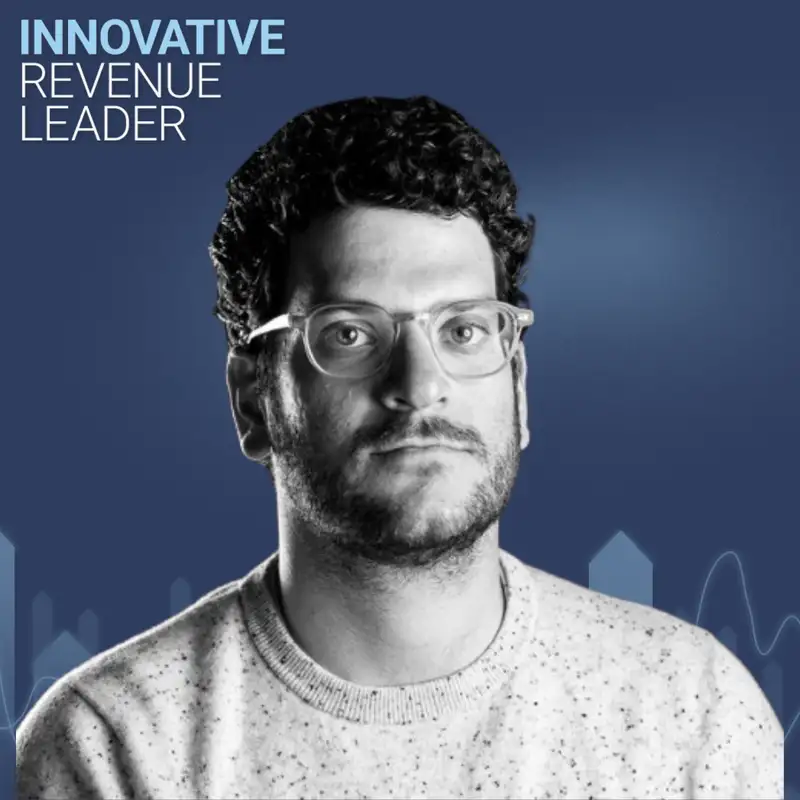
IRL - Jamie Sacks
===
[00:00:00] Welcome to the Innovative Revenue Leader Podcast. I'm your host, Seth Mars. Join me as we deliver practical insights to help B2B CROs Find new and innovative ways to grow in this fast changing environment. The Innovative Revenue Leader is sponsored by Sandler, a triad company, empowering sales professionals and leaders to master the craft of selling at all levels.
jamie-sacks_1_05-04-2026_160937: one of the best things about doing this podcast is getting practitioners on that are doing really, really cool, cool things. So the, the person I'm speaking with today is a sales strategy leader, commercial operator, and a forecasting expert. He has an impressive background in commercial strategy, business development, and analytics across Oracle, PlaceIQ, and Rocket Fuel.
He's built... He, he has built experience driving cro-cross-functional projects spanning product marketing, BI, and customer teams. His current position is head of strategy and operations at LiveRamp. Jamie [00:01:00] Sachs, welcome on.
jamie-sacks_1_05-04-2026_160936: Thanks so much, Seth. It's a pleasure to be here. And, and as I was saying before, I could not be more excited to chat, uh, nerd out about, uh, forecasting and everything that we've done over the past
year.
jamie-sacks_1_05-04-2026_160937: Yeah, I mean, we've talked in the past, so I'm, I'm looking forward to it because you're doing some very, very cool stuff. So let's just start out, like, what's the most innovative thing that you've seen right now in B2B?
jamie-sacks_1_05-04-2026_160936: Um, the most innovative thing that I've seen is the democratization of AI, and particularly around sales signal. So, um, a- as many of you probably know, everybody's trying to figure out the secret sauce as
jamie-sacks_1_05-04-2026_160937: Wow. So you,
jamie-sacks_1_05-04-2026_160936: to get all the signals you need from your sales stack to synthesize it in a way that every morning you wake up and you look at a cockpit to understand what needs to be done, what's not being done, and you get it from every single point of your sales stack.
Um, and I've been seeing really, really innovative stuff, especially around, um, the creation of AI-driven or Claude, and this is not a plug for Anthropic, um, uh, using Claude code, um, to synthesize all the signals from your sales stack, whether it's a conversation from Gong, um, all [00:02:00] the signals in Salesforce, uh, and Outreach to build a cockpit for
jamie-sacks_1_05-04-2026_160937: stuff in. What made you go there? Like in, in Claude, are, are you using
jamie-sacks_1_05-04-2026_160936: go
jamie-sacks_1_05-04-2026_160937: the
jamie-sacks_1_05-04-2026_160936: next.
jamie-sacks_1_05-04-2026_160937: the
jamie-sacks_1_05-04-2026_160936: we are, we are starting to use these. Um, uh, and, and we're sort of... I will say that we're in our infancy. Uh, we're a very data privacy and compliant company, so it's taking quite a bit of time for us to get, uh, the buy-in we need from our wonderful data ethics,
jamie-sacks_1_05-04-2026_160937: Wow.
jamie-sacks_1_05-04-2026_160936: partners to make sure that we have safe access to all of our stage data.
But ultimately, this was a push from Vihan, our CRO. He, he is one of the most analytically driven sales leaders that I've ever met. Um, and, and he, he wants to be able to touch as many deals as humanly possible, but we do somewhere in the neighborhood of 500 transactions a quarter. Um, and those transactions, it's impossible to touch every one of them.
So the need to synthesize them into what you really [00:03:00] care about, um, has been his, uh, his marching orders to, to me and to the team
jamie-sacks_1_05-04-2026_160937: So, like what made you go... So Outrage, you, you talked about Glo- Gong, some of the other providers are all saying that you can do that synthesis in their tools, but it, it Always kind of a little bit hard to do. Like, what led you to, to Claude, and how, how has that been? Has it been-- Was it fairly straightforward to do?
jamie-sacks_1_05-04-2026_160936: I, I will say that we're on the real, like, like I said, we're on the beginning of our jour-journey, but it hasn't been hard. What I've noticed is that, um, I've had brilliant analysts on my team for a very long time, but since we
jamie-sacks_1_05-04-2026_160937: [00:04:00] Yeah, with data.
it seems like these things work because you take one of-- Like the experts, if you have a really strong team that, that are, that are experts on generating, identifying, and analyzing insights, and you put a tool like that in front of them, yeah, they're not coding experts, but they're experts at understanding what to look for.
So these, like, is it, is it like they just iterate on it? I, I know what, I know what good looks like. I ask a question, I ask another question, you're building this out, and it ends up with a result that you can put in front of your CRO.
jamie-sacks_1_05-04-2026_160936: Uh, 100%. And, and I, I've been, uh, particularly impressed with some of, um, my, like, direct
reports who
don't have [00:05:00] any SQL, uh, history, um, being able to generate on-demand insights on really hard questions, um, and SQL queries just, just easily. And, and these are complex problems we're trying to solve. Um, we do a lot of amazing.
proud of how fast people have been picking it up. And I realize I didn't answer your question. Um- I have the philosophy of, that we need to be meeting our customers in one place, and I think the reason why we're trying to build an overarching layer on top of all of our tools is we find that people, especially sales leaders and salespeople, will go to 10 [00:06:00] different touchpoints on any given day, whether it's an outreach, whether it's Salesforce, whether it's Slack to get their insights. they're touching too many places, and it's taking away from their selling time. It's taking away from them being in front of the customer. And while you can do some stuff in Gong you might be able to do some stuff in Salesforce, we wanna create an environment, and that's my goal for our new fiscal year, is to create an environment for our sales leaders to get all of their insights based on how we view the world rather than how a gong will say, "This is what matters."
While they're incredibly good at synthesizing signals, I believe that we have that domain expertise and that subject matter expertise to say, "This is what good looks like," and to create a system that has an overarching infrastructure that allows them to work within our framework
jamie-sacks_1_05-04-2026_160937: Now, one thing I've, I've heard, I'm really interested in your opinion on this, is like, it, it used to be kind of dashboard hell, right? Like, you'd make a dashboard. Everyone's asking you to make a dashboard. Seems like what you're doing with Claude and how you're bringing all this data together is more impactful because [00:07:00] as a-- A lot of the dashboards you're asked to create are ad hoc one-off things that you need, not necessarily something you need to waste time creating something that is static and there forever or for as long as you keep it.
Seems now what, what you're providing is the ability to ask questions, so which it seems more tangible to sellers and to sales leaders. If I have a question, I go to this place, and I can ask it and get my answer, and that question could be different every single time, and it-- but it's also, it's allowing me to ask that data set and get it without having to worry about asking you or anyone else.
You've built that infrastructure. Are you seeing that change where less dashboards, more putting in a place to ask questions and get answers right at your fingertips?
jamie-sacks_1_05-04-2026_160936: Uh, yeah, we're starting to see that. I would say that we suffer from this dashboard fatigue where, you know, I've, I've been at LiveRamp for six and a half years, and I can't even tell you how many Tableau dashboards we've built that nobody will use. It's like impertinence. Um, it, you know, it may... At a point in time, it [00:08:00] was really important to us to get a signal, whether it's around activity or prospect intent.
But at the end of the day, we, we don't really know how people are gonna wanna interface and what questions they're gonna wanna answer. There's some that are
durable, Right? Like, what are my-- who are my accounts? Which ones are, um, showing high sense, raising their hand, um, going to our website? Sure. Those are the type of things that we can feed directly in our systems.
But the type of questions we see our, our sellers asking right now is, "Where's my opportunity?" Like, "How do I better research?" What are, like-- And we wanna give them the tools we need, they need to answer those questions without saying, "Here's this really rigid dashboard that only does two things and not all
that well." And, and I'll be honest, we've built a lot of dashboards that are crummy.
jamie-sacks_1_05-04-2026_160937: or they're for the moment, and the moment changes, or they can't be flexible. So it sounds like what you're building now is just very-- will be very dynamic.
jamie-sacks_1_05-04-2026_160936: Yeah. That, that's the hope and, and obviously, like my eyes are very big. Um, and, and we'll see if my mouth is ready for it. But I, I will tell you that I've never [00:09:00] seen, um, a team and my team rally around, like really solving a problem. And I think oftentimes revenue ops teams and sales operations teams will do what they think, think is best, but it will end up creating more friction in the way people do their jobs.
And ultimately, I wake up every morning saying, "How do we better serve our customers?" And our, my customer is our CRO. My customer is the CEO, and the, and more importantly, our sellers who need to be out in the field and selling and not pressing buttons, going through dashboards, but asking natural language questions.
And I think that should be the shining light for everybody that's doing this job. They should be thinking of: How do I make salespeople's jobs easier? How do I make sales leaders' jobs easier? And how do we have a bias for action? Which I think is, I, I would say one of the bigger challenges we, we start to see with AI is not a lot of it has a bias for action.
You say, sure, you can ask it a question, but what we're focused on is like, where, where are you gonna act? Where should you act? And how do we curate an experience that'll say, "This is how you act based on everything we know and [00:10:00] see in our data."
jamie-sacks_1_05-04-2026_160937: Yeah. Yeah. Yeah. Yeah, that's, that's awesome. And I think it's a perfect lead-in to talk about forecasting, right? Because forecasting can, in a lot of cases, be reporting the news, and I think you guys have done a lot to be able to turn it into a, a bias for action. So tell me a little bit about your philosophy around forecasting and how, and how you ensure it's as accurate as possible.
You do not have a simple forecasting process. Like tell... How, how do
jamie-sacks_1_05-04-2026_160936: Yeah.
jamie-sacks_1_05-04-2026_160937: How do you manage it?
jamie-sacks_1_05-04-2026_160936: Yeah. The, so, uh, just to give a little context, about a year and a half ago, we upended everything. Um, we decided that, you know, our, we were not doing right by our leaders. You know, we, we suffered. We were, uh, over 15% forecast accuracy, which is unacceptable for, for a publicly traded company that has fiduciary responsibility to our shareholders, um, and to, and to our leaders.
Um, and, and the reason was, is we weren't, we weren't viewing it from two lenses. We were viewing it from one lens. It's like, how do we deliver on our target? But the most, single most important thing in [00:11:00] forecasting is not on your target, and anyone who hears this from LiveRamp, that is incredibly important to me.
We want to deliver on our target, but it's to be accountable to a
jamie-sacks_1_05-04-2026_160937: Yeah.
jamie-sacks_1_05-04-2026_160936: And we found that everything that we had built, and we had built all of this process in Clari, was just to report the news. It wasn't to synthesize signals, to figure out where deals are, to understand risk, and to apply it to a sales methodology. Um, it was just checking the boxes so everybody could see what was going to happen. And even then, we weren't that close to what actually happened. So, uh, we went on a bit of a journey, um, one where we really said, okay, in mind how we really want to simplify people's lives and also balance like what our responsibilities are as revenue ops leaders, which is making sure that we can stand behind our forecast.
This is really, and I, I'd like be happy to report last couple quarters we're, uh, around 5% accuracy, which is, to me, pretty incredible based on where we came from.
jamie-sacks_1_05-04-2026_160937: Well, it's phenomenal too because you have lumpy sales. Like [00:12:00] the, the-- it's, it's not like you're doing ten thousand transactions and, and it's flowing through. I mean, there's big, small, and everything in between. That's phenomenal. What, what do you think's had the biggest impact on making that happen?
jamie-sacks_1_05-04-2026_160936: So there are two things. So tools for sure. So we really leaned into Gong. Um, uh, and I'm excited to talk a little bit more about what we did, but, but we, we had the hypothesis that the more we knew and the more we could understand about what customers were saying and what was going on in the sales cycle, the better we can inform our forecasting process as leaders. Uh, we'd be able to hey, these are the things we need to know that's going on so we could actually push. So a big part about hitting your forecast is all, is for leaders to know areas where people need
jamie-sacks_1_05-04-2026_160937: Yeah.
jamie-sacks_1_05-04-2026_160936: And we weren't getting that. So our focus on that, that transformation, the migration to Gong allowed us to b- be more hands-on in deals where risks occur, risks where you don't have the buyer power, risks where people were ghosting, and, um, focusing [00:13:00] really on the areas where we can control, um, outcomes.
It was super helpful for us. Um, and then finally is, is simplifying the process and the definitions. And a lot of people want to throw as much definition and science at a forecasting process, but they also have to understand that it's really the rep's job to do one thing, and that's close
business, And that the amount of information you need from them should be a- as limited as possible so they could go out and sell those seven-figure deals rather than just enter in opportunity notes and tick something, um, uh, from a forecasting box.
so w- in the past, we asked our sellers to forecast weekly, like ab- with definitions and stages. Right now, we're only asking our sellers to say whether or not this is in forecast or out of forecast and to manage their close dates and update opportunities. And I think that has really helped our leaders take it to the next level in terms of being accountable to their number and t- and keeping sellers out selling, which is really what we should all be doing here.
jamie-sacks_1_05-04-2026_160937: This is not [00:14:00] overcomplicating things. You have basic foundational processes and yeah, I need you to report on that. But it also sounds like I, I just wanna double-click on this, that what, what you appear to have found is I don't need as much from you if I can incorporate your conversations, 'cause I can get the rich niche thing context both from a forecasting perspective and from a selling perspective without having to overcomplicate things.
So if I keep it simple and do that
jamie-sacks_1_05-04-2026_160936: 100%. And the, and the, the beauty of data when it comes to the forecasting process is as long as you have the same people and the same leaders by and large in seat, you're gonna have amazing amount of consistency in the way people do things. So looking at their historical close rates, historical conversion rates based on day in the quarter, we can use all this data to better inform what we need to say to our C-suite and to say to our leaders, and then manage deals rather than a forecast.
And y- a, a lot of times leaders wanna say, "It's unacceptable to do your forecast. Of course it's, uh, to do your number." It's, of course, it's unacceptable to do your [00:15:00] number, but that's not what forecasting is about. Forecasting is about being accountable to what you forecast. And the bifurcation of that has also really led to, I would say, from the C-suite down, uh, of course, we would remediate if you don't hit, uh, hit your target.
But, but hitting your forecast is, is your word is as good as gold, and that focus on that has taken a little bit of the pressure off the process to come in every week to our big Thursday call and say, "Hey, I'm doing my number." It's less about doing your number and more about doing what you say you're gonna do, and I think that phase shift and the philosophy shift is really painful at times for really talented, uh, CROs and sales leaders. But it's super important to get the signals you need because there is data. and then, and anyone who's listening out there, like that data is really what's gonna inform you about what you're going Like, it's up to us as leaders to manage our business and manage our deal cycles rather than overcomplicate the process.
jamie-sacks_1_05-04-2026_160937: Yeah, Yeah, I mean, if I read that right, I mean, to a certain extent what you're saying is sellers, I just [00:16:00] need you to go effectively execute the deal and make it visible, and then the rest, the forecasting stuff will take care of itself if you do the best job of, of being on to- like, on top of your deals, working to close them.
All the other stuff kind of takes care of itself if you do that right.
jamie-sacks_1_05-04-2026_160936: 100%. And put, put the burden on sales leaders. And at the end of the day, um, whether it's first-line managers or second-line managers, it's their job to manage towards a number. Your job as a seller is to manage a deal. And, uh, the s- the sooner, um, we in it, like deep in that, and it took a really long time from a change management perspective to get our leaders there.
The sooner we were there, that sellers don't need to enter, that what they need to do is sell, the better off we were. And I mean, uh, especially from a forecasting accuracy standpoint.
jamie-sacks_1_05-04-2026_160937: y- before you had... So you talked about your switch from Clari to Gong, but you had Clari and Gong at one point, and then you decided to move away from Clari and go Cl- go to Gong for both conversation intelligence [00:17:00] and forecasting. Can you just talk a, a, a little bit more why you need... 'Cause technically, couldn't you just integrate Gong into Clari and get what you want?
Like, how did that... Like, what made that change?
jamie-sacks_1_05-04-2026_160936: And a shout-out to my salesperson because, of course, he did a really great job, and it wasn't about wining and dining, but it was about telling that value story to me about, like, why it works better altogether. But, uh, the reality was is even feeding the Gong data in there, there, there were competitive limitations on what you're able to do in Clari with that Gong data. That's because they have a competitive, uh, CI product. Um, and when I went and I evaluated it, I already had Gong installed. And if I really, truly philosophically believed that that data was gonna change the way we lead our forecasting process and the way we approach it as a mindset, I needed the access to all of the data as a part of one BI experience.
And that's really why I went there. I, I would also be lying, um, uh, if there weren't
economies of
scale as you
sort of Buy more and [00:18:00] more from Gong. Cost is always, uh, in the equation. Um, but actually found it to be really seamless process. Um, uh, so much so that I was like, I think it was like every couple of weeks while we were doing the transition, my, uh, AE over at Clari kept on saying, "Hey, how are you guys doing?"
Like, "Are you making it through fine?" And my response was like, "We're great." Like, it was one of the best decisions that I've made in the last year, and, uh, I would do it again anytime.
jamie-sacks_1_05-04-2026_160937: I mean, the rep was kind of expecting it to fail. Like, it sounded like he said, "I'm just waiting for this one to fail because it can't happen this way."
jamie-sacks_1_05-04-2026_160936: It, it happened, it happened that way, and it happened in 90 days, which th- this like, and I will take zero responsibility for that. Like, I have an incredible, uh, forecasting practice lead, um, who understands these tools inside and out and was able to replicate all of the key dashboarding, um, that we were doing in Clari, uh, into Gong.
Uh, and we basically did a cutover in the middle of our fiscal year, which everyone, um, [00:19:00] I mean, everyone was just like, "Are you sure you want to do this?" And I was like, "Absolutely." I had enough faith in where we were at to do a cutover, and I think we cut over in Q2 of our H- the, the word from everybody is it's like open heart surgery to move away from Clari. So did you say y- so you did it in ninety days?
Yeah, we signed in August and, um, on 1st, we, we-- It was like, maybe it was even less than 90 days. Uh, October 1st we cut over
jamie-sacks_1_05-04-2026_160937: So why, why do you think you were able to do it so quickly? Is it that it's just really not that hard? You found a, a, a way to do it that made it work for you? I mean, h-how did you pull that off?
jamie-sacks_1_05-04-2026_160936: Well, um, I have a tremendous team that understands the tools. That's one thing. Being able to replicate the same sort of feeling and access to insights is the single most thing that, uh, the single most important thing you can do to make the sales team comfortable with the change. I knew that going in. I said, "If you [00:20:00] can't replicate these views, then it-- we're gonna, we're going to be, we're gonna fail on the onset." But one other thing that I really focused on before we launched this is redoing the forecasting process as a whole to, to focus on where Gong's strengths would be, um, and, and where like... And that story sort of flows through. Sure, I, I will tell you that when we went over, there were, there were limitations. Um, and I would say Gong is sort of narrowing that gap now. They just, uh, were in the beta for OLI, line item level data. So if you have a very complex product like LiveRamp does, you want to have the greatest insights, um, on the opportunity. They didn't have that. We're finally testing it. But, um, the re- the reality was it wasn't...
It w- it was slightly like open heart surgery, but it wasn't that painful because it aligned to the philosophy that we were all trying to do, which is better, more data. Uh, better data is better insights. And we, we found that the way that Gong works within itself, um, was just better for our business.
jamie-sacks_1_05-04-2026_160937: So, I [00:21:00] mean, one of the key things I think you pointed out is they were able to... Like, y- going back to keep it simple, you kind of, you, you reinvented the process, streamlined it. So you had a straightforward process how to do it. You knew that the insights on the conversations you valued more than the structure of how your forecast works.
And then you just said, "Hey, Gong, can you replicate the dashboards and stuff that I need, and in return I get access to all of that?" And because you did those steps, ninety days later, you're seamlessly moved over where it normally takes forever. Or, I mean, people are scared of actually even doing it.
jamie-sacks_1_05-04-2026_160936: Yeah. And, and change is scary, um, but we were in a position where we knew we had to change something because like I mentioned before, like, like worse than 15% forecast accuracy, that's a problem. And that's a problem that requires open heart surgery. And the question is, what is your tolerance for pain and change?
And, and the, the reality is mine is incredibly high. Um, and, and I knew that from [00:22:00] the onset, and I'm lucky enough to have a team that also has that same pain tolerance. If it's in pursuit of outcomes like we've seen, the pain is always worth it. Um, and my urge to people out there listening is try it. You know, try it and, and whether it's a...
Whether you wanna go to Gong or to Clari, y- just because you have everything there does- like there's a reason why you're evaluating other tools, trust your gut on it, um, and jump in, you know, I would say headfirst because it's
jamie-sacks_1_05-04-2026_160937: Yeah.
jamie-sacks_1_05-04-2026_160936: Of the best decisions I've ever
jamie-sacks_1_05-04-2026_160937: yeah. have just implemented usage-based pricing, right? H-how... Talk a little bit about how that's changed in the way that you're doing forecasting when it comes to, like, that type of pricing versus the, the typical pricing that you had before.
jamie-sacks_1_05-04-2026_160936: Yeah. And, and, and I would say that it has changed quite a bit in, um, our revenue forecasting. Um, and right now we're, we are addressing some of the gaps that we saw both across Clari and Gong in our ability to forecast revenue associated, [00:23:00] um, with a deal. From, from right now our, our token model, and for most people who probably don't know, um, we, we introduced a token
model.
It was about a year ago. Uh, it was a big change, From a SaaS or subscription, it really did forecast perspective, which is right now. So we sort of live and die by our SaaS forecast. Uh, for now, uh, that's all gonna change. It really wasn't that disruptive. We ju- what we saw was exactly what we thought we would see, which was, um, initial ACVs starting to decline because commits were lower, and that's just better for customers. Um, but, um, I would say that right now one big concern that I do have is h- how does this practice, um, endure, uh, as we see more and more of this? Because, um, the focus will be less and less on what your SaaS or subscription forecast is, and more and more on how revenue growth can be forecasted. And I will tell you, uh, I wish I could say we have it all solved right now, but it's one of these things where, uh, I'm really glad I have some great mathematicians on my team that can fill in some of the holes offline [00:24:00] because we, we don't really have, um, that built into to our Gong world.
We, we rely heavily on a, a lot of, uh, offline, uh, math, uh, and one stream that, uh, FP&A runs, um, to do a lot of our revenue forecasting.
jamie-sacks_1_05-04-2026_160937: Yeah. Yeah, 'cause you're gonna be moving from, "Hey, where do you think this deal is gonna land?" to, "How much do I think my customer is going to use that?" And those are two completely different ways of forecasting.
jamie-sacks_1_05-04-2026_160936: Yep. And, and the-- we are lucky in that the model that we've introduced, I would say, is a consumption model, but is a, the most consumption-like, subscription model to ever exist. Uh, which is, you know, um, which, which is good for our business, especially being a SaaS business. You wanna have that predictability of revenue, but you also wanna reduce that friction on the onset.
And I think where we'll be very successful in forecasting is when people come in and they know what they're gonna use, it's gonna be easier for us to forecast, uh, rather than people coming in that haven't done use cases with us before, um, which is what we're really excited
about, Is just seeing [00:25:00] that growth.
And, and I honestly, I, I consider that to be a little bit of a gap, and we're sort of wait and see mode. Uh, and I, and I'm hoping that we'll wait and see that, you know, we have what we need to do it. But, you know, if you were to ask me what I'm concerned about in the next year, it's how does, how does that change change the way me and my team
work?
jamie-sacks_1_05-04-2026_160937: Yeah. Yeah, yeah. It's legitimate. I mean, you guys will figure it out, but I mean, I think that's where a l-large portion of the market is right now. All these things are happening almost to you. There isn't the-- Like, if you've been in the SaaS world for forever, there's a playbook for SaaS companies.
Everyone, everyone in SaaS does it the exact same way. That's all getting blown up with this stuff. Yeah.
jamie-sacks_1_05-04-2026_160936: Well, yeah, we, we definitely see that as, as we try to, like, really open up to the, the mid-market and make it easier to work with LiveRamp. We're going to be forced to out of our comfort zone when it comes to forecasting to, to onboard new clients that haven't typically been our bread and butter.
Like, we're really, really good at the Fortune
500. Um, w- what we [00:26:00] wanna be great at is the Fortune 1500, and I think we have the, the products and the tools. It's, uh, gonna be an uncomfortable transition as we figure out how this process applies to all the great things I know this team's going to deliver in the next
jamie-sacks_1_05-04-2026_160937: Cool. So let's, let's switch and talk a little bit about you. So when, when you were growing up, did, uh, like becoming an expert in strategy for business and forecasting, was that kind of what you, what you dreamed of?
jamie-sacks_1_05-04-2026_160936: No, and, and I think very few people, if that's their dream. I will say that is my dream job now. But when I was growing up, I actually wanted to be the CEO of Mercedes-Benz, and if, if anyone at Mercedes-Benz is listening right here, like, I'm still open to that role. Sorry, LiveRamp, but if, but if you're hiring, I, I'd be, I'd be happy to move
overseas.
jamie-sacks_1_05-04-2026_160937: Okay. So tell me why Mercedes-Benz? Why CEO of Mercedes-Benz? I, I get the CEO part, but Mercedes-Benz, there's a story there.
jamie-sacks_1_05-04-2026_160936: There, there-- Yeah, it's like I've always just loved Mercedes. Um, I don't drive a Mercedes, I'll tell you that. I am more practical than that. I, I've owned a few in my day, and I don't really like, I don't really [00:27:00] like what happens to some of these cars after 50,000 miles. Um, but I was just always awed by their quality and, and their beauty and, um, to, you know, be leading a company that is, that is founded on such, such historical reliability and, um, just great vehicles.
It's, you know... I, I actually remember some holiday, I must have been seven years old, and they asked me, they said, "What do you want to be when I grow up?" And deadpan, in front of 30 people, that's exactly what I said. And, you know, m-maybe that's still a dream. It's seeming, uh, more and more unlikely as every year passes, so.
jamie-sacks_1_05-04-2026_160937: I mean, to a certain extent, I mean, Mercedes is all about like precision and excellence, right? Like, I think you're kind of translating that into the forecasting side of things, the precision piece, like being able to do that. I mean, not the same. I mean, if they call, I, I think, yeah, it...
jamie-sacks_1_05-04-2026_160936: They call, I'm Call. I will tell
you.
jamie-sacks_1_05-04-2026_160937: So go back a little bit. Uh, go back to when you graduated college. If you could go back there right now and give yourself one piece of advice, what do you... what, what would that be?
jamie-sacks_1_05-04-2026_160936: I would say that [00:28:00] embrace the numbers earlier. So when I broke in, um, I did a little bit of analytics, account management, then I spent a lot of time in sales. Um, but I always had a knack, and I loved the numbers. I just didn't know how that would, uh, convert to a happy, long career. But I would've gone back to myself, and I would say, "Take that extra math course.
Even though you just graduated college, get that foundation you need to understand how numbers rule business." And I think that a lot of people say that, but very few people who majored in history would have ever thought like that. And I did major in history. I went to a liberal arts school. So, um, uh, I would have told myself, "Brijesh, uh, spend some time learning SQL." Um, now that matters a lot less than it would have for the past 10 years of my career, um, with the advent of, like, all these great tools that allow you to code without really any experience. But I would tell myself to lean in and, and really believe that, you know, analytics can change the way people do business.
'Cause we've certainly seen that here, and I've seen that in my career. And I think we're at an inflection point where AI's really-- the democratization of AI is really gonna make [00:29:00] people powerful that weren't technical in the
past.
jamie-sacks_1_05-04-2026_160937: Yeah. So the, the analytical nature is gonna al-- is more important than your ability to code or your ability to, to master those things.
jamie-sacks_1_05-04-2026_160936: Yeah. The, the, the... I would say the want to or the need to solve problems is ne- it's never been more of a boon for productivity or success now that you have all of these tools that translate, I would say, fervor for outcomes i-into action. Um, and that's what I'm excited about. It's like, uh, you know, it sounds corny, but it's really a wonderful time to be alive in a lot of senses because, um, there's a lot of stuff that we couldn't
jamie-sacks_1_05-04-2026_160937: Yeah.
jamie-sacks_1_05-04-2026_160936: a couple years ago that we can do, and, and I think that's a really
beautiful thing
jamie-sacks_1_05-04-2026_160937: Yeah, it's phenomenal. So tell me a little bit more about LiveRamp. What's... What does LiveRamp do? Uh, yeah, just a, a little bit more about, about the company you work for.
jamie-sacks_1_05-04-2026_160936: Um, LiveRamp's a data collaboration company. Um, so we really, um, our number one goal is making sure that marketers and [00:30:00] platforms can move data effortlessly in between each other. Um, uh, we're really focused on making sure that, um, we can move data, measure outcomes, and make marketing and advertising easier with better first, second-party, and third-party insights.
We're the only, uh, company that allows you to excel- excellently market with your data across first, second, and third-party
sources.
jamie-sacks_1_05-04-2026_160937: Fantastic. So if people wanna talk to, to you and learn more about some of the stuff that you're doing, how, how do they get in touch with you?
jamie-sacks_1_05-04-2026_160936: Feel free to, uh, LinkedIn request me or just send me an email, jamie.sacks@liveramp.com. I'm always happy to talk to people in the industry or not in the industry, um, about their, about their sales stack, about how we've done great things with some limited resources and, and my vision about what the future holds, uh, for RevOps and RevOps leaders, because it's something I'm very, very passionate about.
jamie-sacks_1_05-04-2026_160937: Jamie, thank, thank you so much for coming on. It's always great to talk to you. You're always doing such cool stuff over [00:31:00] there, so thanks for joining and sharing a little bit with this audience.
jamie-sacks_1_05-04-2026_160936: It's my pleasure, Seth. Thanks so much for having me
And that wraps up another episode. Thank you for joining. For show notes and other episodes, visit us@innovativerevenueleader.ai. The Innovative Revenue Leader is sponsored by Sandler, a Trilia company. Sandler provides top corporate sales and business development training while empowering sales professionals and leaders to master the graph of selling at all levels.