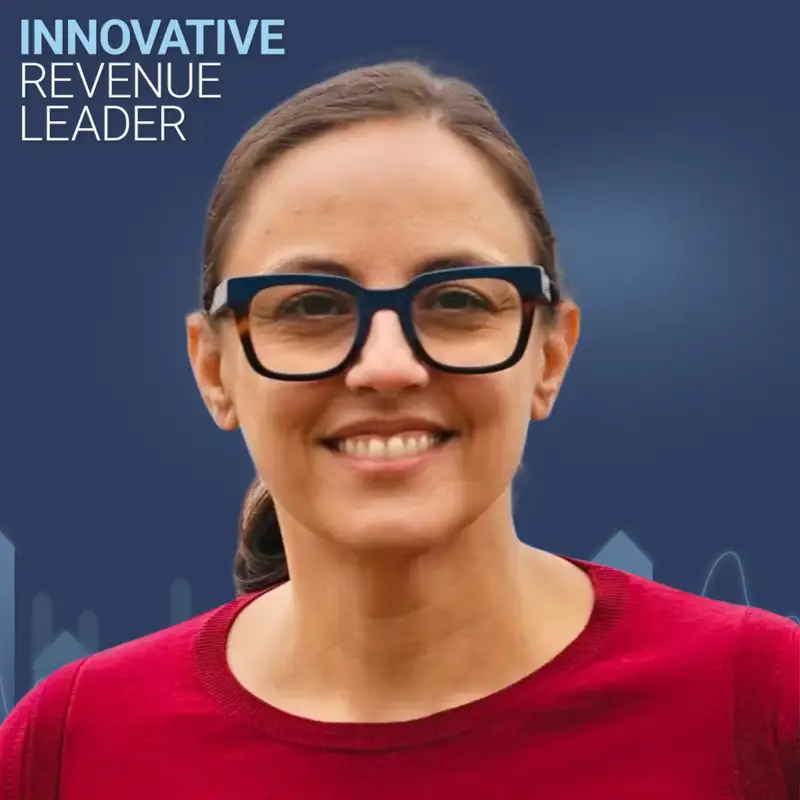
IRL - Dina Vaccari
===
Speaker 2: [00:00:00] Welcome to the Innovative Revenue Leader Podcast. I'm your host, Seth Mars. Join me as we deliver practical insights to help B2B CROs Find new and innovative ways to grow in this fast changing environment. The Innovative Revenue Leader is sponsored by Sandler, a triad company, empowering sales professionals and leaders to master the craft of selling at all levels.
seth-marrs_28_09-22-2026_131051: Hello everyone. Welcome back. Today's guest is someone that I've worked with and, and, and worked around for six plus years. She's an AI first product leader, has worked at Outreach, Amazon, Microsoft. Basically, if there's a sharp company around sales tech or technology in general in Seattle, she, she's played a key role in their success.
She spent six years at Amazon building three commerce stores from scratch and developing a product setup process that enabled creation of over 100,000 product pages per month, 500% increase that was [00:01:00] adopted across all of Amazon retail. She spent four years at Microsoft leading product for Azure Marketplace before she moved into AI-driven sales technology at Outreach, where she grew weekly active users from 10,000 to 60,000, uh, and had monthly retention of 15...
From month, from 15% to 60%. Uh, that's where her and I met for, for the first time to talk about these types of things in sales tech. She's now head of product at, at, for Revenue Accelerator at Zoom. Dina, great to have you on. So you're here.
Speaker 2: you're here. Great to see you, S- thank, thank you so much for having me.
seth-marrs_28_09-22-2026_131051: Yeah, this should be a fun conversation. There's, and I know there's a lot of interest in this because you guys are doing some really cool stuff at Zoom.
I'm just gonna start out with kind of s- with the standard question that I, that I ask everybody on the show. What's the most innovative thing you're seeing in B2B right now? If you're a CRO looking at this, like, what, what's, what's the thing?
Speaker 2: Yeah, that's a great question. So for me, I think the most interesting thing right [00:02:00] now is seeing how, uh, these tools and systems are moving to systems that learn and act on the learnings. Um, so I've been in this space a very long time, and the way I like to talk about how this space used to be is, you know, a lot of these tools gave you a dashboard that someone had to go and become a detective to figure out what was working and what's not and what to change, and then to change it, it was like a miracle.
Uh, and, and now all of this context, um, around what's happening, all of the context around your business and the things that are fixed, like your goals, um, and, uh, and you know, how you run your shop, all of that is now codified in a system. It can be codified in a system, a system that learns what's working, what's not, what to change, and then it can change it for you.
So I'm super excited about that just as a concept. [00:03:00] It's what we've been building at Zoom. Um, and, and so we, we are very lucky in the sense that, um, we've started from first principles with building out the Zoom Revenue OS and said, "What do revenue leaders really care about?" Well, they care about hitting their goals, and they need to know what's working and what's not and what to change.
And so building a system around that principle, um, is what we're really convicted about.
Speaker: Interesting.
seth-marrs_28_09-22-2026_131051: Interesting. Yeah, I
Speaker: a
seth-marrs_28_09-22-2026_131051: system that learns, I mean,
Speaker: it's
seth-marrs_28_09-22-2026_131051: a... Conceptually, it's kinda hard to think about, but you're, the, in reality
Speaker: it's
seth-marrs_28_09-22-2026_131051: playing out, right? Ask a que- a super simple thing that most people have done. Ask a question, then you ask the next question, and the con- context from the first question is being used to help answer that question.
You guys have taken that
Speaker: and
seth-marrs_28_09-22-2026_131051: now
Speaker: you
seth-marrs_28_09-22-2026_131051: create that learning experience based on
Speaker: all
seth-marrs_28_09-22-2026_131051: of a company's sales organization, what they need to do, what success looks like. That's the, that's the goal
Speaker 2: like. That's the, that's the goal. Yeah. Yeah, absolutely. I mean, and we've already done it, Seth, in different parts of the [00:04:00] buyer journey. So where our DNA really kind of started with Zoom Revenue Accelerator is with coaching and conversational intelligence. Yeah. And so we've really focused on a learning loop around coaching first and foremost, um, and have launched things like AI role play to practice before the call, uh, live assist to, to get help in real time during the call.
So you have these digital teammates helping you before and during, and then after, you get the coaching after. Um, and we look across everything that's working in real conversations to see what's working, what's not, what to change. Again, like, I keep repeating that 'cause it's just what I've heard for years and years and years, but it's the DNA of the product.
And so with the coaching loop, we built this virtuous cycle around that whole experience and kind of like a micro loop. But as we build out the system, um, you know, we just acquired a company called Common Room. So Common Room focuses on buyer intelligence on all the context that isn't in Zoom [00:05:00] already.
Um, and that is another learning loop that we've built, which Common Room can identify the signals and the buyers that are in market and create something called a segment around those things. Mm-hmm. Then you can put those segments into workflows and sequences and get clear understanding of what's working and what's not, and what's creating pipeline and what's not.
And then who to prospect more of, um- Yeah ... into that top of that, that part of the loop. So we've been focused on building these micro loops for a while now, and now we're orienting the system ar- really around the whole buyer life cycle.
seth-marrs_28_09-22-2026_131051: So little loops that are turning into a big loop as, as you refine them and connect
Speaker: together.
Speaker 2: Yeah. And, and I think it's interesting because the, the smaller micro loops get you clear answers for a discrete part of what you're trying to do. Yeah. But think about this example. So, uh, I, I talked about the pipeline creation example.
Speaker: Yeah.
Speaker 2: We might be a- l- in the micro loop, we'll be able to tell you, "Okay, here's what's booking the most meetings."
But what we're working on solving now [00:06:00] is, like, do those meetings convert? And if they do, are they healthy customers? Do they retain? Do they grow? Um, that's really what you want at the top of that, um- Yeah ... journey. Um, so, you know, getting the meetings gets you there, and, and converting it to pipeline gets you there, that outcome, but it's really about this holistic outcome that really gets you, um, surgical on, like, what you can do in targeting the right ICP at, with the right message at the right time, you know, and, and s- and multi-threading the right stakeholders to move the thing forward, get the revenue, and have it stick and grow.
seth-marrs_28_09-22-2026_131051: Yeah, that's phenomenal. 'Cause I
Speaker: that's
seth-marrs_28_09-22-2026_131051: what you've been a- like what a lot of companies ask sellers to try to do, but it's been
Speaker: very
seth-marrs_28_09-22-2026_131051: hard to, to connect all. It's much easier to connect the data together and then using an engine like
Speaker: ZRA
seth-marrs_28_09-22-2026_131051: to be able to pull that out, and then the seller can focus on those different areas and guiding towards it, and they'll know an insight
Speaker: that,
seth-marrs_28_09-22-2026_131051: "Hey, yeah, you may be going after this customer, but this customer is [00:07:00] likely to not convert.
Why don't you spend time with this?"
Speaker: Phenomenal.
Speaker 2: Yeah. It all goes back to what's working, what's not, what do I change? Actually, like a, a customer told me that years ago, and it stayed with me, but in the last 12 months, I would say, like, it's just become what I wake up and think about.
Um- ... because the problem hasn't changed, Seth. Like it's how- Yeah ... we can solve the problem in a way better way, uh, that has fundamentally changed and gets me- Yeah ... most excited.
seth-marrs_28_09-22-2026_131051: Yeah. So true. So true.
Speaker: okay,
seth-marrs_28_09-22-2026_131051: so I gotta ask the obvious question here. Like Zoom, it's a communication platform. It's been around, very well-known, everybody knows what it is. How does Z- how does Zoom Revenue Accelerator, I call it ZRA bec- I, but like Zoom Revenue
Speaker: Yeah,
seth-marrs_28_09-22-2026_131051: Accelerator, how does it, how does it fit into the portfolio that is Zoom?
Speaker: Zoom?
Speaker 2: Yeah. So, like, just for some context, I'll tell you why I came to Zoom first. So, [00:08:00] um, back when I was... You know, I'm an old, I'm an old rev tech lady, uh, but a few years ago, what I started to realize was the majority of tools in the revenue orchestration space are really not a tool unless you have the truth of the customer conversations that are happening.
And so I really started to get convicted about this idea of the system of record for customer conversations being just foundational, um, to anything that I would ever build. Um, and so when I connected with the folks at Zoom, I was immediately excited because they had the customer conversation, which I think now the way we talk about this, the richest context.
So they're the owner of the richest layer of context in this story. So that's one of the reasons why I, I came to Zoom. Now, if you think about Zoom, Zoom owns the seller workflow. Very few tools- Yeah ... can say that they own the seller workflow. Zoom has phone, [00:09:00] Zoom has meetings, um, and, and contact center are really, like, a, a massive part of the business.
Um, and contact center is more and more increasingly revenue use cases.
Speaker: Yeah.
Speaker 2: So, so we're already owning the seller workflow, and what Zoom is transforming into is not just a place where you have the conversation, but it's where you complete the work from that conversation. So we say something called conversation to completion.
So that's more broadly kind of Zoom thinking about, um, AI prod- how AI can drive productivity, um, in work. And when you anchor that down to one of our largest customer bases, which is sellers and people talking to customers, um, it really starts to become a powerful opportunity to help them save time, drive more business impact, and, you know, really just grow their business.
So the sales persona, quote unquote, or the revenue persona, is a large strategic focus for Zoom to [00:10:00] extend this kind of conversation to completion, um, broader overarching strategy and really focus in and understand the problems of these users and solve them in a way that holistically helps them grow their business.
seth-marrs_28_09-22-2026_131051: So,
Speaker: like,
seth-marrs_28_09-22-2026_131051: I, like, as you were talking, the thing that came to mind to me is it's, it's
Speaker: it's,
seth-marrs_28_09-22-2026_131051: Zoom is almost transitioning from being a communications engine, but to being a context engine for every company where the majority of the work that gets done is done through day-to-day conversations with people, like sales, like cust- like customer success, like contact centers.
Is that a
Speaker: representation?
Speaker 2: I, I think that, I think that's a good way to describe it, but it's one piece of the story because I think there's the context layer and exposing the context layer for intelligence, and then there's the action that you can take on it. So, you know- Wow ... we are very heavily invested in, um, both the UI aspect of that, but also the headless [00:11:00] aspect of that.
So all of this context can be exposed via MCP, and you can work from the agent harness of your preference. We also have our own called ZoomMate, um, uh, which also has capabilities like agentic search and, uh, uh, personal workflows. Um, and that's all anchored around the ecosystem of the revenue OS we're building, which is really more that specific tailor-made system, uh, of learning and action for revenue teams.
Speaker: Uh,
seth-marrs_28_09-22-2026_131051: Okay. Now
Speaker: I
seth-marrs_28_09-22-2026_131051: think that's a good segue. You talked earlier about the acquisition of Common Room, right? And that one is kind
Speaker: outside
seth-marrs_28_09-22-2026_131051: of the normal course of Zoom, but very much at the center of how do you get good information that a seller can act on. Can you talk through the logic of that acquisition?
And then y- you talked a little bit about the action part of it
Speaker: in
seth-marrs_28_09-22-2026_131051: what we just talked about on the context side, but how does Common Room fit into the overall strategy of
Speaker: ZRA?
Speaker 2: Yeah, absolutely. [00:12:00] So as I mentioned, kind of ZRA started out as a conversational intelligence and coaching and deal intelligence tool.
And as we looked at expanding further up the funnel into pipeline generation and prospecting, um, and sales engagement, um, what we realized is this entire world is obviously transformed and it's gone from a volume-based, uh, automation play to I need to reach out to the right person at the right time with the right message- Yeah
that's personalized and, like, it better be good and, and I better be- Yeah ... hitting them across all channels, right? So, so- With that in mind, we wanted to approach building out our sales engagement, um, capability from an AI native perspective. And Common Room was already, uh-- Common Room really stood out to us as the one that was really focused on getting the richest buyer intelligence, um, in the world outside of what Zoom already had access to.
So things [00:13:00] like website visits or signals or communities, um, all of these things, along with enrichment, um, come with Common Room into the mix. And so when you take Common Room and, you know, we just launched Engagement, which is a sequencer, and, um, you know, you'll see more and more all of this good stuff come to market.
Um, but with Common Room, we're able to then say, yes, you can reach out to the right person at the right time with the right message, learn what's working, and feed that back in to the, um, to the whole loop. Exactly. And, um, Common Room has something also called Segments, which are ways that you can really, um, slice down your set of prospects into a discrete set of attributes that are very nuanced.
So let's say you have a set of-- you have a segment of someone who, of, of folks who are, um, CROs in the tech industry that have people at their company that have [00:14:00] visited your website, that have, you know, any number of signals. That kind of surgical aspect, I use the word surgical, but it lets you get super surgical on your ICP and really running plays to learn who those folks are that you should be reaching out to that convert the best.
So the marriage of the two has been really powerful. It's resonating in the market, um, and we really feel like we're bringing something super differentiated into the mix. The only other thing I will add is, um, it's not just a pipeline generation play, um, with their account, Account 360, People 360, highly relevant throughout the entire buyer life cycle.
So we're now able to ge-generate buying committees, get rich contact info and enrich those so people can be multi-threaded as they go through the deal cycle. Um, a lot of this helps us, uh, with the coaching aspect too, in terms of like profiling different kinds of buyers. So, uh, it really adds that secondary layer of context that we don't have as Zoom, um, [00:15:00] once the conversations start.
So, uh, yeah, it's, it's been pretty powerful.
seth-marrs_28_09-22-2026_131051: Yeah. I
Speaker: it,
seth-marrs_28_09-22-2026_131051: it... When you talk about it in that,
Speaker: in
seth-marrs_28_09-22-2026_131051: that way, the, the logic of this acquisition becomes very obvious, right?
Speaker: you
seth-marrs_28_09-22-2026_131051: have all of this context in the actual conversation, but you're dependent on a lot of other things to get the right context around what is an account, what is, like, all the other variables that go into understanding and making sure when you're in the conversation that it is relevant.
To your point earlier, it's not just a generic conversation, it's a targeted conversation. This gives you that, and now you drop that on the top of a really strong context engine around the conversations, and now you've got a, you've got a proper sales tool that can do really cool stuff, and actually some stuff
Speaker: others can't do.
Speaker 2: Yeah. I mean, that... And, and that was really critical for us as we made this acquisition. So, like, a big part of this was we wanted to bring on a team and a tech stack that had been solving [00:16:00] these problems from a different perspective from the beginning and weren't bolting on AI after the fact. Um, and so, you know, with Common Room comes this AI native DNA, um, in, in, in the product, in how they work and how they think about problem-solving.
Yeah. So it's been super, super valuable, uh, to have them join the team. Uh, we couldn't be luckier. They're all amazing. Um, and so yeah, it's been a lot of fun.
seth-marrs_28_09-22-2026_131051: It's,
Speaker: it's
seth-marrs_28_09-22-2026_131051: interesting, right?
Speaker: 'cause,
seth-marrs_28_09-22-2026_131051: uh, this, y- it's, it's somewhat for you, it's a little bit of repeat to a certain extent because you went through all of this
Speaker: at
seth-marrs_28_09-22-2026_131051: Outreach at a certain extent. Different type of technology, even a different conversation. No one even knew what context was back then.
So it's
Speaker: the
seth-marrs_28_09-22-2026_131051: same but different. It- as you went through the journey, uh, one thing that stood out, like the time with Outreach 2019 to 2024, you went from burn money to get customers and do whatever you can, to like no money and I've got to be super [00:17:00] efficient to be able to, to keep my business 'cause I'm not getting cash anymore.
And that had tangible impacts on the market. You watch this switch happen from whatever feature you want, we're gonna build
Speaker: build
seth-marrs_28_09-22-2026_131051: and build, to I'm gonna consolidate all of this stuff I've invested in and give you a unified product. And I think there are benefits to both of those things. Where the market is today in this new world, where would you put it?
Would you put it on that kind of Wild West early frontier, like we're figuring this stuff out? Are we maturing?
Speaker: Are
seth-marrs_28_09-22-2026_131051: we not to the c- like, where
Speaker: you kinda see it?
Speaker 2: Yeah.
Well, I mean, I think it w- it, it was Wild West before because money was like willy-nilly, and now it's Wild West for a way different reason.
You know? Um, and I think what we're experiencing these polarities now, um, around, uh, you know, on one hand there's a, a massive set of buyers who are like, "Just give me my dashboard, Dina." Yeah. And I'm [00:18:00] like, "Yeah- I, yeah ... I need to give you your dashboard. I'm happy to do it. Like, I get that." And then there's others that are like, "I need this thing to be fully headless, and, um, also you should never talk to me.
Like, a AI BDR should be selling me this." Um, and the journey from the first to the second I think is gonna be a little longer than I had originally been thinking. Oh, really? I do, yeah. I mean, because the market, the TAM here is massive. And so, like, everyone's journey towards this self-learning system is gonna be different.
And, and, and our whole thing is we wanna meet our buyers where they're at on that journey. Um, so we're not overly dogmatic, um, on any given thing. We have dashboards in our product. We understand people need them. I call them, you know, a security blanket. Um, and we'll get there to the point where you just ask AI, everyone just asks question, um, you know, out of their chat surface and never goes to a UI.
Um, but, uh, but yeah, I think it, it's been interesting [00:19:00] trying to manage the polarities of kind of the, um, I don't wanna call it AI mania, but, like, AI enthusiasm. Yeah. Right? And, um, and, and being able to capture the market with where it's at today, and also be building for the future of where we believe it's fundamentally going.
seth-marrs_28_09-22-2026_131051: Yeah. I mean, the, you kind
Speaker: said
seth-marrs_28_09-22-2026_131051: the quiet part out loud, Deena, right?
Speaker: everybody
seth-marrs_28_09-22-2026_131051: talks about AI speed, like the whole world. We're AGI and,
Speaker: the
seth-marrs_28_09-22-2026_131051: world's gonna be completely automated and all AI agents, like fast,
Speaker: fast,
seth-marrs_28_09-22-2026_131051: fast. I think you're right about the reality of it taking longer because
Speaker: when
seth-marrs_28_09-22-2026_131051: things are so different than they have been in the past, the human can't consume it quick enough.
The human is more cons- con-- Like a, a cadence, I get it. Like, load it up and run it, right? I can, I can see it and I can go. I, I, I think it's a really prescient point because everyone thinks this is gonna go incredibly fast, but I think it, I agree with you. It's gonna go way slower just because you actually need to consume it as a human into [00:20:00] your business and understand how
Speaker: use it.
Yeah. Use
Speaker 2: it effectively. Well, totally, and the other part of this, Seth, is, so I fundamentally believe the technology will get us there fast. Like, th- that's not the constraint here. Yeah. I believe the constraint is actually on the buyer side of this, the buyer's receptiveness to an AI calling them and be- You know, I don't want anybody, any AI bot calling me, asking me to buy something I don't need un- unless it's something- Yeah
I kinda want for myself. Yeah. You know? But, um, no, but like I always think of it from that lens too. Like if you think about problem solving from, uh, like in revenue tech from the perspective of people buying from you, it completely changes like what you would focus on. Um- Yeah ... because the buyer has to be receptive, and ultimately sellers are there to build relationships and help buyers.
Yeah. Like, that's what they're there for. So, um, we try and keep that angle to this as well. Um, and again, [00:21:00] like we are more excited than anybody about the idea of digital teammates, and it's getting incredibly tr- uh, incredible traction for things- Yeah ... like role play and sales assist. Um, but there's some use cases that I don't think buyers are ready for yet, and so we're probably not gonna focus on those, and we're gonna keep helping sellers and revenue teams figure out what's working, what's not, what to change.
seth-marrs_28_09-22-2026_131051: Yeah, that's smart. A smart way. Still, still about getting the
human to work the way that you
need to and helping them.
Speaker 2: Yeah.
seth-marrs_28_09-22-2026_131051: So every company has its different advantages. You have a distinct competitive advantage in that you work for arguably one of the best, like arguably the best communications company in, in the world, right?
Like, w- when you talk about web conferencing, there really isn't a better web conferencing platform. You've got soft phones, you've got... Basically, any way you need to communicate, you can communicate through Zoom.
Speaker: Can
seth-marrs_28_09-22-2026_131051: you explain to those who are looking at this, like how does, what advantages does a company that's basically kind
Speaker: a
seth-marrs_28_09-22-2026_131051: sales tech company in this communications company, we talked a little bit about the context, [00:22:00] but what other advantages do you get from having that support alongside you?
Speaker: I
seth-marrs_28_09-22-2026_131051: noticed that just
Speaker: b-
seth-marrs_28_09-22-2026_131051: b- before you jump- before,
Speaker: you
seth-marrs_28_09-22-2026_131051: answer, like I noticed it in how quickly when I evaluated ZRA for conversation intelligence, you were advanced very quickly. Like
Speaker: how does that work for you guys?
seth-marrs_28_09-22-2026_131051: for you guys?
Speaker 2: Well, I would say in general, so regardless of, you know, the communications DNA or already kind of having the seller and revenue team workflow being owned within these different surfaces of Zoom, um, you know, Zoom at its core is, uh, uh, it's a founder-led company, um, and Eric's DNA is to build and invent.
And, um, it's been a tremendous place that has, um, really invested in AI, um, to help solve these problems for our customers. So I think just having, uh, that conviction, um, from, uh, our CEO that AI [00:23:00] is critical and, and also, um, we have, we're in, really in a great position to solve these problems for our users has been huge.
So, um, so I think the priority and the investment just from a company perspective has been really, really valuable. I also think that to your point, you know, people like Zoom, you know. They log in, it's blue, it works. Like, you know, you have some good memories of having birthday parties on it in the pandemic.
I don't know. Like, there's just something about it that people connect with the brand and they like it. Um, and, uh, you know, we have this concept of like delivering happiness with Zoom. Um, and so I think given that we've also kind of won the seller heart and mind in many ways, and it gives us really access to those sellers that are already within our distribution base to learn from, um, and, and also sell our products into obviously.
Um- Yeah ... so within the Zoom distribution base, on any given day, if I wanna talk to a seller, sales manager, sales leader, CRO, [00:24:00] um, you know, we have a massive distribution base, um, and, and it's been really, really valuable in terms of helping us drive what we build and, and how we solve problems, um, and ul- ultimately grow the business.
seth-marrs_28_09-22-2026_131051: Yeah. So you've
Speaker: you've
seth-marrs_28_09-22-2026_131051: got an innovation
Speaker: opportunity
seth-marrs_28_09-22-2026_131051: with it, a proven, uh, in a space which by the way is like the, where the world's going is in unstructured data, and you've been living in the unstructured data world for forever. But the part that you brought up that I think is maybe less understood is access.
Like I have, you have access now at a level that is significantly bigger than a company that would be starting from scratch. You can call a CRO, you can call a head of IT
Speaker: IT and,
seth-marrs_28_09-22-2026_131051: and have a conversation around that. Great.
Great point.
Speaker: point.
seth-marrs_28_09-22-2026_131051: Okay, so I'm gonna, I'm gonna give the... You and I have had this conversation over the years, um,
Speaker: uh,
seth-marrs_28_09-22-2026_131051: around soft phone versus BYOD,
so you know- my
Speaker: Of course
my
seth-marrs_28_09-22-2026_131051: aversion to it around like I, I don't understand why companies Still do [00:25:00] BYOD with sales where the seller gives their personal number and thirty percent of them leave every year. You guys have a soft phone. I think your sales team is actually using a soft phone with it. And if you have it, you think about contacts and unstructured conversations, that allows for recording of those conversations Why is nobody doing it?
Speaker: Like,
seth-marrs_28_09-22-2026_131051: why do no enterprises, organizations... Some- there's gotta be a reason, but, like, what's your perspective ?
Speaker: perspective ?A- and, uh, you
Speaker 2: said it's safe. so, okay, so here's the thing. I'll push back and say there's a lot of companies that are doing it, and I'll tell you why. Yeah. So first of all, Zoom Phone is a massive part of the business.
Um, it's grown tremendously, and obviously for many reasons, like, a lot of the users of Phone are sellers. Um, and what we've done with the Revenue OS, um, is we've leveraged the mobile app, um, to capture in-person meetings, to capture SMS, um, and also phone [00:26:00] recordings on mobile. And so once we started bringing in more and more and more of this context layer, um, it really unlocked more business for us, but also then started helping drive our phone business.
Speaker: Yeah.
Speaker 2: Because... And so, like, when you talk about this is another shift, um, and I believe some of it is carrot-based and some of it is stick-based. So obviously, like, we need to add enough value that sellers are like, "I should use this phone instead of this one." Um- Mm-hmm ... so we have to help them and, and, and, you know, um, and also their managers and leaders.
Uh, but at the same time, I do think some of this is going to require companies to kind of mandate the adoption of this, and that's where we wanna give tremendous value to leadership to show them, "Here's what's working, what's not, and what to change," and you never would've known this if you didn't capture these in-person meetings or texts or whatever.
Um- Yeah ... so it, it's another one where I think we're going on the journey, uh, but what I'm seeing so [00:27:00] far is very, very promising, especially... And when we talk about the distribution, um, the size of the Zoom Phone business is huge, uh, and, and it just represents another growth factor for us.
seth-marrs_28_09-22-2026_131051: I'm gonna use you for my own cause to get people to do this.
So any, is it fair to say-
Speaker 2: Have 'em
seth-marrs_28_09-22-2026_131051: Is it
fair to say that- ...
Speaker 2: phone.
seth-marrs_28_09-22-2026_131051: Any modern company that is really committed to getting context would be using a soft phone instead of
Speaker: bring your own, bring your own device?
Speaker 2: 1000%. Like, and I- Yeah ... I think I, I talked to a founder or, or somebody once who told me, um, "A deal isn't real unless you're texting with your champion," which I think is so true.
Yeah. And you know what? Like, if you don't have your texts, then good luck finding that out. Um, so it's little nuance things like that that I think it, it, it, again, it goes back to the relationship building and, and h- sellers helping the buyers, and what relationship are you building? And really that's kind of codified in the [00:28:00] texts, the calls, and the in-person meetings that you're having with them, so.
seth-marrs_28_09-22-2026_131051: So true. Okay. So let's talk a little bit about, uh,
Speaker: about
seth-marrs_28_09-22-2026_131051: you. So w-
Speaker: take
seth-marrs_28_09-22-2026_131051: me back, like, when you were a kid, did you ever imagine that you would be standing on stage talking to a packed crowd aro- about sales tech,
Speaker: like you did last week?
Speaker 2: I mean, like, uh, I, I never really dreamed it would be in that context.
Uh, but, um, here's the thing. So, uh, everyone in my family is in some form of sales, so I grew up around all these ragtag sellers.
Um, and actually my first job out of college was as a, uh, as a BDR. So, um, in terms of this being my dream, I wouldn't, I wouldn't say when I was a little kid it was my dream, but it was absolutely fascinating to me, um, the world of sales.
Yeah. And, um, and I think as a kid, I always thought of myself as a builder, an inventor, and so the marriage of [00:29:00] product with, um, revenue technology has just been such a, so fun for me. Uh, and I, and I just love it. I, I, I wake up every day thinking, "How am I gonna help people figure out what's working, what's not, what do I change?"
And so, yeah.
seth-marrs_28_09-22-2026_131051: You could sit at the dinner table telling all of your family
Speaker: sellers how you're making their life easier.
Speaker 2: Yeah. L- usually I don't try and sell to them, I just listen.
Speaker: Okay.
seth-marrs_28_09-22-2026_131051: Well, last question for you around,
Speaker: if
seth-marrs_28_09-22-2026_131051: you could go back when you graduated college
Speaker: and,
seth-marrs_28_09-22-2026_131051: give yourself one piece of advice,
Speaker: what would that advice be?
seth-marrs_28_09-22-2026_131051: be?
Speaker 2: Oh, my goodness. Um, well, it, if I'm being honest, it's probably to, you know, hold all your RSUs from certain companies. Um,
seth-marrs_28_09-22-2026_131051: I think I know
Speaker 2: but, um- I think
Speaker: I know what the companies are, yeah.
Speaker 2: Right? Um, but, no, I think, you know, what I would tell myself is, um, be curious. Always be curious. And, um, I think that's served me well throughout the years, and it continues to serve me well in this [00:30:00] space.
Um, like I said, it, I'm always learning from, uh, our revenue stakeholders. Always learning. Um, and as long as I remain curious, um, I believe that we'll take the, the product in the right direction for our users.
Speaker: Yeah.
seth-marrs_28_09-22-2026_131051: Yeah.
Speaker: it's
seth-marrs_28_09-22-2026_131051: so true. Your fourth point is also true. As somebody who had
Speaker: RSUs at Apple
seth-marrs_28_09-22-2026_131051: in 2000-
Speaker 2: Oh.
Speaker: Yeah. Right? I agree with that one.
Speaker 2: Yeah, exactly. It's like the Back to the Future thing, uh, with the book. So-
Speaker: Yeah ...
Speaker 2: can't, can't get the book. Yeah.
seth-marrs_28_09-22-2026_131051: Dina, always great talking to you. Thanks
Speaker: thank you for coming on. I really appreciate having you.
Speaker 2: Oh, thank you so much for having me. It's been a lot of fun, Seth.
Speaker: And that wraps up another episode. Thank you for joining. For show notes and other episodes, visit us@innovativerevenueleader.ai. The Innovative Revenue Leader is sponsored by Sandler, a Trilia company. Sandler provides top corporate sales and business development training while empowering sales professionals and [00:31:00] leaders to master the graph of selling at all levels.