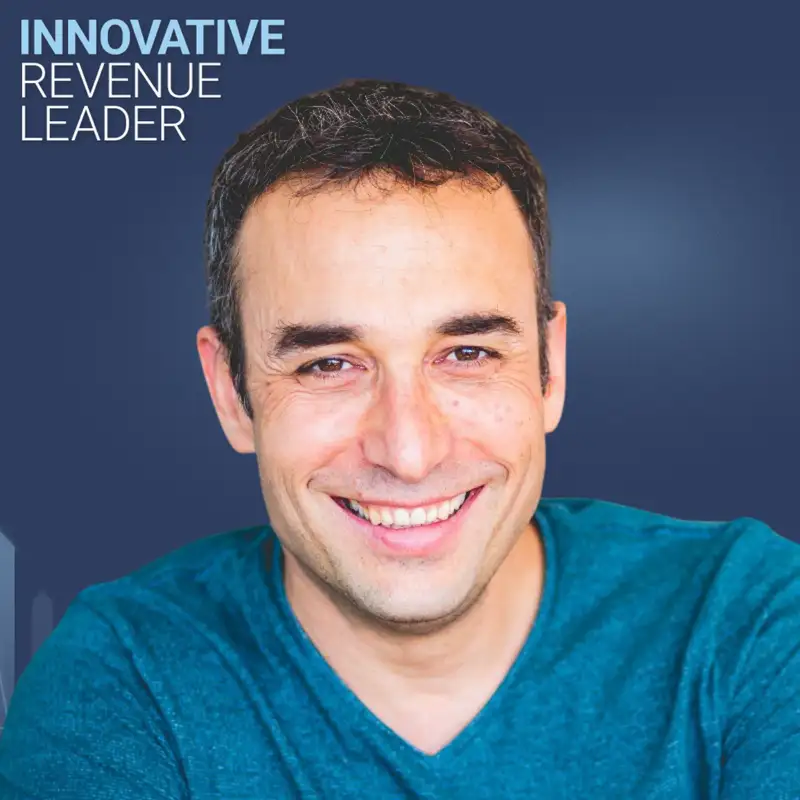
IRL - Ariel Hitron
===
Speaker 2: [00:00:00] Welcome to the Innovative Revenue Leader Podcast. I'm your host, Seth Mars. Join me as we deliver practical insights to help B2B CROs Find new and innovative ways to grow in this fast changing environment. The Innovative Revenue Leader is sponsored by Sandler, a triad company, empowering sales professionals and leaders to master the craft of selling at all levels.
seth-marrs_27_07-22-2026_135314: Hello, everyone. Today's guest is someone I'm super excited to sit down with. He's a tech entrepreneur, product builder, sales leader, and AI innovator. Even before AI, as you'll learn in this session, even before ChatGPT, he was doing very cool things with AI. He was part of a core founding team at Co- at Kaltura, where he built multiple product lines from the ground up, uh, used, uh, used by companies like Fox, Disney, MIT, Stanford, Bank of America, Intel, and generating tens of millions in recurring revenue.
He led a global sales operation of over 25 [00:01:00] professionals across four continents, doubling growth from existing accounts and achieving 115% customer retention rate. He lo- he took everything he learned about sales, product, and built Second Nature, which is an AI-powered virtual partner that coaches sales reps in real time so they can improve on their own, and it's one of those technologies that is really taking hold in the market.
So I'm really excited to have the CEO and Co-Founder of Second Nature on. Ariel, great to have you with us
ariel_1_07-22-2026_205314: Yeah, absolutely. Great to be here and looking forward to it
seth-marrs_27_07-22-2026_135314: Yeah, let's, uh, uh, looking forward to it. Let's d- let's jump in. So what's the most innovative thing that you've seen in B2B right now?
ariel_1_07-22-2026_205314: So I think that right now it's all about AI, right? So everything is AI
everywhere.
seth-marrs_27_07-22-2026_135314: Maybe. Yeah.
ariel_1_07-22-2026_205314: Yeah. Yeah. So when we started, it was like very new and innovative, and now it's, it's all about AI. I think that, uh, where I'm seeing is that, uh, what limits us is our imagination and our ability [00:02:00] to execute. And, uh, I think that the most interesting things is, uh, building synergies between different, uh, data sets what you can create from that.
So, uh, and we can talk about this more, but I think that having separate point applications to do certain things is one thing, but once you start tying all of the data together, then the magic really happens. And, uh,
you can see how AI is really supporting sales professionals, customer success professionals, customer support professionals in their day-to-day actions more and more.
So I'm super excited for that.
seth-marrs_27_07-22-2026_135314: Yeah. And you're starting to see people do that just naturally with, like they're trying to stuff as many different datasets and ask questions to it as they can. I'm sure we'll get more into it, but I'm gonna go here now just because I, I think it's an important one. The, like, how are you guys doing that?
Because I-- One thing that I'm starting to see, and you're seeing this through think [00:03:00] terms like, uh, Harness and this, that where, where expertise matters in how you build and consolidate that data. Like, how are you helping customers today when they're trying to pull all their datasets together and use Second Nature?
ariel_1_07-22-2026_205314: For sure. So again, we started before AI was cool uh, started with an AI and my co-founder that came from Facebook, been many years there and kind of led AI team building there. We were not shy of being bold and innovative and starting something new. Uh, and I think that, uh, that was around AI role play at the time, and how do you speak with a computer and how do you practice things and so on. I think that right now it's really about bringing everything together making these exciting things work. So, uh, we used to do a lot of these top-down. We still do, like, uh, we can work with a Microsoft and kind of train, co-certify like tens of thousands
of people on the new messaging of the [00:04:00] copilot and whatnot, right?
seth-marrs_27_07-22-2026_135314: Yeah
ariel_1_07-22-2026_205314: that's like a top-down motion. Everybody needs to be certified. It's all about what leadership wants and what kind of AEs needs to learn because this is the new stuff. I think what's happening now is a transition from like the company, company, company to what I need. What
I need as a rep to be good at my job.
I-- great that, uh, the company has this new strategy, but I'm working on this deal right now,
seth-marrs_27_07-22-2026_135314: Yep
ariel_1_07-22-2026_205314: and I need help with that deal. And if you can be really concise in helping me with this deal and kind of brainstorm with me about this specific deal, and let's talk about it, and hopefully you remember what we talked about last week about this deal, and you
listen to all of my calls, and you know the playbook of the company, and you know all of my competitors, and you know the best practices of the, uh, sales methodology that we use here at Company X, [00:05:00] then you can give me really concise advice. And maybe next you can also help me and do some stuff and not just give me
advice and start helping me in actually writing emails or doing follow-ups and doing this and doing
that, right? But let's start with, with the coaching, so to speak. that comes from not just top-down, like this is what everybody's doing, this is the new feature that was pushed
from the development to the code was pushed to production and all the sales reps needs to master it.
Like, sure, we've done that like two, three years ago. the interesting part is what do I need to win this specific deal that I'm currently working on? And what skills do I need in order to grow from an SDR to AE or from an SMB AE to an enterprise AE, and how can I be better at that to achieve my career goal?
seth-marrs_27_07-22-2026_135314: Yeah. So I mean, but way-- the way you're talking about it is the company can build the infrastructure, puts all that data together, but then the individual seller just uses it for their own. So they feel [00:06:00] like they're, and are, using it for their own needs, but they're getting the benefit of all of the structure of that data coming together in that one company.
So it just provides a better experience
ariel_1_07-22-2026_205314: Absolutely. So the company is integrating the deal data from your CRM. It's integrating the call transcripts from your live calls, wherever you're having them or recording them. It's integrating all of the best practices that you have with collateral. So you have a product marketing team, and we work mainly with large enterprises, right?
So your
Oracles, your SAP, your Microsofts, your Adobes, all of these guys. There's a lot of playbook and the collateral and then things that were built, right? Then you have the
seth-marrs_27_07-22-2026_135314: Yeah
ariel_1_07-22-2026_205314: methodologies, whether you're using Sandler or someone else. You have your talk track, your, say, five stages,
seth-marrs_27_07-22-2026_135314: worker
ariel_1_07-22-2026_205314: metrics, all of these good stuff. then you have your competitors that are constantly evolving and changing and releasing, and this one had like a quarterly earning report, and this one had [00:07:00] something else, and this one went to, publish something and whatnot. And based on all of that, how can the AI help me win this specific deal that right now I'm in
stage three, and I had three conversations?
Does this AI really know what I'm going through? Does he-- does this AI remember that we had a conversation a week ago when we talked about something? So all of these
seth-marrs_27_07-22-2026_135314: Yeah
ariel_1_07-22-2026_205314: what we're doing.
seth-marrs_27_07-22-2026_135314: So like when you talk about those things, I bet people listening kind of go, "Yeah, I kinda get that." Like that sounds like something that AI should be able to do. In 2019, when you guys founded Second Nature and Open, there was no ChatGPT. There, there was AI, but it was not, not-- So what were you guys thinking?
Like why, why, like is role--
I mean, obviously role play was not easy. It's, it's like what, where, where does that, where, what made you think there?
ariel_1_07-22-2026_205314: does that
seth-marrs_27_07-22-2026_135314: [00:08:00] Yeah
ariel_1_07-22-2026_205314: from? Yeah, I can tell you it, it wasn't easy, and, uh, I was, I was really blessed with my co-founder who was, like, really technical savvy and brought a lot of that kind of machine learning, uh, muscles in. uh, we looked at Alexa, Amazon Alexa, which was, like,
seth-marrs_27_07-22-2026_135314: Yeah.
ariel_1_07-22-2026_205314: Thing at the time.
Right now it's like speaking to your grandfather, right? Because you're, you're speaking with Claude and with
seth-marrs_27_07-22-2026_135314: Yeah.
ariel_1_07-22-2026_205314: and whatnot, and Alexa feels, like, a little bit old. Sorry, Amazon. But, uh, this was, like, the hottest thing, and I came from product and moved into, like I
said, leadership role. So I thought, "Oh, what if, you know, what if we could use something like this to kind of
seth-marrs_27_07-22-2026_135314: Yeah
ariel_1_07-22-2026_205314: knowledge?"
So it was all about
propagating knowledge, creating alignment within a large team and whatnot. And, uh, people thought we were crazy, to be honest. Like, we were coming to people saying, "Hey, you know, speak to the computer and the computer will guide you what to do." And people said, "You're crazy. Like,
seth-marrs_27_07-22-2026_135314: Yeah
ariel_1_07-22-2026_205314: are done. would do any chatbots ever," [00:09:00] right? So 2019. "And speaking to the computer? What, you're crazy? Like, this, this would go nowhere." But lucky for us, we were persistent, and we started working with, uh, SAP with some other customers who were really large enterprises that believed in that
vision and started building it step by step.
So we started off really building our own kind of technology, and then, uh, as soon as, uh, GPT-2, which was pre-ChatGPT, came about, was still completion, so there was no chat. It was just completing whatever, uh, you started the sentence, it would complete, like, the rest of the story.
seth-marrs_27_07-22-2026_135314: Yeah, it didn't have the ability to interact that way, right? So You, could use it, but you had to encode
it into your s-
yeah
ariel_1_07-22-2026_205314: Correct. You, you had to do it via the API. There was no, like, UI, and then it was really early days, and it didn't do chat, and it, it was like continuous of whatever sentence you put in. But we started doing that to have like an interactive [00:10:00] conversation and question answering and whatnot on top of whatever infrastructure that we built in-house. And so that was a starting point, and I think that people really kind of cling to that, uh, because it's cool. Like, it, it is still cool. It's just that the level of expectations
of what you can do now is, like so much greater.
seth-marrs_27_07-22-2026_135314: Yeah. They probably didn't believe you when you put like a GPT-2 on it, 'cause it was doing things that no other role play could possibly do at that time. And then now it's like almost every-- it, it's almost nothing, like nothing can surprise a person.
Like, oh, it does that. It--
okay, whatever. It's life-changing, but isn't that what we
kind of expect?
ariel_1_07-22-2026_205314: It's like obvious, right? So now it's obvious that. you do this and that. But I think that
what still surprises people and where we see the big benefit is with
the quality. Because, uh, you'd see with AI, and there's great models out there, Anthropic and OpenAI and others, and Microsoft obviously.
Like [00:11:00] there's great models and there's great LLMs, but the context and how you structure it really matters, and how you tie everything together really matters. 'Cause on the surface, like when you do a demo, everything sounds great. But once you get down into it, does it really sound like my prospect? Does it really sound like the objections that they're saying? Does it really sound like it gives me the right feedback to guide me on how to get better? It's in this quality thing that, that really makes a difference.
seth-marrs_27_07-22-2026_135314: Yeah, it's
a, it's a really great point around that too, and I think that's actually made it harder to a certain extent to understand what technology to buy because people are used to, do I have feature A? Yes. Do I have feature B? Yes. Okay, that competitor doesn't, but
ariel_1_07-22-2026_205314: found that
seth-marrs_27_07-22-2026_135314: AI role play? There is a broad set of vendors that have AI role play and more than ever the value of it is in how well it interacts with you, And that's [00:12:00] hard to actually determine without really setting it up right
ariel_1_07-22-2026_205314: Where we have success is, uh, where the organizational needs are complex. So if you have like, uh, three, four sellers and then maybe two customer success people, and you're selling a very simple product, it's like anything would work.
But if you have a complex organization and multiple hierarchies and multiple products and multiple markets, and each seller really cares about their own. If I work SMB in oil and gas in SAP, I
care about that. I don't
care about hospital systems in like other parts of our business. I care about my thing and how easy it is to balance the consistency of like, this is the message
with really tailoring it to what this individual needs. Uh, and, [00:13:00] and,
you can see it in the, in the results.
Like, uh, you can see it in the results of, uh, of the adoption of the ROI that they're seeing. Like that's what they care about, that's why they renew and they stay
seth-marrs_27_07-22-2026_135314: Yeah. I mean, it's, it's amazing to even think about all the things that you just talked about and how that has to come together to be at the, at the point of an AI role play. It's just so cool to hear, 'cause like, think about how far we've come. So when, like, y- you talked about being in sales, like, is that why you chose going into sales to focus?
'Cause training is a wide space. Like, AI role play has massive implications, like, all over the place. What, what made you kind of lean in on the sales side?
ariel_1_07-22-2026_205314: So I was thinking about what are the conversations that makes the most impact and that ROI is
clearest to,
to prove. And today we do all sorts of conversations. So we do a lot of customer support, training for customer support reps. We do a lot of customer [00:14:00] success. We do manager training. We do language proficiency. We do interview prep. We do all of it. But where our customers see the most distinct ROI is with sales
seth-marrs_27_07-22-2026_135314: Makes sense. Yeah, 'cause that's where it is. If you do a really good job there, it does change the deal. Like if you're able to stand out, you're influencing a deal and that has, yeah, that makes total sense. Makes total sense. So every tech company just kind of starts somewhere and goes somewhere else, right?
Like the starting point, I mean, you've, you've seen this across with a bunch of these companies starting in cadences, starting in forecasting, starting in CI. You guys started in role play. Do you guys have plans to go beyond that? You actually kind of hinted toward that at the beginning where you started talking about different things.
Like are you guys looking to go beyond where, where you are with role play? Or like what does that look like to you?
ariel_1_07-22-2026_205314: Yeah, I [00:15:00] think that we mastered in the past few years is really being able to help train sellers sell for their own company. And with that, I mean that it's like, uh, generic sales skills. How do you run discovery? How do you handle objections? How do
seth-marrs_27_07-22-2026_135314: Yep
ariel_1_07-22-2026_205314: uh, the empathy and, and so on and so forth.
I think that, uh, we shine is bringing that skill level understanding together the specificity of each organization and
seth-marrs_27_07-22-2026_135314: Okay.
ariel_1_07-22-2026_205314: Playbook together for that organization. So it starts with this role play, and the way that I was initially thinking about it was of you have to learn something, then you have to practice it, then you have to implement it, then it's-- a- a- anything is disjointed.
This was my kind of thought process a few years back. think that now with the pace of everything, like [00:16:00] everything is mashed together. Like I was coding, like I haven't coded in like 20 years because I'm a coder in my past, but I haven't coded in 20 years. I was coding
seth-marrs_27_07-22-2026_135314: Yeah
ariel_1_07-22-2026_205314: the, with Claude Code, and it's just like amazing.
I was learning so much while I was building this new
seth-marrs_27_07-22-2026_135314: Yeah
ariel_1_07-22-2026_205314: application and whatnot. So you're learning by doing, and everything is mashed together. the way that we're thinking about it is this, uh, kind of coach or helper or assistant, it depends on what hat it puts on, that really helps you do your job on an ongoing basis. So think about first your data layers. You're taking all of these data sources, you're pulling them in, you're building it into your kind of AI playbook that really maps your organization. So your organization's sales motion, your sales stages, your entry and exit criteria, your kind of methodology, products, your competitors, [00:17:00] and, all of that together from your live calls.
And this is a constantly evolving thing, right? So
seth-marrs_27_07-22-2026_135314: Yeah.
ariel_1_07-22-2026_205314: New features and products, and your competitors are doing this, and maybe the sales methodology updates once in a while. And then based on that, how can I do the training certification, what have you, once a week, once a quarter, onboarding,
seth-marrs_27_07-22-2026_135314: Mm-hmm.
ariel_1_07-22-2026_205314: All of that. Then how can I help with a specific deal? So I'm working a deal. to speak with a coach, the coach would come in and say, "Hey, Ariel, you know, this deal that you're working on with the company X, like you wrote in the CRM that you're in this stage, so on and so forth, but you haven't really identified the economic buyer yet, you know?" And I would go, "Sure I did. It's like, it's probably either Joe or Jill or, or, uh, Miriam. It's one of those." Said, "No, you haven't. Let's talk about this. How do you identify an economic buyer? Because you're in stage
three, and [00:18:00] per your methodology, you should have already done that. So let's talk through that." And, and do that. And then here's some tips on how you can do that on your next call. Let's role play that a little bit. Let's make sure that you're ready for your next call. And then the next call, you come into the same environment and this coach rememb- remembers the advice that it gave you, and it listened to your next call. It says, "Ariel, we talked about this. You should have identified the economic buyer. You were hesitant to ask. What happened?"
seth-marrs_27_07-22-2026_135314: Yeah.
ariel_1_07-22-2026_205314: So,
I think that's the next step
seth-marrs_27_07-22-2026_135314: so like I'm gonna clarify this just because like, so you're moving-- Um, instead of just role-playing, I'm going to be an agent working alongside you, helping you, coaching you, providing feedback, letting you-- Like just that partner working with you as you go through the deal.
But you're not
ariel_1_07-22-2026_205314: Exactly. You'll be the agent that, that knows of the-- listened to all of my calls, that knows all of the [00:19:00] company's playbook, that knows my product through and through, that knows my competitors through and through, they know my battle card through and through, and that knows all of the best sales methodology. And out of all of this universe would synthesize for me, this is what we should talk about in the next call, in the next email, in the next
interaction. Let's walk through it
seth-marrs_27_07-22-2026_135314: Now, are you gonna have it start moving into orchestration where it does the pre-call plan for you, where it does the updates for CRM for you or are you gonna keep it as an agent along to work alongside?
ariel_1_07-22-2026_205314: Absolutely. I think that it's like it's a natural progression. So you're having this conversation with a coach and it, it expl- explains to you what you should be doing, and then you say, "Okay, why, why don't you write the email for me, put it in my draft? Why don't you find the right content? So you thought that I should send the SAP the, the case study with Oracle. Why don't you find this case study and put it in my email so I can just send it? 'Cause you're connected to all of my [00:20:00] Google Drive, Highspot,
seth-marrs_27_07-22-2026_135314: okay. Okay. So
Ah, okay. Okay. it
makes sense,
and it, and it is the progression, right? Like that is tech companies. They expand and take capabilities by building on the things that they've, that they've done well. One of the things I wanted to ask you is just around like the way that you assess people's skills. And one of the things like with Sandler that we focused heavily on is pivoting away from a skill assessment that's, "Hey, seller, how did you do on this?
Hey, seller, how did you do on that?" And moving towards, "Here are the skills when you bought us, uh, that you wanted to acquire so that when you're on a deal, you can execute them." And now we're starting to score those based on you being able to either execute it through a role play or execute it in a real live call.
Like how, how do you think about that? And because like this is, it doesn't [00:21:00] happen today, but to me it's more valuable. Like there's a knowledge component to this, someone that could say it, but to me the value has shifted with companies like yourself doing this work to I, I don't care if you could tell me if you could do it.
Can you show me you do it in a live call or in a situation? Like how have you thought of that? Because you've been a part of making this real
ariel_1_07-22-2026_205314: Yeah, absolutely. And, and I think that we're very much aligned in the way that we're doing it. So it started off with role plays, and the next step in the, in the evolution was, okay, now upload one live call that shows that you actually not only implemented in the lab but also in the field, and if you presented these skills and so on and so forth. And now it's evolving to more of a skills coach. So you start off by scanning all of your calls. So you have a skills taxonomy, right? So you have a skills framework. Like Sandler has a great skills framework. Uh, others have others. And, uh, you have a skills framework that the organization deployed. You start [00:22:00] off by analyzing like the last 20 calls of each reps or the
last 20 opportunities, 'cause sometimes it's not a single call, right?
'Cause some of the skills happen in the later stage, some of them happen in the earlier stage. It's not all the same. So you start analyzing and saying, "Okay, if right now..." And you don't have to do a survey, you don't even have to do a role play for that. Right now, the stage of Ariel is this. Here are his strong suits, here are his...
Like Ariel has a problem controlling the timing in a conversation. We see that he runs out of time constantly.
Ariel has a problem with the implication questions and assessing the implications. He's okay with pain discoveries. Okay with the situation discovery. Implications, he's like shy of this conversation repeatedly in the last 10 conversations, last 10 opportunities he worked on. And this is the status of Ariel. Now let's start recommending Ariel the implication role play to get him better. Let's start working with Ariel in a coaching conversation saying, "Hey, Ariel, do you know what implication-based questions are? Do [00:23:00] you want me to demo for
seth-marrs_27_07-22-2026_135314: Yeah
ariel_1_07-22-2026_205314: based on y- this last opportunity that you spoke with company
Y? Do you want me to run you through like a quick example of how I would have asked these questions?" "Okay, great. Now why don't you
seth-marrs_27_07-22-2026_135314: Yep
ariel_1_07-22-2026_205314: "Okay, great. You have a call tomorrow. I've seen in your calendar. Why don't you try implication questions, because in this deal you haven't done it?" I think that's a progression, and then seeing how skills have improved over time with the seller. So you started two months ago, and now based on either a structured top-down weekly practice or just these kind of interactions, you've progressed into the skill level on those specific skills that you were missing. think that kind of speaks, uh, volume for the need of the, the reps to improve. The more specific and more personalized you can make it and less generic, I think it's more exciting for, for all of us.
seth-marrs_27_07-22-2026_135314: Yeah. And more valuable, right? I could use it. I'm using it. It's real. And then also less easy to fake, right? Like a seller may know the [00:24:00] skill and just decide they don't want to apply it. So you wanna-- If you're investing in this type of stuff, you kinda wanna make sure that they apply what you train them to do
ariel_1_07-22-2026_205314: I, absolutely. And I would go further than that, that sometimes you have to sell them on the value. Like, uh, we all think that implication-based questions are great, but like, do I really need to do this? And then if you can come up and say, "Okay, look, Aria, like you haven't done that, but Dan has. Here are five
examples from Dan calls where he did it. And guess what? His average sales price is like 50% higher than yours. Here's the data and here's why you should do it." Because just forcing people for your training just does not cut it anymore. You have to convince them, you have to sell them on the idea. And like if you can do it really specific and say, "Here's how..." Salespeople are very competitive. "Here's how you're falling behind Dan and Ruth and whatever,
because they're doing That
Why don't we try
doing that as well?" That works really [00:25:00] well
seth-marrs_27_07-22-2026_135314: Absolutely. So I mean, th- this is-- You guys
were, were, first into this market, really kind of burst on the scene. I mean, there's been others around, but like you guys came in and said, "This is, this is like the new world of doing it." You were leveraging GPTs before other people were doing it. The market's like, there's a lot more com- competition now.
How are you guys-- And you guys continue to evolve to stay, to, to stay competitive. What's that one feature that when it comes down to it, you guys just have an advantage over everybody else? Like it's just that, that feature is the one that is just really, really tangible and valuable to customers.
ariel_1_07-22-2026_205314: No, no, I, I, I expect the question. I think it's fair. I think that, uh, there's a lot of, uh, companies that followed, and I like it because for now, uh, the conversation is, is easier. It's how we're different than company X or Y versus why do I even [00:26:00] need this? So
I appreciate every marketing dollars that our competitors are putting in to educate the market.
Uh, I'd say that for me, it's not one feature, like, unfortunately. It's like you could say, "Well, the conversation sounds more natural," or, "It sounds more realistic," or, "It's a video,
real video of a real person, not just an image," or... But it's more of a combination of everything. It's like, uh, does it really help me and not just the sales enablement team that's pushing it?
Does it really help me? And in order for something to
really help me as a seller, the bar is high because, like, th- they are-- They do sales for a living. They
know how to sniff the, the things that are just talk.
seth-marrs_27_07-22-2026_135314: Yeah. If it works, they'll use it. If
not, they won't
ariel_1_07-22-2026_205314: Right. So I think, I think it's a [00:27:00] combination of everything, but if I have to highlight one thing, is becoming very specific and very personalized
because there's no time, and the top-down certification we do, but I think that's like table stakes today. I
think that being very personalized for the time I'm having this conversation, the continuous of the conversations we had before, uh, the quality of the engagement that mimics whatever conversation I want, I want it to mimic, I think that's the,
the real differentiator. and obviously, I think that in this day and age, the ability of the AI
to really self-improve, right?
So
seth-marrs_27_07-22-2026_135314: Oh yeah. underestimated and hard to do
ariel_1_07-22-2026_205314: the AI has one methodology for this, uh, pain question, so some of the reps could send like, "Here's what Dan is doing," and some of the reps would say, "Here's a few things that would help you close more," and then see what gets more response from the reps, and then that's the thing that you would lean into, [00:28:00] right? Or if you do some training, and then you see in the next call if they actually implemented it. If so, then that's a, signal for the system to continue and lean into that methodology or that way of doing it versus if
they hadn't implemented it. So it's a
continuous feedback loop
of learning from that feedback from the real calls into the training, from the real calls into training.
seth-marrs_27_07-22-2026_135314: Got it. Yeah, that's awesome. And, and way, way har-
like
like I said,
it, it's way harder to do than... People talk about that like everybody's doing it, but not everybody's doing it. It's way harder to do than people, than the people think it is. let's talk a little bit about, about you. So what-- When you were a kid,
Amy, was technology always a pathway?
Like I, I just have this image of you as a kid doing role play with your friends around different, around, around different things.
What, What kinda got you into-- What kinda... Was there a spark around things that were like that that kinda led you here? Or was it like completely different wor- completely different world?
ariel_1_07-22-2026_205314: [00:29:00] I don't know if as a kid, I think that in my professional life going from product into sales and sales leadership quite a transition because I used to be like, I came from engineering background into product leadership and then leading a 25 people sales team. And, and that's a jump 'cause you think that sales is so easy, right?
You're the product person, you just give them the page, they read from the page, and all of our great features and people just buy it and it's awesome. And then jumping head, head in into that, it's so much more nuanced and so much more ... It's hard. Sales is hard. It's hard mentally, it's hard personally. It's hard with rejection.
Like, there's a lot of things that you have to get ready for, and I think that was my personal experience moving in from Like, techies always think that writing code is, like, the most important thing in the world and the hardest thing in the world, and they have to be the smartest person in the world and whatnot.
But in reality, building that [00:30:00] endurance and the soft skills and the ability to really what's behind the person that you're speaking with, I think that that was really challenging for me personally. And I think that I was finding, like, ways to think about that and sort of think about it. And then when, uh, I started
seeing AI come about, the Alexa and whatnot, I said, "Okay.
Let, let's do that."
seth-marrs_27_07-22-2026_135314: the pathway. So
y- there's gotta be a story there. What were you thinking moving from product to sales? Like that, like, th- th- like, that, it's a, it's not a common thing to, to a large extent. Like, what, what made you move? Like, what get, got you to do that?
ariel_1_07-22-2026_205314: Yeah, for sure. So, uh, the company kind of grew and matured and there's, there's different stages in the life cycle of a company. I think that at first, like you're building the initial kind of product. That was before Second Nature. So I, I was building a, a product with the company Cocultura, and we, we were just starting out, like 20 people in a room and building something, hacking it, hacking it, and then [00:31:00] the company grew to tens of millions in revenue.
And all of a sudden it was about scale, go-to-market distribution and and whatnot. And, that was where the action was. So I think that's part of It The second one was personal. I moved from Tel Aviv to New York, and being closer with customers living in New York and, and working with them, I thought, "This is interesting." And,
uh, I think that anyone who has an opportunity to move into sales should. It teaches you so much about,
about everything
seth-marrs_27_07-22-2026_135314: So true. So true. And, and it had to be interesting for you 'cause you basically had to go sell the product you created to a certain degree, it sounds like.
ariel_1_07-22-2026_205314: it was so eye-opening, you can't imagine. Because like you think certain things from the perspective of like engineering and product. and then the reality is nobody cares. Nobody cares about your product. nobody cares. about your features. No- nobody cares. They care about their [00:32:00] needs, and that's it. And you have to be very precise with what you say. and I think that's, to me, that's also a part of it is the, the sales conversation
is like a performance, right? It's the moment of truth. This is where, where it's
at, right? So you can build--
seth-marrs_27_07-22-2026_135314: Closing the sports, yeah
ariel_1_07-22-2026_205314: can build all of your decks and all of, your features and all of, all that but how you present and how you say and what you say really makes a difference.
So that kind of got me really excited for this. I don't know if I answered your question or
not, but hopefully.
seth-marrs_27_07-22-2026_135314: No, you did. That's a big jump. But yeah, it's, it's, it's very cool. Uh, one piece of advice that you'd give to yourself, uh, like if you just graduated college and you can give yourself one piece of advice, what would that be?
ariel_1_07-22-2026_205314: Start a
seth-marrs_27_07-22-2026_135314: Really
ariel_1_07-22-2026_205314: Don't wait. Start. Yeah,
start, start sooner. Like, uh, I was,
I
seth-marrs_27_07-22-2026_135314: jumping
ariel_1_07-22-2026_205314: because I worked with these great entrepreneurs. I looked up to them [00:33:00] I said, "I couldn't do that." Like, "This is like, I have to learn so much more before I do
that," and whatnot. But no, you just
have to If you have it in you, just
go in and do
it.
I would start 10 years earlier as an entrepreneur, in retrospect.
seth-marrs_27_07-22-2026_135314: That's, yeah, great advice. And, and you did it. Yeah. So, yeah. Errol, thanks so much for, for the time. It was great talking to you. A- and thanks for, thanks for joining us
ariel_1_07-22-2026_205314: Thank you for the opportunity. Really enjoyed it. Thank you so much
Speaker: And that wraps up another episode. Thank you for joining. For show notes and other episodes, visit us@innovativerevenueleader.ai. The Innovative Revenue Leader is sponsored by Sandler, a Trilia company. Sandler provides top corporate sales and business development training while empowering sales professionals and leaders to master the graph of selling at all levels.