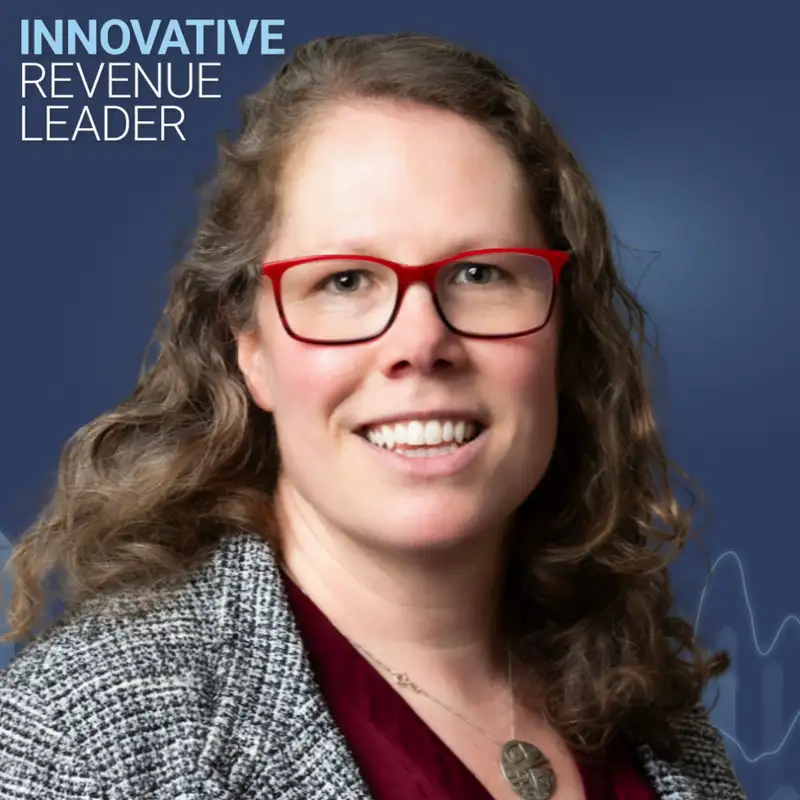
IRL - Ellie Fields
===
Intro: [00:00:00] Welcome to the Innovative Revenue Leader Podcast. I'm your host, Seth Marrs. Join me as we deliver practical insights to help B2B CROs Find new and innovative ways to grow in this fast changing environment. The Innovative Revenue Leader is sponsored by Sandler, a triad company, empowering sales professionals and leaders to master the craft of selling at all levels.
seth-marrs_30_10-05-2026_141419: super excited to bring on a, a good friend and someone that I worked with for, for many years in the sales tech space. She's a seasoned enterprise executive, an AI innovator, former chief of product and engineering officer and a tech startup co-founder. She's one of the few people out there who has done both the build and the deployed side of analytics, so has perspectives from both sides that really shapes how she does what she does.
She's named, she was named one of Okta's top ten up-and-comers in enterprise software, scaled sa-sales loft into an AI platform, [00:01:00] earning Forrester Leader status. That, that was an evaluation that, that, that I did with her and where I got to know Ellie. Uh, she led key product initiatives and, and developer ecosystems at Tableau, including Tableau Public, and is a major...
and has done major keynote presentations at Dreamforce. She drove global product launches for Microsoft Dynamics and managed enterprise software venture capital investments. Uh, she is the person that I turn to when I have questions around analytics, and in this crazy world where people are talking about headless and this, that, and the other around analytics, I can think of no better person to talk to around this space.
She's the CEO and co-founder of Ridge.ai or Ridge AI. Ellie, so great to talk to you.
ellie-fields_1_10-05-2026_111418: Thanks for having me on, Seth
seth-marrs_30_10-05-2026_141419: Cool. So the, the first thing I ask everybody is, um, what is the most innovative thing that you've seen in B2B right now?
ellie-fields_1_10-05-2026_111418: You know, this is an odd answer, but I think it's actually integration. Uh, there's always been a lot of interesting point solutions here and there, and there are [00:02:00] more now. But I think this idea of how do you bring them together thoughtfully and then bring things that may have been outside of that loop in as well.
And so you see sales engagement collapsing with CRM in a lot of cases. Um, you see ways to integrate using Claude as opposed to having to use homegrown integrations. I think that's in- interesting. And in my world, I see analytics coming really deeply integrated into the workflow as opposed to being kind of your, your revenue system over here and your, your, uh, data system over there
seth-marrs_30_10-05-2026_141419: It's such a great answer and such an underrated one, right? To a certain extent, what everyone's talking about is integrations, right? Try- trying to pull data I wanna integrate, but they're using the, the term MCP or they're pulling all their stuff into Cloud or different areas. None of this stuff kind of works without any of these integrations
ellie-fields_1_10-05-2026_111418: Yeah. And I, I think that's the, the question of how do you want, to integrate and how do you want data is, is such a good one. Every [00:03:00] product will try and get you to integrate into
their product, and I think one classic thing is to, to expand in all the directions at once and, and try to capture customers that way. I prefer, and a- as a customer now, uh, 'cause I'm obviously running our own GTM stack in our company, I really prefer a thoughtful path where you, you, you have really defined areas and, and maybe you use Claude or different defined integrations to, to get in there. But you, you, uh, you're able to own and, and know what you want from different parts of your, of your
stack. And that, that actually makes it more powerful overall 'cause you can leverage the p- the other pieces, uh, of, of the stack
seth-marrs_30_10-05-2026_141419: It's
kind of what you enable with Rhythm when you built Rhythm at SalesLoft to a certain degree, is that ability to pull all those things and make use of them through a, a centralized place for your customers. Is that fair?
ellie-fields_1_10-05-2026_111418: Yeah, that's fair. I think what we were trying to do was really put action and data in a tight loop [00:04:00] and solve the, the most core things within the platform. And then if customers wanted, uh, you know, s- special, uh, functionality for different ICPs or, or their motion or what have you, they could go get it.
But I think the idea of having, uh, you know, for, for a while at least, sales tech was a feature per product almost,
And it really fell to the customers to figure out how all this stuff worked together. Um, we've seen a lot of what used to be products become table
stakes, you know, and, and, and integrated into different platforms like follow-up emails or data enrichment.
Some of that, some of that is just easier if it happens right in the flow. And then RevOps and, and other people can go spend their time on the harder stuff
seth-marrs_30_10-05-2026_141419: Yeah. So you bring it full circle. If you have all the integrations tucked and tied or ticked and tied, all of this stuff just kind of works versus trying to do it in one or import your stuff into a Claude or all these other places
ellie-fields_1_10-05-2026_111418: Yeah, exactly. And, and we see that on the data side as well. I mean, I think, um, bringing action and data together [00:05:00] is, is a core of what we were trying to do at SalesLoft, and I, I saw how hard it
was to do There even, even from the vendor side. Um, uh, but I, I do think it's one of those things where sellers are very, very smart.
They, they can go and make decisions if they have the right data in the right moment. Um, but you have to put it where they're working and, uh, it has to be integrated into their experience, and that's, that's when they'll use that. That's when they'll use any new, uh, tool or functionality is when it's integrated and it actually gets them the benefit, saves them the time
seth-marrs_30_10-05-2026_141419: Yeah, it And they don't know how to do it. They need somebody to do that for them so they can focus on selling.
ellie-fields_1_10-05-2026_111418: It's not their job.
seth-marrs_30_10-05-2026_141419: Yeah, yeah. So you've been... You've have a, had a really, like a, a- an established career on the product side, and now you're stepping into a CEO role. How is that different?
What's, what's life like on that side versus the, the chief product officer role?
ellie-fields_1_10-05-2026_111418: Well, it's, it's got some similarities and some differences. I mean, the similarity is that I think when you, when you care about your business, and especially in a, in a product leader
[00:06:00] role, you're thinking about it all the time. You're acting like an owner. I think the best, uh, the best team members are always acting like an owner. Um, now I, I, I am the owner and the s- the CEO, the, the ultimate owner of all the decisions. Um, so the feeling is very much the same. The scope is bigger.
Uh, and so it's been interesting actually building out a, uh, GTM stack and doing all the sales side of things, um, and the marketing. And in a lot of ways it's really nice, uh, when you start small and you found a business because you, you do actually see all aspects of it, and you get this really visceral feel for where the customer is and, and what they're w- what they're worried about and what they're feeling. Um, and then you grow from there. So it's, it's, uh, it's, it's been a fun transition
seth-marrs_30_10-05-2026_141419: Yeah. So you're connecting dots across the whole organization, where in typical fact- in typical times you would be heads down on the product and then still talking, but you're, now you're living on both sides of those it sounds like
ellie-fields_1_10-05-2026_111418: Yeah. Absolutely.
Yeah,
seth-marrs_30_10-05-2026_141419: Fun times. Um, [00:07:00] you've had, uh, uh, you've had 20-plus years in the analytics space.
You've been dedicated. You spent a ton of time at, at Tableau building this out, and now you're, you're at Ridge AI doing this, uh, this stuff. How, how has analytics changed from your early days at Tableau to what you're doing now at, at Ridge.ai?
ellie-fields_1_10-05-2026_111418: Yeah. Uh, it's changed so much. I think the idea throughout all of analytics has been get more use from your data and let more people use it.
And the industry's gone in a few different directions with that. I mean, at Tableau, we were really trying to get self-service analytics, trying to get everyone to build
dashboards. In my last at Tableau, I, I really started to question that, not making it easier, but the idea that everyone needs to build dashboards.
Um, I think that, uh, I think that there are some people who really just need to use data, and they may never go and, and, uh, learn all the front-end toolkits and data best practices and all those things, and that's okay. We just need to figure out how to [00:08:00] get things to them as, as an industry. I think AI has changed things tremendously, right? It's, it's so much easier to be able to ask questions of data. It's so much easier, uh, to do a lot of things with data. Um, but you still need those guardrails because it's still easy, uh, to make poor decisions with data.
And so, uh, uh, you know, I'll give you an example. I think there's a lot of data agent experiences out there now where you can type some things into a box and you get some answer out and, and that's really valuable, uh, at times for the right person in the right moment. So if you're, if you're a data analyst and you're in your Snowflake data agent and you are deep in all your data sources and you can just join things up and whatnot, that's great, and you'll probably get some good answers out. If you're a customer success rep, and I've heard of some that have been dropped in there, might get a different answer every time. You may be joining things in the background or accessing data that is not appropriate to what you're trying to ask, but you don't realize [00:09:00] that because you don't know the whole data infrastructure and nor should you have to. And so I think, I think we're, we're-- we keep trying to iterate on this idea of getting value out to people, and the question is how do you do that in the most effective way? and at Ridge, what we're trying to do is we're trying to bound that problem, help, uh, you know, help really bound that problem for people and, and give the end users an experience that is delightful and rich and, and targeted to them so they can ask questions. It's performant, it's beautiful, but they're also in the world they're in and, and they're not expected to go become a, a, an expert in, data toolkits or backends or things like that.
seth-marrs_30_10-05-2026_141419: So it seems like if I'm reading that right, like there's a, the, the... You're, it's somewhat counter to the world today of, "Yeah, go build anything you want and make it work, and you can do whatever. Go vibe code the dashboard that you want, go do all this stuff." If, if I'm reading it right, what you're saying is, "Look, I'm gonna build a great tool for [00:10:00] someone who knows how to build dashboards to be able to build beautiful experiences for people to understand analytics, but that's not the same experience that I'm gonna provide to the user of analytics.
In that situation, I'm gonna, I'm building a tool so the user can extract as much value in the most easy-to-use, efficient way possible." Is that a fair representation? '
ellie-fields_1_10-05-2026_111418: Yeah, it is on the user side. I, I think one of the things we're seeing in analytics is, is really, uh, we're honoring different use cases. We used to think a dashboard was, was great for everything all the time, and everybody should build all the dashboards. And we found out that most of them d-didn't get used and, and a lot of them were wrong and so on. Um, you know, I think using Claude is great for directional ad hoc analytics. Somebody sends you some file, you need to look at it. It, it's fantastic for that. It's fantastic. It's, um, you know, when you build, say, a dashboard with Claude, it, it can be really hard to de-deploy and maintain it. It might have issues in there that you didn't know, assumptions that Claude made. [00:11:00] It may be building on top of five different libraries that you gotta keep up to date. And so I think, you know, Claude is, is great for a couple of different use cases. Uh, we actually make it as easy or even easier to build than with Claude because we incorporate a lot of the data best practice, so you don't need to be an expert to build. You can build at the business level. Um, but we're trying to bring what we know about building with data into the experience for builders. But then the, the, the difference is instead of ad hoc directional stuff that I might have on my, uh, uh, you know, on, in, in my Claude workspace, we are trying to provide that shared data experience.
Uh, really broad sharing where you want a, an artifact that people can see and use, and they don't have to be an expert in the data. Somebody's done a little bit of that for them
seth-marrs_30_10-05-2026_141419: Got it. Got it. So it almost seems like the non, the, the non-expert but responsible for, or AKA the rev ops leader, the back end that you're building is for that leader [00:12:00] to be able to take advantage of all the structural stuff that you know that you could do to make sure they could build a good report and then enable them to be able to, without maybe as much experience as like a data scientist or somebody who really is in the weeds with it, to be able to use it to be able to create great analytics
ellie-fields_1_10-05-2026_111418: Absolutely. And, and, and we're using AI to help do that. I mean, basically it's building at the business level. So a RevOps leader might have questions that they wanna, uh, you know, answer and share out things like, "Hey, where's all our churn coming
from?" You know, "I wanna look at our new business in, in, in this region, a-a-and I wanna understand, um, you know, what are the demographics of that?
How does that break down? Or, or, or what are the channels that, that drove a lot of this business originally?" Uh, RevOps leaders have lots of questions. That's, that's, that's a characteristic of them. They should be able to engage with the data at that level. They should be able to point at, at their, all their, you know, customer data, their CRM data, and be able to ask questions like that, and then build artifacts because the, the RevOps leader is often the one who knows what's right, what's [00:13:00] wrong.
seth-marrs_30_10-05-2026_141419: Yeah
ellie-fields_1_10-05-2026_111418: they get those questions out. Build artifacts that can be used by all the frontline managers or, you know, all the execs or everybody out in the field. Um, but it is, uh, it is building at that business level. So the RevOps leader doesn't have to know, you know, I want a bar chart here, or this is the best representation of data, or this field has this shape. They just need to know the business questions
seth-marrs_30_10-05-2026_141419: Yeah,
and then you've already determined that a bar chart's good for this one, a, a donut chart's good for that one, and we're gonna visualize it in the way that's most useful to the use case
ellie-fields_1_10-05-2026_111418: Yeah. We basically translate. We build from the business questions and then elicit a couple... If we need to fill in the gaps, we elicit a, a, a couple more answers, and then we do some reasoning about what that would look like using the data, and then we, we actually execute the chart. So if you watch somebody build a really good dashboard in Claude, it usually takes them one to two hours if they're a data expert and they're guiding really
tightly. You know, do this, don't make that assumption, fix this. Um, our, our, you know, our [00:14:00] experience usually builds in under five minutes and, and the, the, only things you bring to it are the data and, and the questions you wanna, answer
seth-marrs_30_10-05-2026_141419: Uh, like I have a data scientist that's guiding me along and making sure that I make the best decisions as I'm pulling this stuff all together and allowing me to use my business experience and expertise to be able to make the best possible visualization
ellie-fields_1_10-05-2026_111418: Yeah, absolutely.
Yeah Awesome. So headless, everybody's talking about headless this, that and, and, and the other.
seth-marrs_30_10-05-2026_141419: Like where does, where do visualizations fit into that? Is like the... Like where do you see this, this world where like it's almost anti-dashboard to a certain degree or like micro dashboarding where I'm just, when I have a question, I ask for a dashboard and it gives it to me. Like how, how do you see that?
Like in, in the world you're working with Ridge where this fits in
ellie-fields_1_10-05-2026_111418: I think it's a huge, uh, it's a huge opportunity, but I think not in the way a lot of people are thinking about it. I mean, one of the things we know about data, and it's really not what we know about [00:15:00] data, it's about the human brain, is that people process data
visually. And so y- if you really wanna understand a topic, you often do need to see it
visually.
Now, I'll go back to use cases. Is it sometimes really handy to use Claude and say, "What was my revenue in the West, you know, last quarter?" Of course it is. Of course it is. But if, if you are in a, a place where you really need to understand, and I call this the human
data interface, right? There are, there are quick questions you need to answer, and that can be great with headless, and there's a human data interface, which is typically visual and typically should give you a way to ask other questions. One of the interesting things that, that we're actually doing is, uh, in a headless way, letting you spin those dashboards up on the fly. So you can imagine you've got some workflow, agentic or otherwise, that goes and does a bunch of different things with the data or in your systems, and at some point you still need a human being to look at
that data. Maybe not at every
step, but at some point you do. w- we're making it possible to [00:16:00] spin up visualizations on the fly, but with this kind of, um, uh, you know, very deep and rich experience. It's not the ad hoc on the fly, like you get what you get kind of thing with, with Claude. but actually spin up a, a really durable asset that you can then share out and do that in the middle of a
workflow
seth-marrs_30_10-05-2026_141419: So you would take it and say, instead of me trying to describe what I want it to look like, you would say, "Hey, I'm sharing out P&L numbers and I want to see where, what our gap to, to plan is." Hit enter, and instead of letting Claude decide, you would use a solution. Your Ridge would say, "Okay, you're trying to visualize this number.
This is the visual for it. I'm gonna show it this way." So the c- the user never has to ask what it should look like. You've already determined that based on the c- based on what you're gonna visualize, and then you get this beautil- beautiful visualization that you never asked for, but it just fits because you know, and have built into the system what would look best for that [00:17:00] question.
Is fair?
ellie-fields_1_10-05-2026_111418: Yeah, we, we build... It's, it's fair. We build on all kinds of, uh, research and, and best practice around working with data. But I would say even if you w- were to build a clash- a dashboard in Claude and you like it, and, and I think we can build better ones and faster, but even if you take that off the table, you get a Claude dashboard, you've gotta maintain it, deploy it, make sure it's secure, do all the things.
And we're really building for this use case of shared data. You, you get value from data when you, when you share it, and you can act on it, and it's out there for, for broad audiences. I think one of the issues, and you asked about how the industry has evolved, I think we're, we're realizing that data really is a communal artifact in a lot of cases.
Again, not always. Sometimes you're just following a thread in your own head, and you just go all the way down the rabbit hole, and that's great too. lot of times it is a shared artifact. I mean, if I have a completely different understanding of our churn than you do because we both built our own Claude [00:18:00] dashboard, um, that's not gonna be very productive.
But if, if we have RevOps working on that, and you and I both get a really solid view of what churn is, and we can really dive deep into that and understand it, all of a sudden we can start getting to, okay, how do we act against this? What are we gonna do versus, uh, uh, you know, competing and fighting Claude dashboards?
seth-marrs_30_10-05-2026_141419: Well, let's, let's take it up a level, right? Because you're talking about just structured data and trying to pull that together. When you think about like the, like the artifact, trying to derive insights from con- contextual data, that is, I mean, that it's really like, it really resonates when you say it's this is a shared data set.
And context basically is what did you, what happened when you talked to finance? What hap- it's all these connector points that are coming together that nobody even knows how to connect to a certain degree at this, at this point in time, 'cause it's never been done before. Like, when you think about context capture, h- how do you, like, how do you visualize [00:19:00] context?
Everyone's talking about... Or can you? Is this just some weird thing that has to be translated into structured data and then visualized? Like how do you see that?
ellie-fields_1_10-05-2026_111418: I, I think it's incredibly important, and this is we get back to integration. It's, it's how many, uh, technology questions are integration questions. But I think, um, context has to come into the analytics. This is where MCPs can help so much. I, uh, I don't think Ridge will be the system that owns all your context.
In fact, I think it's gonna be hard for any one system to own all your context. You'll have it in Slack and a thousand different places. What we make it easy to do is bring it in, whether it sits in your data sources, 'cause a lot of times you've got semantic context in data. Uh, you might have context in, in some of these other shared systems. make it really easy to bring that in with the dataset and with the context that you as a user or, or your, your agent is injecting to create that and, uh, and then to take action. I mean, the whole point of data is typically to gain understanding, um, and then take
action. And so MCPs are [00:20:00] helpful there too. And I, I, I think when, when you think about how systems work together, um, you, you've got to respect that there will always be something outside of your system that the user's gonna need. And I think if, um, you know, the- these all-in-one systems are just-- they're not gonna be effective because they're gonna miss something. So at, at Ridge, we're really trying to think about, okay, how do we bring the right context in? How do we let the user bring it in? And then create that, um, really, you know, deeply vetted artifact that they can then share out, deploy, highly performant, um, you know, a- and get that out so that people on the other side can then use it and, and maybe take action with it in some of those same shared systems.
seth-marrs_30_10-05-2026_141419: So th- this is like the whole context thing versus headless, like, th- this is when I reached out to you about this, I'm like, okay, headless doesn't seem to make sense to me in terms of how a seller would work. It's a tool in the toolbox. Get it that there's different tools that would be set up for agents.
But [00:21:00] to me, the future becomes analytics that are, that use context to make sure when you log in, you have everything you need to do your job that day based on all the context that you have. All your emails, all your phone calls, all your meetings, you know, the stuff you need to do, documents, you... All of that type of stuff so that you may log in and never see the same page twice.
But the pages you do see are visualized in a way that makes the most sense and contextually relevant to the moment that you're working on right now. So you could run, almost run with your analytics. What's your perspective on that?
ellie-fields_1_10-05-2026_111418: I think it's gonna be multiple things. I mean, there are, there are definitely times when you, you, you always want things personalized and contextualized, like full stop, of course. Uh, so you, you, you wanna be able to, uh, show that, and I would add in, in the workflow that you're
in, right? Nobody wants to go get a thing over there.
It's, it's, it's too, uh, too much time, too much cognitive load. So you, you always want things personalized, contextualized, and you often [00:22:00] want them completely on the fly. And I, I think that that's, you know, there, there's, there's some room for that. I also talk to people, especially, uh, field people like customer success leaders, sales leaders, who say they actually wanna see the s- the same view with the personalized data,
and that's because they might be talking to 10, 15 customers in a day, and they don't have time to, you know, parse whatever new view came out.
They actually wanna be able to look at something, know they understand it, know they trust it, know exactly where to get the data, but have it be relevant, um, have a, a data agent so they can ask questions and so on. Because again, it's all cognitive
load. So right there's, um, there, there... Sometimes novelty is not, uh, is not the right approach, with big field teams, right?
We all know how hard it can be to train and enable, and so you want some things to stay the same, uh, when, w- when it makes sense. And then you want people to be able to go and do [00:23:00] d- you know, go, go get very contextualized things when they need it
seth-marrs_30_10-05-2026_141419: Yeah. So i- i-- like one of the things that I was thinking as you were talking is like, I think we're asking too much for people to say that they're gonna just remember the same thing every single time. I may need to see that same dashboard for four different conversations, and I don't want it to be different.
I need it to tell me what the same thing every time. I need it to visualize, because meeting A could be a board meeting where I'm talking to that. Meeting B could be a pipeline review. Meeting C,
ellie-fields_1_10-05-2026_111418: Or, or you're talking to five different customers and you don't wanna have to figure out that revenue's in the top left once in the bottom right, but it was actually filtered when it was down in the bottom right, which is one of those things that you might get with
Claude or, um, you know, or, or it hit the wrong table when it came up for the third customer. It's like, look, I walk into a bunch of customers. I want it to have the different customers' data, of course,
right? But I, I, I wanna be able to walk through a conversation. And then I think one of the big things that has changed in analytics is you can now have a personalized [00:24:00] experience on top of that with a data agent, right?
Give me the visual data so I, I, I've, I've got it kind of organized in my mind, 'cause that's one of the things that visual data
does. It's sense-making, right? It's storytelling. And, and when we go into our customers, especially with customer-facing data, we wanna make sure we control that story and that narrative.
You know, if we know that we're, we're providing value in some ways, we wanna, we wanna, uh, sketch that story out and start there with the big picture so we don't get kind of locked into some, some kind of minute detail. And then as the customer asks questions, we wanna be able to kind of evolve from that point. But I think trying to walk into every single customer meeting and start from a completely different point and a completely different view of the data is, is, is creating more problems than, uh, than, than it's worth
seth-marrs_30_10-05-2026_141419: So like the, the way that it's... Like after what you just said, the way it sits in my head is you've got standard views that I just need to see. When I'm in that situation, I need to see the same thing, 'cause I need to have similar conversations. I have another one that would contextually roam around based on what's [00:25:00] going on and give you insights that are useful for that, there mo- that moment, and then you're gonna have a prompt that if you have a specific question, you could ask that prompt, and it's gonna give you the visualization that you need at that moment.
So it's all three of those together are the perfect kind of future of data analytics for end users
ellie-fields_1_10-05-2026_111418: Yeah. And
I think the right, the right one or two of those at any moment, uh,
typically.
seth-marrs_30_10-05-2026_141419: That would end the million dashboards that nobody uses,
ellie-fields_1_10-05-2026_111418: Yeah.
seth-marrs_30_10-05-2026_141419: which would be a beautiful thing
ellie-fields_1_10-05-2026_111418: and it's funny 'cause people will say dashboards are dead, and I think what's dead is having 500 dashboards, like you
said, for a whole sales team, and maybe two of them get used, but, you know, five of them are contradicting the other t- you know, the two that get used, and everybody's confused. The way I see teams evolving is having those five, I call them canonical dashboards, right? Maybe you got one on churn, you got one on new business, you got a couple more on, on, uh, you know, just demographics or prospecting or what
have you. [00:26:00] And, and they're used in different ways, and then there's all this flexibility for people to ask questions. And, uh, and those five canonical dashboards, I think in a revenue world, are absolutely gonna be owned and run by RevOps, right? Because RevOps understands the business and understands what's important to get out. And maybe there's two or three dashboards you're sharing directly with customers in the product as well. but these are, these are the, I call, you know, the head-tail dashboards. Those are the head. The tail is all the little questions people
ask. And it used to be all those questions became new dashboard requests, and that's how we got to the 500
dashboards, which nobody ever wanted 500 dashboards
seth-marrs_30_10-05-2026_141419: No. No, no, Yeah. You, you get the... I, I always talk to clients about this. It's like you- there's a, there's a line. There's the canonical dashboards that you need to keep, maintain, and then there's the ad hoc, "I had this idea in the shower today, and I'm the sales leader, so I'm asking you," and I go create a freaking dashboard for a person looks at it once and then never looks at it again, and just goes in the pile.
Now, [00:27:00] those things will go into just a- don't call me, ask the question to the, to your dashboard, we'll get you the answer
ellie-fields_1_10-05-2026_111418: Yeah. Yeah. And, and for a while in the industry, we, we thought that, uh, that person in the shower would go create, you know, his or her own. And, and maybe one out of 100 will,
but honestly, they mostly won't. And so what we need is a way to, you know, empower the folks who are a little closer to the data.
Maybe they're not data scientists or data analysts, but they know their data and they have business questions to, to answer those quickly without a whole bunch of custom work and, uh, having to take some training courses and
seth-marrs_30_10-05-2026_141419: Yeah. Makes Okay, so let's talk a little bit about you. Um, if you go back to when you were a kid, like, were there signs that you were gonna be this dedicated to analytics? Like, you're, you've, you've built one of... an incredible career around analytics. Were there signs when you were a kid? Like, were you running around, like, counting things?
Did you have like a d- like a, a, a 2 by 2? Like, what, [00:28:00] what... Anything that would have called that out?
ellie-fields_1_10-05-2026_111418: I, I loved, uh, I loved math and science and all of that, but I also-- I, I'm actually gonna go a little meta on this one. I loved, uh, reading newspapers. I loved books. I, I actually, I was a super geek, and to me, school was where, school was f- freedom to, to learn and
explore. And ultimately, the truth of data is it's just a representation of the world. Nobody cares about data in the abstract.
Data's interesting because it's your business, or it's your favorite sports team, or, you know, it's, it's some societal issue you care about. Data is only a way of thinking about and representing the world, and I think it's a, a really important complement to other forms of understanding the world.
It's definitely not the only
one. Um, but I think that we've probably underutilized data a way of understanding the world. And so as a kid, I was just... I mean, I was a kid reading The New York Times all
the time, and
seth-marrs_30_10-05-2026_141419: I am not surprised [00:29:00] at all
ellie-fields_1_10-05-2026_111418: two or three newspapers and, yeah, I was reading biographies and then I, you know, I'd read two, two or three biographies to see if I could get different views of the same, same person.
And, uh, you know, it, it, it, it-- And when I started getting to the data world, that's what really lit me up, was like, this is just a way of seeing the
world
seth-marrs_30_10-05-2026_141419: Yeah. Storytelling to a certain degree, like trying to, trying To make it make sense to you
ellie-fields_1_10-05-2026_111418: Yeah, absolutely. Yeah. It was funny when I joined, uh, SalesLoft, uh, they-- I, I used data as a way to understand the business. So I would look at our opportunities or our tickets in engineering and, and it was just because I was new to the business. I
came in at, you know, chief product an- officer, and I was like, "I need to ramp up fast and understand this."
So I'd start asking questions like, do we have so many tickets on this?" Or, "Why does it look like our opportunities are doing this?" And, and inevitably the first answer I got was, "Oh, it's not." And I'd say,
seth-marrs_30_10-05-2026_141419: It is
ellie-fields_1_10-05-2026_111418: " But it is." 'Cause I [00:30:00] could, I could look at the
data and, and work through it so quickly. And then it w- it actually spawned off a lot of conversations where people had this anecdotal understanding of the business, but they hadn't been able to update it because at that point we weren't using data as
seth-marrs_30_10-05-2026_141419: Yeah
ellie-fields_1_10-05-2026_111418: And so then we, we started getting a deeper understanding of our business just by, by being able to look
at it
seth-marrs_30_10-05-2026_141419: It's crazy how often businesses operate off of assumptions versus facts. yeah
ellie-fields_1_10-05-2026_111418: I, I'll, I'll hold, um, maybe the data industry partially responsible in that it, it was too
hard. It was, it was too
hard. And, and, you know, you and I have talked about this a lot. I think, um, salespeople will very much use data. Revenue ops lives in
data, but they, they need to be able to do their job.
It's... You know, their job is not to go off and, uh, muck around in data and, and just, like, kind of explore forever. Their, their, their job is to get business
outcomes, and, uh, and, and data needs to help them
do that.
seth-marrs_30_10-05-2026_141419: Absolutely.
ellie-fields_1_10-05-2026_111418: Yeah
seth-marrs_30_10-05-2026_141419: So one more for [00:31:00] you. When you... What's... If you could go back and give yourself one piece of advice when you graduated college, what, what would that be?
ellie-fields_1_10-05-2026_111418: I think I would say don't assume.
seth-marrs_30_10-05-2026_141419: Interesting
ellie-fields_1_10-05-2026_111418: Because I grew-- yeah, I grew up in this, uh, uh, my, my mom was a secretary and she was amazing. She raised us, but I felt like I didn't know anything about the
world. so when I got to college and then I, I left college and the workforce, I just assumed everyone knew what they were doing and that everything was kind of known, and my job was to learn how it was
done. and and very quickly I started seeing these things like, "Well, that doesn't seem to make sense," and, "This might be done a little bit better." But for, for quite a while, I kept just assuming that I just couldn't see the whole
picture yet. And then I got farther and farther in my career and I, I realized, oh, so many things are not solved.
And like you said, so many business are run kind of by a- an old
assumption or a heuristic, that, that, and that's okay. Like we're human beings, we gotta make the next decision so that, that is, you know, that's how we, [00:32:00] that's how we roll. But I, uh, I wish I could tell myself like, "Don't assume it's all been figured out," 'cause it
hasn't.
seth-marrs_30_10-05-2026_141419: Yeah. Like you see something, say something. And it usually is. It's crazy, right? How many things... There is so much you could do to help if you don't assume. Like, just ask questions about it. It just brings all that stuff up. That's a, that's phenomenal. Ellie, thank you so much for joining. It's been great to have you.
Really enjoyed it
ellie-fields_1_10-05-2026_111418: Thanks for having me, Seth. It's fun fun to talk
Outro: And that wraps up another episode. Thank you for joining. For show notes and other episodes, visit us@innovativerevenueleader.ai. The Innovative Revenue Leader is sponsored by Sandler, a Trilia company. Sandler provides top corporate sales and business development training while empowering sales professionals and leaders to master the graph of selling at all levels.