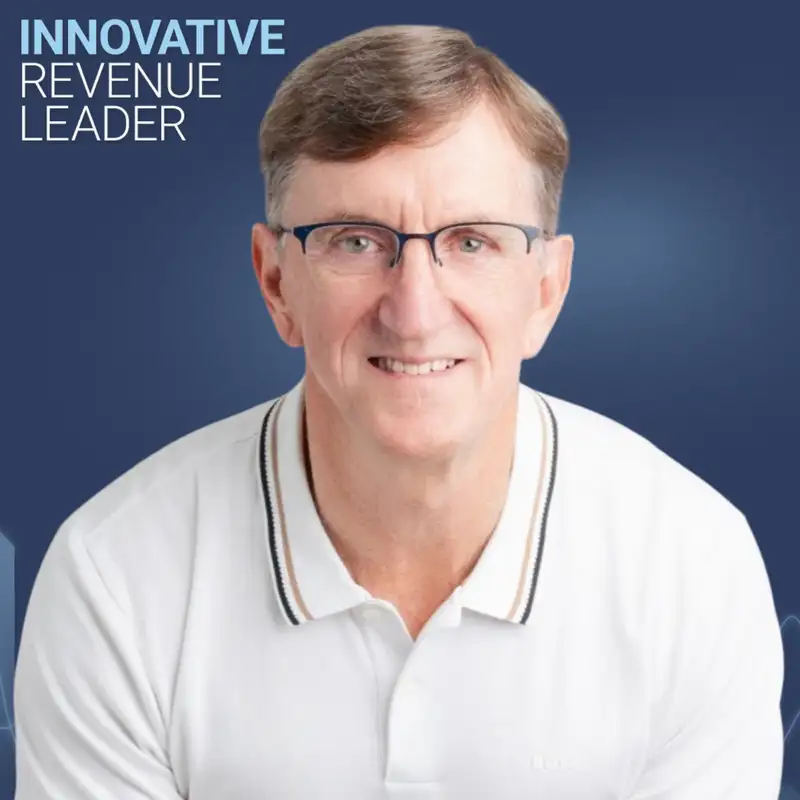
IRL - Todd Abbott
===
Speaker 2: [00:00:00] Welcome to the Innovative Revenue Leader Podcast. I'm your host, Seth Mars. Join me as we deliver practical insights to help B2B CROs Find new and innovative ways to grow in this fast changing environment. The Innovative Revenue Leader is sponsored by Sandler, a triad company, empowering sales professionals and leaders to master the craft of selling at all levels.
seth-marrs_32_10-09-2026_151411: Hello, everyone. Welcome back. This guest is someone I'm really excited to have on the show. He's a veteran in B2B technology go to-- And, uh, a- a, he's a veteran B2- B2B technology go-to-market executive, multiple times startup CEO. He's a go-to-market advisor and, uh, a, a really a huge presence in the sales technology space.
Someone that I've been fortunate enough to, to cross paths with in, in multiple different... On multiple different occasions. He has nearly three decades of experience mana- managing enterprise go-to-market organizations and running multi-billion dollar revenue operations. Carried [00:01:00] a, a $4 billion revenue organization as a CRO at Abaya, while leading the operational and cultural integration of the $1 billion Nortel acquisition.
He served as CEO of InsightSquared, where he and I worked together, and at Deliver.ai. Co-founded RevLens.ai, which we'll talk about today, and executed major M&A integration strategies across multiple tech founders. He's the co-founder of RevLens.ai. Todd, so awesome to have you on.
todd-abbott_2_10-09-2026_141411: It's great to be here.
seth-marrs_32_10-09-2026_151411: Yeah, you and I have crossed paths in many different cases.
Even if when we're not working together in different companies, we seem to always be in the same circles.
todd-abbott_2_10-09-2026_141411: Always. And, uh, I think you, listen, you've been a, you've been a really g- great advocate, I think, in the industry, and I've always enjoyed the time, just pick up the phone and picking your brain a bit. Uh, you've been a good sounding board for me. So I do, appreciate the, uh, the relationship we've had over the years
seth-marrs_32_10-09-2026_151411: Yeah, right back at you. E- exactly the same. Um, okay, so I'm gonna jump in with the, the question that we typically, that we ask for ev- everyone that joins the show. Like, [00:02:00] what... If you're a CRO right now, what's the most innovative thing in B2B that you're seeing?
todd-abbott_2_10-09-2026_141411: well, I think the most innovative right now is the ability to now start to merge your data and start to get a deeper level of analytics, that you just haven't had before. I mean, when I think about myself j- jumping into, or any new CRO, what do you do for the first 90 days? You go spend a lot of time trying to understand, what did I just walk into? Where do I win? Why do I win? Everybody can figure out, RevOps can tell you who your top reps are. but do you really know what a winning sales engagement looks like? And how do I replicate that? Do I really know where the friction points are? And so we spend a lot of time, alwa- always been one of these road warrior, uh, sales leaders, where you spend a lot of time just getting on sales calls, getting in front of customers, talking to your teams in the car, and just trying to really understand, uh, what's working, what's not, what's competition saying, what, uh, is the value prop? That whole ability for an organization to [00:03:00] capture, the best sales rep, the sales leaders, and it's the best marketing leaders, best product leaders, are the ones that anecdotally can connect the
dots, Right? But
it's anecdotal, right, to a great extent. And, and it's all predicated on how many, uh, meetings and sales calls and engagements you can have. Um, and so it's really hard to keep up with that and to see the, the ch- the changes in trends when a competitor starts doing something or the market starts to shift. And, and so what technology has always done is compress time, right? You have to be able to move faster. while all of the components in your tech stack are doing a tremendous job at doing fit for purpose automation in the sales go-to-market, I mean, it's been some amazing automation,
uh, and innovation, they're not doing is helping you to connect the dots on last 12 months, um, or the last six months if I've got a smaller transaction, smaller, uh, sales cycle.
How do I connect the dots so I don't need to, to value or to have debates about my anecdotes versus your anecdotes versus what the [00:04:00] CMO thinks? Like, we are finally getting to a point where those three, I call them the, the really three key stools of any go-to-market product, marketing, and sales. If we can get those three functions to totally agree and align on what the friction points are and, and focus our collective efforts there versus debating what my data says, what, versus what yours, or your anecdotes versus mine, like, just too much of that still goes on today. Um, I think we're on the cusp of just solving that problem
seth-marrs_32_10-09-2026_151411: and, and I, if I, if I'm reading the way, like, y- y- that you're, you're talking about it, data's the answer. Like, it... So the, it isn't that these pe- 'cause they do hate each other, like, at times, sales, marketing, and, and product, they don't get along, but there's... Lo- a lot of that is because there's no foundational source of truth for all of them to work on.
And if I'm reading that right, you're like, you solve the foundational source of truth, you solve the problem
todd-abbott_2_10-09-2026_141411: 100%, right? And the beauty now is with, with Gen AI and these agents, like you can create, uh, your, you know, the, the, the, um, the agent for you as a [00:05:00] product manager is different than that for a marketing, uh, CMO or a mar- or a demand gen or a, or a sales leader. But if you're all, um, getting the same view and the same version of the data from the same data set, well, man, you got a fighting chance now,
seth-marrs_32_10-09-2026_151411: Yeah.
todd-abbott_2_10-09-2026_141411: Right?
seth-marrs_32_10-09-2026_151411: Yeah
todd-abbott_2_10-09-2026_141411: um, it just, it's amazing to me to this day how much there still is friction between those three groups in, in the m- in the monthly business reviews, quarterly business reviews, and the CEO is left to try to figure out where is the truth in all this
seth-marrs_32_10-09-2026_151411: Yep. And I, I think it's really... I'm gonna, uh, as we dive into this, what's really cool about your experience is you've run companies that have been trying to do this and succeeding in some areas, and in some areas, I would argue you were, you were too early for it to be able to be done. So yeah, I, if, I'm gonna jump into that.
So you've been in technology for a long time. Can, can you talk through your perspective on the evolution of sales technology
todd-abbott_2_10-09-2026_141411: Sure
seth-marrs_32_10-09-2026_151411: and the [00:06:00] change that's happening in AI in, in context of... 'Cause this isn't the first time a change has happened. I mean, we went, we moved to SaaS. We are on, like from on-prem, there's...
You've seen it. I mean, you going back to Avaya, like how does this fit in the context is, of are we getting too hyperbolic with it? Are we not hyperbolic enough? Like, 'cause you've seen all of this stuff play out over, over the years from the lens of a, a sales leader right in the thick of the most, like working at some of the companies that have the most advanced technology that they could use with their sales teams
todd-abbott_2_10-09-2026_141411: Yeah. So I, I mean, if I'm, I'm gonna date myself a little bit 'cause it really, I think the first big technological development and enhancement or innovation was CRM,
right? And the issue we had with CRM before then is when you lost a rep, rep went with all, it took all his data with him,
and you had to go rebuild the territory. And
So in a sales cycle of six months, when you, when you lost all of the notebook, every rep had its own version, its own way to, to [00:07:00] capture its data, right?
And so the biggest change on CRM was a cultural one, which was to basically start to, to tell reps like, "Hey, no, no, that data's not yours. That data is the company's."
seth-marrs_32_10-09-2026_151411: I remember having those conversations. That's my customer.
todd-abbott_2_10-09-2026_141411: Go on.
seth-marrs_32_10-09-2026_151411: It ain't your customer. You're, you're helping with that customer
todd-abbott_2_10-09-2026_141411: Bingo, right? And, and y- and then you'd always give a buy to your best reps who would give you the mo- the, the, the most amount of pushback
because you wanted their results, but you also wanted to capture their data. And so when we, when we moved to having automatic data capture to get the rep out of having to put in the data in CRM,
Wow, that was a huge, a kinda, a, a huge advancement, and it kinda took a lot of the friction out of the system. Um, uh, and so those two were really, really big.
I, I think when we got... Now, SalesLoft and Outreach, what they did for sequencing,
now, in one sense, what they did was amazing. Unfortunately, now we've got nobody will look at, you know, emails,
and, [00:08:00] and you can't get through spam, and you can't get people on the phone.
I mean, it's... So it was so effective, but it became so ubiquitous for everybody that now we've got the next challenge,
right? Um, and so, uh, I, I think the next big, uh, challenge we're gonna have is each of these platforms that are in your, your tech stack, now a lot of them are being disrupted with gen AI and agents.
Agents can replace an awful lot. Like, if I was still running InsightSquared, I'd be running for the door 'cause I can create an agent that do dashboarding that
InsightSquared did, like, n- not hard, right? It, um, and there's a lot of components in your tech stack that, that, um, are in that similar risk position.
But what they're all doing now is you think about Salesforce and, and Gong and, uh, uh, any, uh, the combination of, uh, of sales engagement and Clari, like, they all now wanna be the platform that has all your data.
Uh, it's a classic move of a legacy provider. If I own the data, like nobody's, everybody understands it that's in tech, that it's the [00:09:00] data that's gonna be king, but the data exists still in so many different places.
And what we're now seeing is with, with, uh, the MCP protocol that An- Anthropic is everybody is an NCP to enable gen AI to go get data from any one of those component platforms, but it's still a deal analysis,
right? If I wanna review this deal, I can go get it from each of the platforms and get all the data and analyze this deal.
But what I can't do is take all of my engagement data, uh, and consolidate it and, and throw, uh, an, a, a- an agent at it to be able to underst- that, to, uh, to get out the insights that I don't know exist,
right? That's the beauty of gen AI is It, it, you know, it, I learned this at InsightSquared when we went from a, a data warehouse implementation, gen
one of InsightSquared, and we bought Olono. Olono was the data capture, and we had our own LLM. This was
before gen AI, right? Very expensive. We were, we, we were, um, creating the learning models, the training models.
[00:10:00] Um, but the beauty of it, and it opened my eyes, is to say, "Hey, listen, I don't know what I'm looking for," right? When you create a data warehouse, you have to know what, what you want to report on, what the dashboard wants to look like.
And if you wanna change that view, then you gotta go get the architects to go change the structure of the data warehouse so that the reporting works every week,
right? And that's why you would see in the old world, it would take IT two to three weeks to make a change to get the view that you want. Right
seth-marrs_32_10-09-2026_151411: Yeah, because it was the data, it wasn't the view. It was I couldn't structure the data the way that I needed to v- make the view
todd-abbott_2_10-09-2026_141411: Bingo. And I think that's the beauty of LLM, is that I don't need to have structured data, right? It, it's... I, I, the way I like to say it is it's just a big flat file.
seth-marrs_32_10-09-2026_151411: Yeah
todd-abbott_2_10-09-2026_141411: and, and to be able to now have an LLM that says, "Uh, hey, go review this. These are the deals that I've won, these are the deals that I've lost.
Give me the reoccurring themes. Like, what... Connect the dots for me." It's the anecdotal thing that I used to do when I w- in my first 90 days making sales calls,
is to try to h- what do I hear four, five, six times, right? So [00:11:00] now you can point an LLM, that gen AI LLM at it and say, "Go, go find the trends.
seth-marrs_32_10-09-2026_151411: Yeah
todd-abbott_2_10-09-2026_141411: Like, like, what happens over this six-month sales cycle when I win versus what happens when I lose?"
Like, we're doing an engagement right now, a company that, um, uh, what, what we found was that they had a large portion of their deals where the rep began to, to descope, to reduce the configuration to fit a budget.
And what we learned was every time they did it, they lost. Their win rate was zero.
seth-marrs_32_10-09-2026_151411: Really?
todd-abbott_2_10-09-2026_141411: Zero. And so, okay, so now what do you do with that? Okay, is that a qualification issue? Do I need a different set of tactics? I certainly need a h- a, a heads-up to say which deals are in the forecast that,
that I've descoped, for sure
right? So there's multiple actions that you can take, nobody had connected those dots because it's over a series of deals, in this particular case, nine months, 'cause that's kind of the sales cycle.
I think, when I think [00:12:00] about how far back you go, it really is predicated by how long your sales cycle is.
You got a
six-month sales cycle, you probably wanna go back 18 months. Go back any further and it was a different world back then.
30-day, 45-day sales cycle, a year, nine months, probably more than enough.
You get polluted data when you go back too far, right?
But the ability to, to consolidate all this data, and I don't, I just don't think any of these platforms are the winners for consolidating the data.
Um, they're, they don't have the big compute platforms. It's gonna be way too expensive. And, and, and creating a data warehouse, doing an extract from all these platforms into a standalone dataset, a data lake, f- to have gen AI, uh, um, LLM point to it, it's not that hard.
It's not that expensive
seth-marrs_32_10-09-2026_151411: Is it even needed anymore with MCP? Like, it, like you talked about the data warehouse, like, or is it a different type of data, like, like data
todd-abbott_2_10-09-2026_141411: It's,
seth-marrs_32_10-09-2026_151411: storage structure you need?
todd-abbott_2_10-09-2026_141411: Yeah, no, it's different. You have to extract the data. I mean, an MCP, as I said, is if you wanna go look [00:13:00] at a rep's deals, going and getting this little snippet of data, this little snippet of data, this little snippet of data and doing analytics, I, I would say, listen, keep, uh, do that with all of your components of your tech stack today.
Th-
those Are great, uh, it's a great implementation. if you wanna go look at, at holistically, I don't know what I'm looking for, I, I wanna understand what are the underlying correlations between winning and losing, industry, size, actions. uh, you know, the, the analogy I always like to use is, okay, you know who your best reps are. If you go ask them, "Hey, what do you do? Why, how are you winning?" They look at you like, you know, what, like you're speaking Greek. "What do you mean? It's intuitive. I don't know. I don't even know how to answer that question." Right? So I don't even need, you don't even need to ask them, okay? I'm just gonna take all your data, and I'm gonna connect the dots on those top 10% reps, and what's the consistency? What, what I, what we find most often, if we found this back in Alono, is that the best reps know when to unhook a deal way early.
seth-marrs_32_10-09-2026_151411: Yeah. Get out. It's not gonna happen
todd-abbott_2_10-09-2026_141411: The vast majority hang [00:14:00] on. Hang on on a hope and a prayer. And that's in the funnel, it's inflating the funnel. In some cases, it's inflating the forecast. This example I gave you relative to de-scoping a deal you don't win, um, it's just giving you a whole 'nother set of analytics that an MCP implementation won't give you. So I, I really do think that, that, that any one of your existing platforms as the, uh, as the data lake to point your LLM to, I, I, I don't think, I don't think they're gonna win. I think it'll be much less expensive for you to extract your data into an S3 bucket or w- whatever you wanna do from a data lake.
There's lots of different options there. That's not that expensive. I think the bigger debate will be, uh, do I point the generic gen AI platforms at my data lake, or do I bring that in-house? 'Cause I
don't wanna Train the general, uh, AI models, because this now becomes proprietary information
on where I'm winning.
'Cause if I [00:15:00] now know where I win and how, and I double down on that, and I can take my conversion rates up 10, 20%, 5, 10%, like I don't want that exposed.
And so I think the next big thrust is gonna be, am I running-- I, I'm certainly running a data lake m- by myself or in my own infrastructure. I'm, uh, or in a, in a, uh, clean room run by a service provider.
It doesn't really matter as long as it's just yours. And where does the LLM sit? And are you gonna trust Anthropic or ChatGPT to say, "No, no, no, no. We've got an enterprise configuration. It's not gonna go into our training model." Do you trust them or don't you? And I think the larger the organization, the more the answer's gonna be no.
Uh, I don't-- I'm not gonna trust them. The smaller the organization, you're gonna say, "Yeah, wing it. Go ahead. No worries."
seth-marrs_32_10-09-2026_151411: Yeah
todd-abbott_2_10-09-2026_141411: I don't know where that, that demarcation line is quite yet, but I, I do think ultimately there's going to be, uh, go-to-market enterprise LLMs that are gonna sit within either in a clean room or within y- [00:16:00] your four walls behind, behind your firewall
seth-marrs_32_10-09-2026_151411: Yeah. I mean, you're starting to already see it happen with, like, Salesforce announced COA, right? They're starting-- You're start- You're gonna, and you're gonna see the same thing happen with SAP, with Oracle. They're gonna start, they're starting to pull all that stuff in a clean room and pulling that stuff into your own space.
Absolutely, 'cause that's, that is your competitive advantage.
todd-abbott_2_10-09-2026_141411: That's right. That's right
seth-marrs_32_10-09-2026_151411: it's also, I mean, is it fair to say, like it used to be I need to be the single source of truth, and I need everything in front of me, and that's where I'm gonna work. Now it's a layer back saying, "I need to have the context, and I need to have the intelligence to help me make sense of the data," and that's what software providers are providing as value compared to the single pane of glass that they would talk about three years ago
todd-abbott_2_10-09-2026_141411: That's right. That's 100% right.
Uh, I, it, it's, I, I, I'm, I... Having been a part of large, over my 30 years, large companies that were disrupted,
Uh, it is really hard to move from a legacy model to a disruptive [00:17:00] model.
Um, I mean, we had that in a very small ca- case in, in s- in, uh, InsightSquared, as I said, going from a data lake, data warehouse to a data lake was a rip and replace, and a rip and replace for a SaaS vendor is the death.
seth-marrs_32_10-09-2026_151411: Yeah
todd-abbott_2_10-09-2026_141411: can't do it. I mean, we would've better, been better off starting a new company versus buying a lone O
seth-marrs_32_10-09-2026_151411: Really?
todd-abbott_2_10-09-2026_141411: it was j- Yeah. Yeah. It, I, I mean, literally, we were in debates with customers, "Hey, I've got so much more compute and insights, uh, uh, uh, to be able to provide you," and they were like, "Yeah, that's great, but where's the red widget on that dashboard?"
seth-marrs_32_10-09-2026_151411: Yeah
todd-abbott_2_10-09-2026_141411: I'm like, "A red widget on that dashboard? Like, uh, do you understand that a red widget works really well when it's a data warehouse, but on a data lake, do you really need that data, that red widget? 'Cause I can give you 20 other widgets that are much more powerful."
seth-marrs_32_10-09-2026_151411: Yeah
todd-abbott_2_10-09-2026_141411: we spent way too much time doing that, that I, that I just realized just as much as I thought the value prop was so compelling that making this transition, customers would, would jump and run,
seth-marrs_32_10-09-2026_151411: Yeah.
todd-abbott_2_10-09-2026_141411: it was too hard.
seth-marrs_32_10-09-2026_151411: let's talk about [00:18:00] that a little bit, right? 'Cause that was around 2021, and y- you just said it, right? Like, the, like you did the acquisition of Alato, so you had a into InsightSquared. So you had, you had an LLM, wasn't the type of LLM, LLMs we're talking about today with, in terms of like power and capabilities.
But still, like all the vision was there. Like, i- it, with the exception of today, like dashboarding is not everyone's talking down dashboarding versus it being the central source. Like why... I- is it as simple as we just didn't have powerful enough tools to be able to do what we wanted? And then I, I think you, like what stopped you when the, when those tools started to coming, to come available to be able to just make that work?
Was it as like the ar- like you said, like the architectural side of it is just too much, and if you would've taken the concept of InsightSquared, started a new company with the same and pivoted them over, it would've been better?
todd-abbott_2_10-09-2026_141411: I think it would've been. I think it was, [00:19:00] um, it was too much of a paradigm shift for my existing customers, who really, um, I had too many of my existing customers that were really just interested in the pretty charts to bring to the boardroom, or the pretty charts to explain their story to the, the private equity investors or just to the CEO. Uh, they used it much more as a bridge. Um, I came... I'm more of a, a, and I don't, I'm not trying to talk down on any of my customers 'cause, I mean, a lot of them were highly successful. But I had, I had a vision for where this was going, uh, what I like to refer to as the science of sales. I had to find the science of sales, uh, leaders that just had a constant thirst for more analytics, for more data, that didn't wanna live on their anecdotes, on their gut. Um, and those are the ones that I had the most amount of success with g- painting a vision, and they would, like, go with that red widget in a flash. But too many of my customers, to a great surprise to [00:20:00] me, would just be so wedded to the red widget, to the... And when I say, when I mean by red widget, the format of the dashboard that my CEO and CFO and my board wanted.
Like, I, I don't wanna go back and explain to them that I'm gonna give you a different version of the, of the dashboard. Because some of the dashboards we had at InsightSquared, you just couldn't do, uh, on a data lake implementation. It just, it just,
seth-marrs_32_10-09-2026_151411: Yeah
todd-abbott_2_10-09-2026_141411: expensive, and it's just such a waste of time.
seth-marrs_32_10-09-2026_151411: Yeah
todd-abbott_2_10-09-2026_141411: And so, um, I underestimated how much they were using it for the storytelling versus really using it to understand, what do I need to do to optimize my go-to-market? 'Cause that was the big shift, right? A dashboard is a rear view mirror look,
seth-marrs_32_10-09-2026_151411: Yeah
todd-abbott_2_10-09-2026_141411: right? A predictive engine is now what's going on and what does this mean relative to what my conversion rate or my close rate or my forecast is gonna be over the next 60, 90 days, and how do I optimize that to have better results,
right? I had too many that were very comfortable with the rear view mirror view
seth-marrs_32_10-09-2026_151411: Yeah. But that, but [00:21:00] that was the world we were living in back then. I think like the way you were talking about that, your ability to visualize that was the story. There were very few companies that were... What, what I, the way that I interpret what you were saying is I need a system to help me find unknown unknowns.
So I don't know the, I don't know the question to ask. I don't know what I'm gonna get with the answer, uh, so I need a system to tell me. And that is actually becoming, like you talked about it already, like that is one of the cool things you can do with AI is, "Hey, what the hell's going on?" And let it run and then t- like com- like companies like yours can go in and figure out how to help that make that better.
But as a user, I don't have to have the answers to all of the questions. But back then I needed to have the an- the only value in analytics was I, I had to have the answer to all the questions and if I'm an enterprise I had to architect that all the way through my tech stack and then once I did it, I was bound to it unless something crazy happened.
So it was it was, it's crazy it was about the pitch deck to the [00:22:00] board, "Don't mess with it," rather than, "How do I use this to dynamically figure out how to do better for my business?" It seems when you like listen to you say it, seems nuts now that we operated that way, but that was the truth then
todd-abbott_2_10-09-2026_141411: Uh, it, it, and I still think there's a lot of, there's a lot of sales and marketing executives that are still running their businesses based upon how they've run it for the last 15, 20 years.
Um, I saw this, I saw a similar version of this, um, uh, at Deliver,
where We were providing person-based intent. I mean, we basically, uh, concluded about a year, 18 months in, not to sell to the enterprise. Because what I found was, um, we had a lot of CMOs who their biggest measurement was leads. How many leads did I provide into the, into the system? That was their
vanity metric that, of claiming success. Yeah. Right? And [00:23:00] so they would, despite me telling them 1,000 times, intent is not a lead. Intent is something you need to nurture.
You need... Now I, if you take it and you're a d- a science of marketing type, and you realize, wow, you mean I can take my digital advertising and my campaign spend and narrow it to who is actually demonstrating some search and buying behavior to get them to be qualified as a lead? Like, it was a home run. But too many were vanity-driven, and they said, "Well, I just want to give it to BDRs." no, BDRs, th- they won't, they, A, the customer's not ready to get contacted. Y- The BDRs will tell them, "Hey, I see you're searching," and that's like the death knell. And so I wound up spending so much time, um, we wound up spending so much time, uh, consulting on what to do with this data, and it's very similar to my experience at InsightSquared.
That guy who wanted that red widget. I'd say, "Hey, did you know you win, uh, at, at about [00:24:00] 10 to 11 meetings in the sales cycle?" Because every sales cycle is a series of meeting
conversions, right? Get them to see value and want to have the next
meeting and bring In somebody else,
right? The b- buyer group expands. And we were able to tell this one, I remember this one customer distinctly. I said, "Listen, your big inflection point is between meeting four and five. If you can get to meeting five, your win rate goes to X. if this, if the, uh, CXO gets engaged by meeting six, your win rate goes X." And then we would show them deals in the funnel where you've only got two people in the buying group. you're at meeting six, the CXO is not there. You only have two. Like, this has every variable that says this deal is a hope and a prayer. And they would say, "No, no, no, that's Johnny. Johnny's really good. He'll get that deal across." 60 days later, I'd come back around and say, "Okay, well, what hap-" I had their data.
I'd say, "Johnny didn't execute," right? That didn't execute, didn't convert, right? And so, uh, it, it, they're all learning opportunities, but you need to have somebody that is more science of [00:25:00] sales or science of marketing that takes these insights and says, "What am I gonna do about it to help my team execute better?" And I've just been really, surprised how hard it is to find the science of marketing, science of sales type that, that this resonates to and go, "Absolutely, let's go." I mean, when I joined, uh, InsightSquared, it was, it, it was because of the acquisition of Alona, I was like, oh my God, I'm so tired of beating up reps to give me data so I could have sal- rev ops, sales ops at the time do analysis, and they were always dealing with stale data and not complete data.
I mean, no matter how many times I put pressure on the reps, I could move the needle like this much,
right? Um, and so when I saw that, I was like, oh my God, this, this can solve like the biggest pain
point and now I wanna see, okay, what kind of analytics can I get on it? I didn't understand how big of a minority a science of sales type I was.
seth-marrs_32_10-09-2026_151411: you are. I mean, a- and in, and it's, it's really behaviors, right? [00:26:00] Like, there's weird things that happen in a go-to-market motion. I mean, a lead, if you're told your job this year and your MBO and you're get- your success is this many leads, you stop caring about the fact that those don't turn into revenue, even though the company is eventually going to let you go, because you, if you can't generate enough of them.
And as a seller, you care about your quota however you get it. You're not necessarily focused on the right way to go about getting it that generates incremental revenue. It's, yeah, it's, it's not surprising. Um, but it, but it, but it is, because you think in a revenue engine that those teams would be myopically focused on how do I grow?
And you're, you're there telling them how to grow, and they're like, "Well, but I just want a lead," and, or, "I just need to do this." It's, yeah. So I think that kind of dovetails into some of the things, like you, you kind of got the engine when you're talking about InsideSquared, and then [00:27:00] it seems like the, like you got even a bigger explosion to broader data around the buyer with Deliverr.
And, like, that's kind of led you to go, you know what? Like, no one's figured this out. I've seen both sides of this. So tell me about how Revance fits into that.
todd-abbott_2_10-09-2026_141411: Yeah. So I, what I, uh, RevLens is a services company, uh, because, uh, in essence, you can do everything that we're talking about. You can stand up a data lake, uh, and get all the data from all your components. You can point to gen AI. You can go create the agents. You can go do that. Um, but there's a, the tremendous learning curve with it. Uh, and so what we've kinda concluded that, um, me, a, a number of sales leads and some rev ops leads that were really deep technically who have done this, that, um, uh, we wanna help companies, the science of sales, science of marketing types, who see, um, what this technology can do and, and have a thirst to get at those [00:28:00] insights, is we wanna basically accelerate your learning curve,
seth-marrs_32_10-09-2026_151411: Yeah
todd-abbott_2_10-09-2026_141411: So we will come in, uh, with a s- a, a tool set with, uh, learning of how to consolidate all the data. Um, uh, what's your, what's your LLM of choice? the discussion of, are you comfortable with a, a, a, um, a frontier model that's, uh, public? Um, or do you want to move to having your, a private LLM? Um, I, I, as I said, I think that will be predicated based upon the size to a great extent, but I think it'll become more standard over time.
seth-marrs_32_10-09-2026_151411: Mm-hmm.
todd-abbott_2_10-09-2026_141411: Um, but it doesn't matter. Like I don't, I'm, we're not wedded to... I, I'm not trying to displace anything in your tech stack, 'cause that tends to be a,
wait a minute, I don't wanna change the workflow or change what my team is working in. let me help you stand up the data lake. So we come in as a, a team of consultants.
We can do it for you. We can help you do it d- with your team. Uh, we can bring in a, uh, a tool set of agents for the product teams, for the [00:29:00] marketing team, and for the sales team. So give you a rapid head start, um, uh, to the types of things and the, and an interface that you wanna give your sales leaders or your product leaders. 'Cause when we talk about a product team, depending upon the size of the company, you have four or five different product lines. They wanna look at things from their own vantage point, right? Um, um, and so we help them with the, uh, with the deployment, the picking of the LLM if they, most of, most everybody has an LLM enterprise model of
seth-marrs_32_10-09-2026_151411: Oh yeah
todd-abbott_2_10-09-2026_141411: Um, and, and then help you set up with the agents, and then help you, uh, consult with you to evolve those agents to get you the insights that you want. It can be a two-month engagement, three-month engagement. We can continue to stay with you to help you go through your learning curve on developing the agents.
'Cause once you've got the infrastructure set up,
seth-marrs_32_10-09-2026_151411: Yeah
todd-abbott_2_10-09-2026_141411: now it's about continuing to modify and evolve the agents. And, um, I mean, Seth, I don't know what you've seen, but what I've seen is m- most people, um, uh, don't really [00:30:00] understand how to query an LLM effectively.
seth-marrs_32_10-09-2026_151411: No, it's a, it's way harder than it sounds
todd-abbott_2_10-09-2026_141411: Wow. Right? So, so we'll come in with a, a, a tool set for each of those three disciplines of the different, uh, of different agent configurations or, and take them and evolve them for your business.
So you've got a really fast start, and we'll teach your team. We'll teach your, if this sits in RevOps, um, or marketing ops, depending upon what the structure of your team is, we'll help them get acclimated to be able to use th- this technology, which we stand up in the customer's, uh, four walls behind the, the, uh, firewall, so to
speak.
It's your Data. It's your infrastructure. We're really a cons- a team of consultants that have done it before, and as we do more and more of them, um, we're just gonna be able to help you accelerate, what might take you six months to go figure out, like we can go get it, uh, all stood up and running in five weeks
seth-marrs_32_10-09-2026_151411: Got it. So I, I wanna just double click on something with you, 'cause I think a lot of people when they think about how do I engage with an agent, they stop at, I prompt it, right? And [00:31:00] you got
your, you got your Claude warriors that'll bid their, build their project
in, in Claude. You're talking about like a, uh, the, the tool set that takes advantage of way more than just how to even at the best possible prompting
todd-abbott_2_10-09-2026_141411: That's right. Yeah. I mean, think of, uh, uh, a, um, uh, an agent in this context as a UI that is doing that LLM prompting behind it. So, so we've, we've got all of the LLM prompting done, or it will-- And then it will help you evolve that LLM prompting with a UI.
seth-marrs_32_10-09-2026_151411: Got it.
todd-abbott_2_10-09-2026_141411: and, and it's orientated. So we'll give you a, a, a quick head start as a product team.
Like I-- we know, you know, these are the 10 things you're gonna look for. As a sales rep, sales manager, here are the things that you're gonna look for. I, I really think that what we're deploying really is a leadership that will evolve down to first-line level.
Uh, we can, we can create agents for a first-line manager to, to prompt and give reports out to a rep.
But I'm not trying to create a, a rep-based tool, [00:32:00] right? Um, uh, because at this point, our focus is get me the insights. Get me, the customer, the insights,
seth-marrs_32_10-09-2026_151411: Mm-hmm.
todd-abbott_2_10-09-2026_141411: Uh, at a, at a grand level, and then start to do it down through the hierarchy. I wanna be able to have my first-line manager, if I've got 10 first-line, five first-line managers, I want them to understand the big picture, but then I al- also want them to understand what's going on in my team. do I need to focus my time and attention to coach? Because
seth-marrs_32_10-09-2026_151411: Yeah
todd-abbott_2_10-09-2026_141411: if you think about, uh, this, uh, the way I think about conversational intelligence, right? It was, God, it was amazing. I could, I could get all this data, and everybody gets all excited about it. And then three or four months later, after you've listened to so many calls, you just stop listening to them.
seth-marrs_32_10-09-2026_151411: Yeah. You need a better way to extract that
todd-abbott_2_10-09-2026_141411: 100%, right? And so I think Gong is making, um, some really good progress relative to getting the data out on a deal. but on the broad go-to-market, they're not set up to do that.
so-- And it doesn't have all the data. Now it's setting up MCPs to get all-- more data from the other [00:33:00] technologies.
The question is, are you gonna bet on them and what they're gonna charge you for that LLM compute, or, or do you need to stand it up in, in-house?
seth-marrs_32_10-09-2026_151411: Yeah.
todd-abbott_2_10-09-2026_141411: last point. I mean, I just think this point, uh, it really unleashes you to have so much more flexibility. Uh, and I'm not telling anybody to, to, to get rid of Gong or get rid of sales.
Those guys, those companies are gonna be around for a long time. Um, but, but, but you should have greater control on where you're gonna take your business architecturally from an AI, from an LLM perspective to get these insights. And the companies that do it the fastest, the ones that get those insights, the continuous improvement to out-execute competition, who wins
seth-marrs_32_10-09-2026_151411: Yeah. And it's, I mean, e- those companies are gonna have to enable that too, right? That you have to be more flexible in doing that for sure. It's a great point. Okay, so let's talk a little bit about you. Like, you've been a CEO at most comp- at, at multiple companies.
todd-abbott_2_10-09-2026_141411: Yeah
seth-marrs_32_10-09-2026_151411: y- you've been involved in tech for a long time.
Like, what, as a kid, w- any signs [00:34:00] that would've said this would've been the journey you went on? Like, did, did you know it from the beginning? Like, what, what was, like, the goal? Like, if I were to ask you what your goal was when you were a kid, what you wanted to be when you grow up, what would it have been?
todd-abbott_2_10-09-2026_141411: No, it's a great question. I, I, and I won't, uh, I won't spend a whole lot of time on this, but I came up from modest background. I mean, my, both of my parents were school teachers. uh, I had an uncle who was a salesman and, and I thought he was just the coolest, and he had money, and I'm like, "Hmm, I want, I wanna make money." Uh, and I went to Northeastern and got a co-op job at IBM, and that just opened my eyes to a world I had no idea existed. This was when IBM was the, I'm dating myself, but IBM was a, a kickass company, and the whole concept of dark suits and, and the starched shirts was like, wow. I w- I
felt like I landed on a different planet. Um, uh, and then when I went to Cisco, boy, that's, that was all about speed and execution and, and, and I learned just so much. Um, but what I learned s- as I kinda went through that process, if I would tell [00:35:00] anybody anything, I, I, I wish somebody had told me, "Don't be in a rush to keep getting to the next job."
'Cause I always look at, at a professional career as like the opposite of a sports athlete, right? Athlete makes all their money based upon their DNA at the early part.
seth-marrs_32_10-09-2026_151411: Yep
todd-abbott_2_10-09-2026_141411: an executive, uh, business people, they make all their money at the latter part. And so the more you can capture early on in your, in your career to be able to do, and grow into what your capabilities are, um, go into it with a level of intellectual curiosity.
I was humble and intellectually curious on how shit worked
and how the sales process worked and, um, and needed to know really what our solution was and was, what it wasn't. And, and, and I didn't necessarily think, "Wow, I can be a CEO," but I just started to really enjoy, uh, building teams,
um, hiring great people.
And we, we had a bunch of, you know, no bullshit guys that just were execution-oriented and, wasn't for everybody.
but but I just learned early on how I [00:36:00] could motivate, um, and be part of a team, and the team just kept getting bigger and bigger.
seth-marrs_32_10-09-2026_151411: Uh-huh.
todd-abbott_2_10-09-2026_141411: But I never lost sight of the fact that it was al- it's always the rep. No matter how many layers were between me and the rep, the rep is king, man. And I always wanted to know what was going on in the rep's head, um, what was being filtered down and filtered back up. So when I was out on the road, um, now it's virtual meetings, but just connecting with the reps to understand what's going on, how was my message, how was our vision translating, and what are the friction points in your job? Um, I just never lost that, that touch, um, that focus.
seth-marrs_32_10-09-2026_151411: Yeah
todd-abbott_2_10-09-2026_141411: Um, and then over time it just be- I just learned how to scale it and, and up to this level.
seth-marrs_32_10-09-2026_151411: Yeah.
todd-abbott_2_10-09-2026_141411: Something I said, "Oh, I wanna do that,"
seth-marrs_32_10-09-2026_151411: That's crazy. It's always... Yeah, it's always those threads. Like, I think about it very similarly, right? Auto Sweets, and then I had an uncle as well, and then for me it wasn't IBM, it was GE. [00:37:00] Um, like, you have these points along the way that really make you. But, like, your, your point around the rep, like that...
If you ever wanna know what's going on, that's the pl- it's the, it is the place to go. It's the only place you can go to really find out what's going on, and actually have a person that'll tell you. Like, problem telling you
todd-abbott_2_10-09-2026_141411: great point. The, the hard part was to get them to feel comfortable, and I used to always tell them like, "Hey, listen, man, give it to me straight. All right? You- this is... You're not gonna get fired for, for telling me what the reality is. Just, just give it to me straight." And it was hard to get them to open up.
But once they did... But, you know, we have a lot in common. I mean, GE was an execution machine back then, right?
seth-marrs_32_10-09-2026_151411: Yeah.
todd-abbott_2_10-09-2026_141411: Um, to me, Cisco was an execution machine.
seth-marrs_32_10-09-2026_151411: phenomenal
todd-abbott_2_10-09-2026_141411: and so between IBM and Cisco, uh, it was the foundation for me to, to have the career I've had
seth-marrs_32_10-09-2026_151411: Yeah. And it's, yeah. It, it means, I can see it in working with you and you can see it in the foundations of everything you do. You bring it to every job that you've done or every j- I mean, even the conversations we've [00:38:00] had. It's been phenomenal to, to get to talk to you. Thank you for taking the time
todd-abbott_2_10-09-2026_141411: Ah, thank you. I appreciate it. As always, good to talk to you
seth-marrs_32_10-09-2026_151411: Wow.
Speaker: And that wraps up another episode. Thank you for joining. For show notes and other episodes, visit us@innovativerevenueleader.ai. The Innovative Revenue Leader is sponsored by Sandler, a Trilia company. Sandler provides top corporate sales and business development training while empowering sales professionals and leaders to master the graph of selling at all levels.