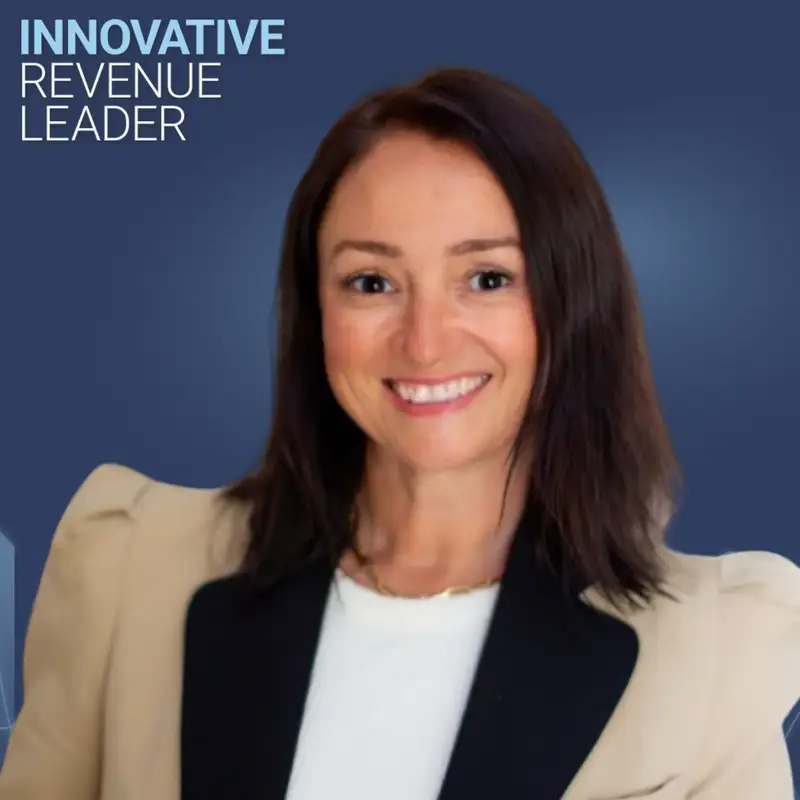
IRL - Kylie Fuentes
===
Speaker: [00:00:00] Welcome to the Innovative Revenue Leader Podcast. I'm your host, Seth Mars. Join me as we deliver practical insights to help B2B CROs Find new and innovative ways to grow in this fast changing environment. The Innovative Revenue Leader is sponsored by Sandler, a triad company, empowering sales professionals and leaders to master the craft of selling at all levels.
squadcaster-jf2a_4_07-24-2026_161256: Hello, everyone. Welcome back. This is someone I'm really excited to, to have on the show and, and a company that I've worked with for a long time, so I'm looking forward to having this discussion. She's an entre-an entrepreneur, a software executive, AI product leader, and revenue systems innovator. She spent over four years at Salesforce as SVP and head of product growing their quote-to-cash portfolio from a CPQ point solution into the number one revenue management platform in the market recognized by Gartner, Forrester, and IDC.
She also served as the CPO at [00:01:00] Zilliant leading product marketing and partner alliances for a market leader in AI powered pricing and revenue optimization, and has spent her career scaling enterprise software businesses to over a billion in ARR sitting at the intersection of advanced AI data and human decision making.
Her current position is Chief Product Officer of Salesloft. Kylie, great to have you on
kylie-fuentes_1_07-24-2026_131256: Hi. Thank you so much for having me.
squadcaster-jf2a_4_07-24-2026_161256: been looking forward to this discussion. So like, I start off usually with this, I start off with the same question every time. Like for, for you, what's the most innovative thing that you, that you've seen in B2B right now?
kylie-fuentes_1_07-24-2026_131256: Um, well, so B2B but I think I would probably just say generally. You know, we-- We're obviously living in an AI era. Everyone's, uh, kind of got the same topic on their lips. I think we've gone through this kind of journey of everybody talking about context and context being something that's really important. I sort of view that as kind of the plumbing in some ways. But to me, the evolution that we're, we're kinda coming to right now, which for me is [00:02:00] very, very exciting, is this notion of AI that kind of perpetually learns. So this notion of like closed loop learning systems, um, you know, we sort of have this... If you just look at this from a technology perspective, there was a lot of talk about like prompt engineers, and then there's context engineers.
squadcaster-jf2a_4_07-24-2026_161256: Yeah
kylie-fuentes_1_07-24-2026_131256: thing really is this notion of do you actually know how to build a loop? Because ultimately, you know, when you think about the power of kind of where we can go with these sorts of things, it's not that you have a human constantly double checking everything an agent does, uh, but actually you've created a mechanism, something that's systematic, that can actually really improve, um, the more you use it.
And so I think, you know, when I think about this category and when I think about B2B, this is something that has like an absolute, you know, perfect fit for the type of jobs to be done that we like to do. So I think this is an innovation that's gonna disrupt
squadcaster-jf2a_4_07-24-2026_161256: Yeah, and it's, it's one that I y- you almost think it's been kind of, um, washed to a certain degree because people have talked about that loop for so long but it never really existed. You either have a human that would [00:03:00] tick a box-- Like I, the thing I come, that comes to mind for me is you'd have like the thumbs up, thumbs down.
And I remember talking to companies about it like, "Okay, so when you click the thumbs up and thumbs down does the system learn to kind of that what works and what doesn't?" They're like, "Uh, n- no, that actually sends an email to the guy in product who then looks at it," and says like... Oh, okay. So, uh, but this is actually happening now if you set the loop up correctly, it allows you to actually do these things for real this time not just kind of faux, right?
kylie-fuentes_1_07-24-2026_131256: 100%. You know, it's funny I, I have a-- um, and we did not compare notes on this. It's funny I, I actually... I, uh, I say often, right? So my background, I actually started my career, I sort of started in like, um, SMB and consumer actually.
world, and I spent a whole lot of time in e-commerce, and if you think about consumer and e-commerce there was this notion of personalized shopping
and it was kind of the holy grail. The reality is it wasn't. It was merchandise stores which to your point, there was somebody there kind of maybe [00:04:00] optimizing a little bit based on what had a better click through rate and what ultimately sort of had cart conversion. But I think we've come full circle now where again, through, through the technology that's available, I think we can unlock two things.
One, this notion of something that perpetually gets better based on learning and kind of what works. But actually I think we're close to unlocking true personalization. Um, and, and we talked about this for forever, like almost 15 years. The secret truth is we've never really done it. But I, but I think, I think, uh, I actually think we're on the precipice of it, which is gonna be extremely cool, um, consumer, but absolutely in B2B, like I think, you know, workflows, they're customized workflows for an individual. Um, again, that's never been possible before and I think we're like this close
squadcaster-jf2a_4_07-24-2026_161256: Yeah. I mean, we deal with it on the Sandler side with like, "Oh yeah, we're gonna do personalized learning paths," and everyone's talked about doing those things, but it really is kind of like I do a learning path and I happen to change maybe one thing based on this. Not like as you learn grow, I'm like evolving it, which is what [00:05:00] everyone thinks when they think of a personalized learning path.
So yeah, it is so cool, so exciting. So a lot of company, a lot of people go in and take a... not a lot of people, but most people when you go into a new product role, you're going in for one company. Y- you're going in for two. Like you started this job and you have two brands, two very established brands.
What, what is that like? Or how's, uh, like what, what made that exciting for you? Because that's a, that's a challenge in itself, like just looking from the outside in
kylie-fuentes_1_07-24-2026_131256: Yeah, you know, I mean, I-- You could... I guess I haven't really thought about it as like two jobs
squadcaster-jf2a_4_07-24-2026_161256: It kinda is. It was at least, yeah
kylie-fuentes_1_07-24-2026_131256: The way I look at it- No, no exactly, I guess that's true. No, I, I mean, the way I look at it and, and, and maybe the direct answer to your question is for me, um, I, I, I guess what I'm passionate about is solving problems that are worthy of being solved, like valuable problems. I think, um, one of the reasons why I've always sort of anchored around commerce or revenue tech is because, [00:06:00] quite frankly, you're just so close to like, at the end of the day, the nugget of business right?
Like nothing happens until somebody buys something and kind of revenue tech is like the vehicle by which you can help businesses maximize that. So for me, that's very exciting. I think, you know, what's kinda more compelling about it is again, building off what we talked about before this notion of being able to have learning loops, this notion of being able to have context all of that is kind of like there's an underpinning independency of being able to have some underlying capabilities that you can stitch together you understand the context so that you can perpetually learn, so that you can deliver these personalized workflows.
And so what was super interesting to me, you know, about the, the joining of Salesloft and Clari you look at the revenue lifecycle, you look at the revenue process, you know, it's not just top of funnel sitting or middle of funnel setting off on an orbit It's that whole thing from "Can I kind of really influence top of funnel?"
through to "Can I
squadcaster-jf2a_4_07-24-2026_161256: Yeah
kylie-fuentes_1_07-24-2026_131256: but more importantly do I have a really good sense [00:07:00] of control of what that's gonna mean for my numbers quarter for my year? Um, and so it's just these like quite frankly this underpinning of capabilities that I think are like mission critical for what revenue teams as they look at the next kind of iteration of what revenue looks like and so who doesn't want that remit
squadcaster-jf2a_4_07-24-2026_161256: Yeah. Yeah, that's true. It's, it's, uh, it's broad, right? And, and there's a salesperson and the things they're doing, and then there's the sales leader, and it seems like, like right now what you guys are doing is you're positioning Clari on the sales leader side, and you're positioning SalesLoft to be able to do the seller side.
H- how are you planning on bringing that together into one orchestration platform?
kylie-fuentes_1_07-24-2026_131256: I mean, the The way I think about it is, revenue is a business process, right? It is comprised of multiple steps in a value chain, and quite frankly, there are different personas or role types that are involved in different things along the way. And so, you know, it is true that when we [00:08:00] think about kind of the Clari and the Salesloft kind of offerings, it's very true that that's in some ways almost like going back to their kind of core principles of how those products originated,
right Like Clari is the trusted solution by revenue leaders to make sure they can feel confident in their number and know what's going on. we absolutely-- It's so important for us to retain kind of the essence of that value proposition because that's what makes that product so special. But on the other hand, you know, having a good sense of what's happening in your, you know, in your down line, your pipeline and, and kind of your number is only as useful if you also have the ability to understand, well, how can I influence behavior or change behavior and then have consequence on that outcome? And so for me, that entire kinda proposition around sales engagement, sales activity, which is where sellers do work, you know, I like to sort of plain speak, I always think through world so like sales doers and sales planners really, right? And, and so we have this, this kind of really beautiful capability that brings this together. But we are doing [00:09:00] some work, absolutely, to make sure that, you know, when a customer uses the entire offering end to end, um, you know, we obviously have the common data sets. We have the same notion of an account. So there's a lot of work on the backend to, to connect in some ways like the data platform,
making great progress on that front and really at the end of the day, this, this notion of persona led experiences is not about having discreet applications per se.
Really, it's about saying, "We serve up for you the right task in the right surface so that you get what you need and not be distracted by the noise." Um, because the reality is, you know, uh, uh, I don't know about you, but the last thing you wanna go is go into an application that has fifteen thousand different things in there that are not relevant to the tasks you're trying to get done. And so I think, you know, that's, that's, that's kind of one of our advantages actuallyif we can sort of lean into the essence of the persona led experiences,
um, that's something really special
squadcaster-jf2a_4_07-24-2026_161256: mean, it, it, to a certain extent, it's the exact same data, but you, if you present it, if [00:10:00] you present data to a leader in the same way that a seller would sees-- would see it, it's leaps to try to get to what you need and actually creates a whole bunch of different work. But if you could take that same data and present it the way a manager wants to see it in their view, and then connect the dots so the seller sees it but in the way that they want to, you, then you have true efficiency on both sides rather than a translation that needs to happen between the two.
kylie-fuentes_1_07-24-2026_131256: That's exactly right. You want the same, you want the same dataset. What you want is a different aperture to look at it through. Um, so y-- the, I guess the thing, uh, I sort of compare it to is like, you know, if I'm, if, uh... It's like a canonical model really, right? Like if I'm the revenue leader, what I wanna see is the roll up and the aggregate, and then when I want information, I want the ability to drill down and click down.
squadcaster-jf2a_4_07-24-2026_161256: Yeah
kylie-fuentes_1_07-24-2026_131256: If I'm a seller, I, I, you know what? I wanna know what are the 15 opportunities that I'm working, what is my probability to close, what are my risks attached to those, and how far away am I from my quota? Which again, it's the same underlying data, but it's fundamentally served up to me in a way that's relevant for me as the end user
squadcaster-jf2a_4_07-24-2026_161256: [00:11:00] Yeah, it keeps you going. It keeps you doing the things you need and then vice versa. When, when you-- I mean, uh, ob- obviously you've got these two big brands that you're bringing together and, and you're talking about how you're kind of making them work harmoniously. I'm sure you're like h- what I've seen in this world is everyone's after the shiny object.
They want the next AI tool. What's the cool thing that I can put a splash on the market? But the integration part of it is where all this is gonna really work or fail at the end of the day. And a lot of these th- or at least that's what I've seen in a lot of these situations. H- How do you keep focused on that work that you probably never get asked about unless something's broken, and keep that part going and grinding and working so that you can...
Like, I don't think you could get the loop you're talking about without that working. Like how do you do it in a world where everyone wants the next shiny thing and you're in a board presentation, they're like, "What are you doing with AI?" And you're like, "I'm just trying to fix, like get this stuff." Like how do you keep [00:12:00] that front and center?
kylie-fuentes_1_07-24-2026_131256: But most of our energy really is in building, you know, what is essentially that intelligence layer, and it's agnostic of the application by the way. Um, that intelligence layer is what fuels all of those agents. It's what make available via things like MCP, you sort of hear all of this. Our applications consume that, increasingly we see use cases where customers want agents to consume that or they want, you know, their own kind of, um, uh, you know, foundational model kind of chat interfaces to interact with this type of capability.
And so those are the sorts of things that I think are increasingly, A, um, becoming part of the con- conversation with customers. And then two, I think those are the things that create differentiated advantage. Like, that's the stuff they expect from us because that's the stuff they can't build themselves, and they certainly can't get from an off-the-shelf frontier model
squadcaster-jf2a_4_07-24-2026_161256: Yeah. So you're, you're, you're taking the complicated part and then making it real and then almost parsing it back to them in the format or the, the, the group they want. So you're, you're-- If I'm reading that right, it almost seems like [00:13:00] the, the integration part becomes, is becoming almost the thing you have to talk about on the, uh, in the board decks because none of this stuff is, has any competitive advantage unless you focus on making that right.
kylie-fuentes_1_07-24-2026_131256: It's, it's all that middle layer.
squadcaster-jf2a_4_07-24-2026_161256: Yeah
kylie-fuentes_1_07-24-2026_131256: You know, I, I, you know, I, I, um, I'm a repressed designer, you know? My design team hate visiting on me but fundamentally we build software for, um, like I said, for, for, for people to solve problems.
squadcaster-jf2a_4_07-24-2026_161256: Mm-hmm.
kylie-fuentes_1_07-24-2026_131256: I think that we've come from a world where the way we served up technology was in interfaces where, know, effectively just because of the way that web design was done, we had to serve things up with click through paths.
this and this and this and this and this. And so the human adapts to the interface, right?
not natural flow of work, especially not for a seller. Like no seller decided to get into business so they can tab around on 15 screens.
squadcaster-jf2a_4_07-24-2026_161256: Yep
kylie-fuentes_1_07-24-2026_131256: But that's kind of where we were. I think for me what we see and where I think the real advantage starts to come, and this is not shiny [00:14:00] object, is when you put a lot of the intelligence and the AI in a layer that can be consumed in an application like the one two three sort workflows in any type of application where workflows,
squadcaster-jf2a_4_07-24-2026_161256: Mm-hmm.
kylie-fuentes_1_07-24-2026_131256: Th-...
I think that is going to be a real unlock for adoption and I think that's also gonna move us away from these shiny object kind of single use cases into really, really powerful goals and outcome based use cases that that is ultimately what customers want
squadcaster-jf2a_4_07-24-2026_161256: Interesting. Interesting. I wanna double click 'cause you talked about the design piece a little bit, like with... One thing I noticed about your background is y-you've done a lot of work in user experience, and I don't, I don't think that's really a core strength with product leaders. Like I've seen a lot of product leaders come in and it's about feature, feature, feature, feature.
So y-you said that you're kind of in on the-- I'd like to just double click and it's like how are, how are you using that as a strength? Because I think the most elegant products and the products that really work, you have to have the, the user [00:15:00] experience makes it. Y-y-you could, you gotta do a good job. You have to have the data, you have to have the structure, but the, the thoughtful user experience makes it.
And this seems like an area that is a particular strength for you. So I'd really love your perspective
kylie-fuentes_1_07-24-2026_131256: it is absolutely an area that I think will be, um, for any software company in this kind of new era that we're about to enter, enter into, the make or break. Like, I think, um, as I said, I think user experience patterns have been the way they have been just because the technology that was available meant that we had to serve up in some ways like linear sequence workflows. And that creates a constraint, you know? I think that, um, there's so much more potential now that allows us to really get back to the notion of what I would... You know, those who have studied UX by trade, which is not me, uh, would be like human computer interaction. Like how do we think about the human interaction with the machine and make that way more organic? And so you think about sellers, for example, really ideally they wanna be faces in places. [00:16:00] They want to be on the road, they wanna be chatting to their customers. The power of mobile, the power of voice, the power of being able to do things in a much more, um, almost in some ways like a passive user experience, I think is really, really powerful. Um, so we are certainly not there yet. You know,
squadcaster-jf2a_4_07-24-2026_161256: Yeah
kylie-fuentes_1_07-24-2026_131256: a long way to go, but I-- But for me, when I think about what's possible now with user experience, I think a couple of things. I think one, because of the fact that we have technology now through a lot of the generative AI, um, we, we can start to look at much more, um, what I would call humanistic user experiences, based, natural language based, voice based, et
squadcaster-jf2a_4_07-24-2026_161256: Yeah
kylie-fuentes_1_07-24-2026_131256: think gonna change the way we interact. think, um, uh, you know, we will end up in a situation where if you look at, especially when you look at generative AI, it's really good at aggregating patterns and insights. So it's no longer about show me like lots of data, more is more, but we can sort of really focus on less is more.
[00:17:00] Um, and then that, when you sort of go back to what makes really great design, designing for simplicity is really hard.
It's really hard, especially when you have really rich complex workflows. Again, I think all of that starts to disappear with what is available now. And so if you ask me, I think w- you know, what I'm thinking about and one of the things that we're starting to really sort of, uh, build our plans on is what are the next interfaces of the future look like? Um, that may be captively within our native application experiences. It might be off platform. But our number one kind of design principle really is serve up that context, serve up that action in the natural flow of work.
squadcaster-jf2a_4_07-24-2026_161256: Yeah
kylie-fuentes_1_07-24-2026_131256: really think about where that flow of work is and think about the optimum kind of, uh, way to serve it up because I think we have a lot more choices these days
squadcaster-jf2a_4_07-24-2026_161256: How, how do you see that? Because it used to be in the world of software I want you in my platform. Like, my goal is you live in my platform. I'm trying to get-- With Salesloft, I was trying to get you out of Salesforce and into my platform. Salesforce wants you... Uh, now, I mean everything you [00:18:00] just talked about, you talked about this surface layer that is just movable and you, I, I, you may be in Chat, you may be in Salesloft, you may be in Clari.
Wherever you wanna work we kind of wanna be where you are. And then you have this added weird thing which is I need you to build, I need to build a surface layer on a user experience for an agent, uh, a non-human entity that's gonna work alongside you. Like the dynamics of that seem to be changing in a way that h-h-that complicates things fairly.
Like how does that feel in comparison to what you were dealing with before working on this
kylie-fuentes_1_07-24-2026_131256: It feels great. I think it's great. Like, again, I, I build software for humans first and foremost, and you know, while agents are absolutely personas that we care about, I view agents as a tool for people. Like at the end of the day, I'm very much about human centered design. Um, what I think is really cool about this is it changes the way you build, right?
So I think, um, how software was built, you know, like 10, 20 years ago was you would think about the user [00:19:00] experience and a lot of the logic was in some ways really tightly coupled to the application.
squadcaster-jf2a_4_07-24-2026_161256: Yeah
kylie-fuentes_1_07-24-2026_131256: What we now look at is abs-- layers of abstraction, right? So data is kind of an asset in and of its own right. Then there's the logic layer, which is another asset in and of its own right. For me, when you... If you sort of ask me what is the primary value that I wanna bring for my customers,
squadcaster-jf2a_4_07-24-2026_161256: Mm-hmm.
kylie-fuentes_1_07-24-2026_131256: First and foremost it's in that logic layer, And so for me, what I want you interacting with is the logic layer. If you prefer to interact with that logic layer in our beautiful user experiences, then I want you to do that because it's fast, because it's easy, it's intuitive and it works for your team. But if you're all in on, I don't know, like Claude and you wanna be able to have most of your use cases served up to you in Claude, totally fine. My goal is to make sure that when you do that, you absolutely are tapping into the logic that we can give you that you cannot get from a foundational model. so you're still using the value of our [00:20:00] product, you're just interacting with it whatever the touch point is that makes the most sense for your end users. And so that's kinda liberating 'cause again, I go back to like we're building software for people,
squadcaster-jf2a_4_07-24-2026_161256: Yeah.
kylie-fuentes_1_07-24-2026_131256: Easy for people
squadcaster-jf2a_4_07-24-2026_161256: Yeah, wherever you are. Now is-- when you say the logic layer, if I were to say it's a, it, it, it, uh, it's a harness, 'cause that seems to be the new term everybody's using today. Is that, is that fairly, a fairly straightforward analogy? If someone's listening going, "Okay, logic layer, what the hell is a harness and how does it fit into this stuff?"
Is that a fair kind of connection point?
kylie-fuentes_1_07-24-2026_131256: I think it's a, it's a decent, uh, connection. I mean, a harness is very specifically from an AI perspective, like the machination of, of like how the agents kind of build. It's like the inputs and kind of, I guess, the skills and all of the components to kinda create that agentic flow. So yeah, it's, it's not a, it's not an inaccurate, um, analogy.
I think, um, I would say that, uh, the logic layer is, effective... In, in layman's speak when I think [00:21:00] about kind of the logic layer, I'm just thinking about really the, the part that's doing the reasoning, the parts that's processing does this signal mean? What do I need to do about it? How can I serve up for you the next optimal action?
How can I understand what this is gonna mean in terms of impact? So it's the, it's the brains. It's the brains behind the software. And so, you know, when you wanna access that logic, when you want to access that, um, um, that reasoning, um, you know, obviously we can serve that out for you directly in the application or you might wanna s-access it somewhere else.
And so that's kind of the way we think about it
squadcaster-jf2a_4_07-24-2026_161256: So if I like just clar- like so the logic wrap, the, the harness would wrap around it, but the, the logic layer would sounds like in, in the way you're talking about it is much more to the cont- what someone would call a context layer or a knowledge graph or those types of things,
kylie-fuentes_1_07-24-2026_131256: that's why I'm saying it's like Harness is a component to it
squadcaster-jf2a_4_07-24-2026_161256: Yeah
kylie-fuentes_1_07-24-2026_131256: many aspects to it. So that-- Like I... Look again, I mean without getting all super in the weeds of, of technical architecture, um, th-the way I kind of explain it to our customers and the way I sort of [00:22:00] talk to our team about it is really we think about the data platform, we think about the application experience, and then we think about what happens in the middle.
And what happens in the middle is comprised of multiple different things. So it does have the agentic harnesses in there. It does have the entire kind of context graph, knowledge graph which is effectively how we understand the relationship between different attributes, how we kind of ... It, it's b- it's the connection point between all of the, the different attributes. Um, but it includes other things too, right? Like it includes recommendation engines, it includes attribution modeling. There're so many different things that go into this for... Suffice to say, I, I guess unless you're sort of like trying to build it yourself probably don't need to get into the weeds of like what's all the bits and pieces that are in it. That's the stuff that we wanna serve up to make it easy for you quite frankly to get the value you need which is what's the problem I'm trying to solve? What do I need to know? What do I need to do about it? And if I do it, what do I think this is gonna mean for my business? Um, and we try to keep it simple at that level
squadcaster-jf2a_4_07-24-2026_161256: Yeah. I mean, I, I appreciate you humor- humoring me on this because, uh, [00:23:00] these terms are being thrown at so many people in so many different ways, and they're being used in a lot of different ways too. So I think it's really good to get how you see it and where this works. So that's fantastic
kylie-fuentes_1_07-24-2026_131256: Like, th- like just, you know, not to put a finer point on it but, but a, a harness is like literally something that is a term that we would use within, um, engineering and software development for how we go about building agentic pro- uh, agentic tools.
squadcaster-jf2a_4_07-24-2026_161256: But it's being taken mainstream these days
kylie-fuentes_1_07-24-2026_131256: I know well everything's being taken mainstream.It's like what has
If one more word context one more time being used out of context I will also kind of lose my mind.
But, um, but yeah, I mean, I think the main thing for me is again, are we talk about things in the l- through the lens of abstraction. So, the other term that, you know, your listeners have probably heard a lot about is like MCP
squadcaster-jf2a_4_07-24-2026_161256: Yeah
kylie-fuentes_1_07-24-2026_131256: this other thing that sort of get bandied around. But, you know, think of it as basically, uh, um, it is an access point in so that when you have, [00:24:00] uh, um, uh, agentic tools or you have other kind of AI tools that wanna interact with that logic layer there's an interface for that to happen.
A little bit like how we would have APIs, you know, from, from a development perspective kind of, uh, just a little bit ago. And that's not the only way. There are other ways for this to happen quite frankly. MCP, A2A, like all these things are also changing and who knows what's gonna be the common kind of development kit that we want it.
But in some ways it doesn't really matter. I mean at the end of the day you create this kind of logic layer which is in some ways the brains or the engine
squadcaster-jf2a_4_07-24-2026_161256: Yeah
kylie-fuentes_1_07-24-2026_131256: then you make that available to the applications, um, and ultimately that's how you deliver kind of on the use cases
squadcaster-jf2a_4_07-24-2026_161256: Awesome. That's fantastic. So one of the other things I think often gets lost is when people buy software or a solution, they, they don't realize it but they're buying the vision of that company that they're investing in, or they should be. At least in my mind they should be because you need to believe in that company especially today where what if things are gonna be six, eight, [00:25:00] 12 months in the future is going to be moving very, very fast.
Can you talk through the vision for Salesloft and like what do you think things are gonna look like for you guys in a year from now? You'll have more time ahead in front of you. Like what-- Talk us through that
kylie-fuentes_1_07-24-2026_131256: Yeah, yeah. Well we've touched on some of these themes already actually. So I guess the first thing I'd say is I, I, I think revenue is a process. It's a full life cycle and so what you'll see, um, in one of the things we care about is really bringing together that entire span of the lifecycle right? So signals, recommendations, actions and then really linking that through to outcomes. Um, and so really this means you're not moving across disconnected systems or n-- or having to try and work out if I pull a lever here what does that mean over here? We really start to bring that together for you and obviously that's one of the main reasons why we looked at bringing Salesloft and Clari together. I think the other thing that you'll see from us is again as I said it's... Think of us as that revenue brain right? [00:26:00] So if, if, if I can connect all of those pieces of the revenue lifecycle together now actually can deliver that really rich revenue context that haven't had access to before. And so you're gonna see a lot more of that and what does that mean?
Well what does it mean? It means you have much higher fidelity recommendations on what you do next. So for example has been our bread and butter. We absolutely have built a background on being able to recommend what sellers should do by way of next best action. We're now about to put that, you know, on 10X supercharger because w-we truly can get to that personalization and we truly can get to an action that we can have a correlation and causation impact on. So those sorts of things are very much in our kind of near future. And then the other thing for me is, um, again this notion of the learning loop which is it's cool for me to recommend to you hey you should take this action but what I want to be able to know is Seth took that action and Jane didn't take that action well now [00:27:00] I can understand when Seth takes that action that is an action I wanna reinforce so we talk about reinforcing my learning. Um, so these are the sort of things that in some ways compound the overall value meaning the more you use it, better you get.
squadcaster-jf2a_4_07-24-2026_161256: Yeah
kylie-fuentes_1_07-24-2026_131256: and so I think this is kinda what you can expect from us in the very near future
squadcaster-jf2a_4_07-24-2026_161256: Fantastic. Fantastic. Cool. So I'm gonna pivot a little bit, talk a little bit of, uh, and talk a little bit about you or learn-- wanna learn a little bit about you. So
kylie-fuentes_1_07-24-2026_131256: Oh, no.
squadcaster-jf2a_4_07-24-2026_161256: Ha- have you always been a builder? Like, when you were a kid, was this like... 'Cause y- y- your whole career has been about building these products and these solutions.
I could just imagine as a kid that you were, that you were... Were you a builder back then?
kylie-fuentes_1_07-24-2026_131256: Well, you know, it's funny. I don't know that I was a builder. I um, building came from me later. I sort of fell into that actually. I think probably what was more innate for me is that I've always been curious about like what drives human behavior. and so like I, I [00:28:00] really kind of-- I think I've always been like curious about what drives, drives human behavior.
And the other thing that's probably also been a constant for me is problem solving. Like I like solving problems. Um, you know, I think I said to you, uh, maybe the last time we spoke but like, uh, s-problems are part of the human condition, you know? And so w-that's what makes us great. You know, I think that's, that's one of the things that if I'm like a, you know, an optimist about humanity, I think we are resilient.
We look for problems that... W-we look to solve problems. We are optimistic, and I think that's always been something for me that has been part of my DNA. Yeah. And I was just lucky that I've been able to apply that to a career, right? Because if you think what is building software, what is product management?
It's do you identify a problem that is worthy enough of being solved? Like do humans care if it gets solved or not?
squadcaster-jf2a_4_07-24-2026_161256: Yeah
kylie-fuentes_1_07-24-2026_131256: Do you deeply understand the problem space well enough to be able to come up with a graceful solution? And so, um, I think the building was a byproduct. It was almost like, well, that's the means to the end.
But like I, I cared about kind of, [00:29:00] yeah, understanding how humans tick and how I could solve problems
squadcaster-jf2a_4_07-24-2026_161256: Yeah, that sounds like a better way to think about it. The, for-- The building part is a byproduct. I'm just trying to solve problems for people, and you're curious about the ways, different ways to do it. That's fantastic.
kylie-fuentes_1_07-24-2026_131256: Yeah. Like I'm, I'm not an engineer by trade. Um, but it's kinda my background is, is, is much more in, on the business side of things than on the, on the, on the UX side of things. And so I think that's just been very formative for me because, like, I love tech and I've obviously been building software for a very long time. Um, I view it as a, a means to an end in some ways. It's not tech for the tech sake. It's m- almost like, this the right tool to solve that problem in the most efficient way?
squadcaster-jf2a_4_07-24-2026_161256: Yeah. There's something compelling about that too, because who cares about the rest of it, right? If you're able to elegantly solve a problem for a customer, does every- does anything else matter? Like if you, if you could solve the problem for the customer better than anybody else, you win. I mean, that's,
kylie-fuentes_1_07-24-2026_131256: Yeah.[00:30:00]
squadcaster-jf2a_4_07-24-2026_161256: Yeah, it's fantastic
kylie-fuentes_1_07-24-2026_131256: Well, and it's interesting 'cause I think the other thing, you know, it's, it's interesting how that permeates maybe in some of your kind of just like first principles. 'Cause I think, you know, I often hear, you know, um, junior product managers come in and, and they're like, and you know, we talk to them about like, "Okay, you've got an idea and what do you wanna do?"
And, and they'll sort of talk to you about well, and this is better than the competitors because X, Y, and Z. And uh, in my mind, the competitor isn't a list of vendors, right? Like
squadcaster-jf2a_4_07-24-2026_161256: Yeah
kylie-fuentes_1_07-24-2026_131256: is what is the workaround, the alternative that people are using today?
squadcaster-jf2a_4_07-24-2026_161256: True
kylie-fuentes_1_07-24-2026_131256: Very often it's using Excel or I'm writing it down on a notepad I'm doing a voice recording into my phone.
And so if you don't think about it through the lens of like do you understand the human behavior, the core truth of the problem you're trying to solve and the human behavior, could be measuring yourself up against a yardstick that's not even the right yardstick,
squadcaster-jf2a_4_07-24-2026_161256: Yeah, yeah. You're like, "I've, I've done the feature. I've done the..." And you-- it, it's a perilous path that leads you [00:31:00] to not good things. You know?
kylie-fuentes_1_07-24-2026_131256: Yeah. Yeah. Or I've got a me too feature. Like, this guy's got this feature, we need that same feature. And I'm like, "Okay, maybe we do,
squadcaster-jf2a_4_07-24-2026_161256: Yeah
kylie-fuentes_1_07-24-2026_131256: like, there's a totally different way to get about solving that problem that doesn't rely on that feature at all, you know?"
squadcaster-jf2a_4_07-24-2026_161256: Yeah, and you see that constantly in talking to product leaders. The, the, the best product leaders are not focusing on solving problems that competitors have brought up. They're focusing on solving the customer problems. Yeah, it's, it, it is absolutely the, the, the, like the primary trait that comes up over and over.
kylie-fuentes_1_07-24-2026_131256: so. I like
squadcaster-jf2a_4_07-24-2026_161256: So one more for you. Like, you go back, you just graduated college, and you can go back and give yourself one piece of advice, what would that be?
kylie-fuentes_1_07-24-2026_131256: Um, I don't know. Let's think. Um, so maybe the first thing which I guess everybody sort of adds as like a, a bit of a cliche but I think it's true which is when-- Like nobody has got it worked out.So don't beat yourself up so much. [00:32:00] That would probably be the first thing. Um, then maybe the second thing is like lean into the yeses. you know, as I sort of look back on my life I think the best experiences in my life have come from when I've just like, just gone "you know what? Why not?" Why not? You know? Just lean into the abyss a little bit and uh, I think that's where kind of your biggest growth comes from. That's where life's biggest adventures come from um, and And so I would say lean into the yeses
squadcaster-jf2a_4_07-24-2026_161256: Yeah, you did. I gotta reiterate that to my daughter. She just graduated and it's like hard. Why don't I have this? Why don't I have that? And I need to be here, and I need to be there. And, and I, I think that age too, like when you're right out, uh, y- you think that you have to do everything right now, and it's probably the best time ever to lean into yeses, to do something crazy that, that you may never be able to do again 'cause you establish yourself over life and it's much harder to do it when you've been-- Y- you have all these things [00:33:00] that are, that are relying on you.
So it's, it's great guidance
kylie-fuentes_1_07-24-2026_131256: Yeah, yeah. It's very liberating when, I mean, you've got nothing to lose when you're young really, like
squadcaster-jf2a_4_07-24-2026_161256: It's so true. God, so true. Kylie, thank you so much for joining. It was great, great talking to you
kylie-fuentes_1_07-24-2026_131256: Thank you,
Seth. This was fun. I really enjoyed it.
Speaker 2: And that wraps up another episode. Thank you for joining. For show notes and other episodes, visit us@innovativerevenueleader.ai. The Innovative Revenue Leader is sponsored by Sandler, a Trilia company. Sandler provides top corporate sales and business development training while empowering sales professionals and leaders to master the graph of selling at all levels.